
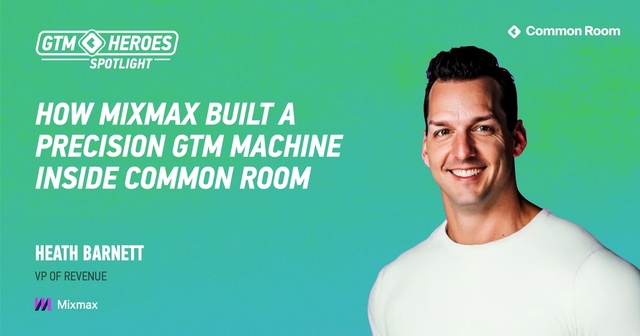

Most revenue leaders build GTM motions the same way. They pick a tool, configure some sequences, and optimize for activities like meetings booked, emails sent, and calls made. Heath Barnett, VP of Revenue at Mixmax, calls that operating. He's interested in architecture.
The difference: operators run the system in front of them. Architects design the system from the customer backward — starting with the problems buyers actually have, building signals that correlate to those problems, and routing every signal into a motion that scales without adding complexity.
At Mixmax, that meant taking one inbound channel and turning it into three distinct GTM motions, building a dual-layer scoring model that segments the entire TAM, hitting an 80% win rate on a single signal, and cutting his reps down to three daily tools.
Here's how he built it.
About Heath BarnettHeath works as the VP of Revenue at Mixmax and describes himself as a “revenue architect” — someone who designs the customer motion and then builds the team and workflows to monetize it.
Before Mixmax, Heath worked at Accenture managing enterprise deals, founded a company that scaled to $5M ARR, then roles across Uber and multiple Series A–D orgs. His sweet spot is joining companies at $10–$20M ARR when the question becomes: how do you productize sales into a repeatable machine?
One inbound channel, three distinct GTM motions
Most revenue leaders see inbound as a queue. Heath sees it as a decision tree, and the difference in results is significant.
At Mixmax, inbound is one channel, but behind that channel sit three separate go-to-market motions, each requiring its own follow-up sequence: sales-led, sales-assisted, and self-serve.
This could easily become a sorting problem, but Heath’s goal was to make that sorting automatic.
The scoring model Heath built inside Common Room routes every website visitor into the right one automatically.
- Sales-led (high score): Strong fit and high value. Route straight to a rep for fast, personalized outreach while the intent window is open.
- Sales-assisted (mid score): Good fit, but not “rep-now.” Start with automated touches to build proof of intent—then hand it to a rep once the prospect engages or raises a hand.
- Self-serve (low score): Not worth rep time yet. Put the account into scalable acquisition flows designed to drive activation and product-led conversion.
"Inbound is one channel, but you could have three different go-to-market motions behind that channel... you have to build an actual machine around each one."
To make those plays executable, Heath needed contact enrichment, website deanonymization, scoring models, and routing logic all built and run inside Common Room as the centralized platform that captures the signal and then routes the next action to the right place.
The Dual-Scoring Model: ICP Score Plus Buyer Intent Score
The foundation of Heath's architecture is a two-layer scoring model built entirely inside Common Room.
- ICP score tells Heath which companies fit the profile. It filters at the company level, evaluating firmographics like size, funding stage, industry, revenue range, sales team size, and tech stack. Accounts scoring 80-plus are “highs”. 60–80 are “mediums”. Below 60 are “lows”.
- Buyer intent score shifts from company to person. It factors in title tags (economic buyer, decision-maker), but the more interesting triggers are behavioral. If a company is hiring three or more roles and one is RevOps, that's a signal: they're scaling without the infrastructure to support it. The buyer intent score tells him whether the actual people at those companies are experiencing the problems Mixmax solves.
"Buyer intent is looking at whether the people at that organization are experiencing the problems that Mixmax is built to solve"
Together, these two scores let Heath segment his entire TAM and then prioritize within each segment. The ICP score cohorts the market. The buyer intent score ranks the people inside those cohorts.
Signal-based triggers that actually correlate to problems
Beyond scoring, Heath builds segments around buying triggers — signals that indicate a company is approaching a pain point Mixmax solves.
Here are the signal categories Mixmax uses (and why they matter):
- Funding + rapid sales hiring: A company raises a Series A/B/C and posts 5+ sales roles in the last 30 days. The board pressure to scale is real, and the operational cracks show up fast.
- New leadership: A new VP Sales or CRO often signals a mandate to change systems, not just tactics.
- CRM migration: A company moving from HubSpot to Salesforce indicates a maturing tech stack — and a timing opportunity.
- Job changers (Mixmax’s highest-performing signal): Mixmax sees an 80% win rate when someone who used Mixmax at a previous company joins a company that doesn’t use it yet.
The job change play works because of how Heath layers it. When someone who used Mixmax at a previous company moves to a company that isn't using it, his team doesn't just fire off a generic email. They combine the market signal with first-party product data, usage history, and Salesforce data before a rep ever reaches out.
"When I know that you were a Mixmax user and I know that you actually used Mixmax and now you've changed jobs…it's a very different conversation we're going to have." — Heath Barnett
The discipline underneath all of this is one principle Heath comes back to repeatedly: signals become noise when you don't connect them to real customer problems.
If you want a deeper breakdown of how teams operationalize this kind of signal-based GTM, Common Room has a few good primers on signal-based workflows, Job change playbooks, and RevOps workflows.
RoomieAI, Slack Alerts, & Mixmax: A Three-Tool Daily Workflow for Reps
Even with the scoring and signal architecture in place, reps were still toggling between tools for pre-call research — Common Room, LinkedIn Sales Navigator, and a handful of other tabs just to build context on one account.
Heath's fix was to build the research layer directly into Common Room. Custom RoomieAI prompts let reps go deeper on any account without leaving the platform. Slack alerts for key triggers, because reps already live there. Heath runs two main Slack channels where segments fire alerts when accounts hit the right conditions
The result: reps now work from three tools. Mixmax for execution, Slack for alerts, Common Room for everything else.
"I want Common Room to be the hub a rep goes to when they ask 'where should I find pipeline?' That's their cockpit." — Heath Barnett
If you’re exploring how AI fits into GTM workflows specifically, Common Room’s perspective on AI for revenue teams is a useful place to start.
The adoption lesson: prove the leads before you optimize the workflow
When Heath first got access to Common Room's signal infrastructure, he did what most revenue leaders would do and built everything at once.
"You get excited. You're like, I have access to all of these signals now. I want to go build everything. And I did that. I overwhelmed my reps because they had too many segments. They didn't know where to start." — Heath Barnett
So, he reset the rollout. He pulled back to five segments across categories like product, outbound, expansion, etc. The team walked through them together and committed to one rule: every segment should be at zero by the end of the day because every lead had been worked.
That discipline had nothing to do with tooling. It was about proving lead quality first.
"If your reps don't have faith that you're giving them good leads, nothing else matters. Not AI or how much context you're giving. If they don't believe that the list is worth their time, stop what you're doing until you get that." — Heath Barnett
Building the system is the easy part. Getting reps to trust it is where most revenue architects fail.
Once trust was established, Heath moved to phase two: reducing friction so reps could engage 7-10 prospects in the time it used to take to work 3-5.
Precision go-to-market starts with knowing your customer
Heath's closing point cuts through the vanity metrics that dominate most GTM conversations — full calendars, pipeline screenshots — and gets specific about what actually matters: the conversion story.
- Where are wins coming from, and what triggered them? (Which segment, which signal, which play.)
- What converts — and what stalls? (Hand-raisers to meetings, meetings to pipeline, pipeline to closed-won.)
- What changed right before the customer crossed the finish line? (Timing, champion, pain, budget, urgency, internal alignment.)
- What’s repeatable? (What you can codify into routing + follow-up instead of hoping a rep “figures it out.”)
"When we stop worrying about what others are doing and we pay attention to what actually moves the needle for our customers, everything is figureoutable after that." — Heath Barnett
That's what revenue architecture looks like in practice: define the customer motion, map the real buying problems, choose the signals that correlate, route every signal into a repeatable GTM play, and keep the rep workflow simple enough to run every day.
That applies directly to how he thinks about Common Room.
"It's not about finding and unlocking new ROI. It's about prioritizing the ROI that you know is already there, but you don't actually know how to go get." — Heath Barnett
Submit your story at commonroom.io/spotlight
See what’s possible with Common Room
- Signal-to-sequence automation: Route high-intent accounts into the right outbound motion with scoring, enrichment, and automated handoffs.
- Closed-lost reactivation: Re-engage accounts when signals show the timing has changed (new leadership, new hiring, new intent).
- Account prioritization: Cohort the market by ICP fit, then rank people inside those cohorts by buyer intent.
If you’ve built a workflow like this (or you’re in the middle of designing one), submit your story and help other operators copy what works.