
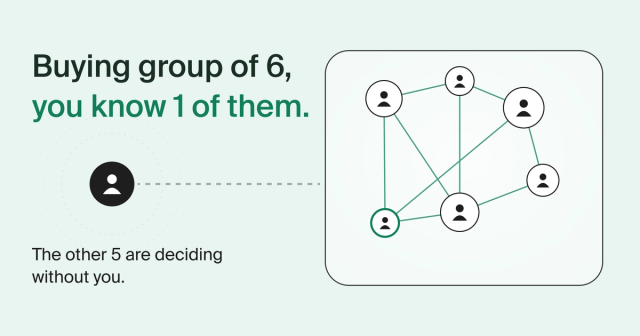

You might think the Scranton Analytics buying committee has a coordination problem. But they definitely don’t.
In fact, they meet every Thursday. The CFO, procurement, IT, the champion, those two people whose exact titles nobody quite remembers; they all know what’s going on. They’re aligned, informed, and talking to each other all the time. So why can’t you close the deal?
Because you’re the only one who isn’t in the room.
Your champion says "we're aligned internally," and they're telling the truth. What they're not telling you is who "we" is. You've got one name in the CRM and five people you've never met, never emailed, and wouldn't recognize if they walked into your booth at a conference.
Procurement's been on your pricing page for three weeks straight and nobody told you procurement was involved. IT has an opinion strong enough to kill the deal, and you've never had their email address, let alone a call on the calendar.
Your champion isn't ghosting you, they replied to your Slack thread an hour ago. But they're just one cat, and you've been trying to herd a group you can't even count.
The single-threaded deal doesn't feel single-threaded from the inside
Here's what makes this so sneaky: the rep working Scranton Analytics doesn't think they're single-threaded. They have a champion who's responsive, enthusiastic, and clearly plugged in internally. Every signal the rep can see says the deal is healthy.
Then it stalls. Not because the buying committee fell apart, they were never the problem. Because someone on that committee, someone the rep never identified, let alone got on a call, had questions nobody outside Scranton Analytics was ever positioned to answer.
That's the two-part problem hiding inside "multi-threading." First you have to know how many cats you have. Then you have to actually herd them, get them to reply, take the call, show up.
Most reps are failing at step one and don't know it, so step two never even gets attempted.
Every sales methodology tells reps to multi-thread. Every manager asks about it in the pipeline review. And the deals keep stalling the same way anyway, because "multi-thread this deal" is advice that assumes you already know who the threads are.
What the manager can't see either
Zoom out one level and the manager has their own version of this problem: eight reps, a forecast, a pipeline view, and still no reliable answer to "how many cats are actually in this account, and how many of them have we actually talked to."
When the manager asks about Scranton Analytics in the pipeline review, the rep says it's healthy, and they believe it, because the one cat they can see is healthy. Nobody's lying. The rep just has no visibility into procurement's pricing page visits, no line on IT, no idea the committee is six people deep instead of one. The manager ends up coaching to the only data point available, which is whatever the most visible relationship in the account happens to say.
That's not a coaching failure. That's a counting failure. Nobody in the chain has ever had a reliable way to see the full committee, so nobody's had a reliable way to know what's actually missing.
The buyer committee view: get in the room
The buyer committee view starts from a simple idea: open the account, and immediately see who's actually in the buying group, whether Scranton Analytics has been talking to them internally, and whether Scranton Analytics has been talking to your team at all.
Not a static org chart nobody updates. Not a contact list sorted by whoever last opened an email. A live view that does two things at once: first, it identifies who should be in the conversation based on Common Room's 400M+ contact database and your ICP, even if they've never visited your site or opened an email. Then it layers in engagement status so your rep knows exactly where each person stands.
Every committee member will carry one of three statuses. Engaged: they've had a real interaction—a call, an email, a meeting. Warm: they're in the room but haven't been directly contacted yet. Cold: they fit the buying committee profile but your team has never reached them at all. The cold ones are the multi-thread targets. That's the list your rep needs.
Flip on the buyer committee view for Scranton Analytics and it surfaces the CFO as a real person with a real title, active on your content, never contacted. It flags procurement's pricing page visits as belonging to someone with a name, not an anonymous hit in your analytics. That's not a report sitting in a dashboard nobody opens.
That's the cat count, delivered while there's still time to go herd them.
And it doesn't live in a separate tab your rep has to remember to open. The same committee data flows into your Chrome extension when your rep is in Salesforce or HubSpot, into MCP workflows, and syncs directly to Salesforce so RevOps can report on buying committee coverage across the entire book without ever opening Common Room.
The manager view: the same count, one level up
Same logic, applied to the whole book instead of one account.
Instead of guessing which deals are real off whatever the most responsive contact happens to say, a manager can see committee coverage across every account at once: which ones have a fully identified, engaged buying group, which ones are running on one relationship the rep is mistaking for the whole account, and where coaching needs to happen before the pipeline review, not during it, when it's already too late to go count anything.
Natural language, because filter complexity shouldn't require a ticket
The rep knows exactly who they're looking for. Enterprise accounts in the Northeast, no activity in 30 days. They just can't build the filter to find them. So they ask RevOps, and they wait. Natural language filtering changes that equation.
A rep describes what they want in plain language like "enterprise accounts in the Northeast with no activity in 30 days" and gets back structured, editable filter chips and a result set immediately. Not a black box. Not a locked view. A real filter they can tune, save, and share. The expertise that used to live with RevOps is now available to anyone who can describe what they're looking for.
And somewhere on that list, every single time, is Scranton Analytics.
They were never quiet. You just weren't in the conversation.
Our AI ambition, meet AI execution argument was that scaled execution takes more than a working demo. It takes infrastructure that survives contact with an actual organization, with its handoffs, its team structures, and its moments where the deal is on the line and nobody outside the buying committee has the full picture.
The buyer committee view, the manager view, and natural language filtering aren't three separate features. They're the same answer, at three different altitudes. The rep gets the full count. The manager gets the full count across the book. Nobody has to file a ticket to get either one.
Scranton Analytics was never disorganized. They were just invisible to you. That part's changing.