
There has never been more technology, more data, and more AI layered into go-to-market than there is right now. New signals, new tools, new agents, new workflows.
Sourcing buyer signals and intent data isn’t the hard part anymore. The hard part is turning it into something your team acts on consistently, confidently, and without burning hours on manual work.
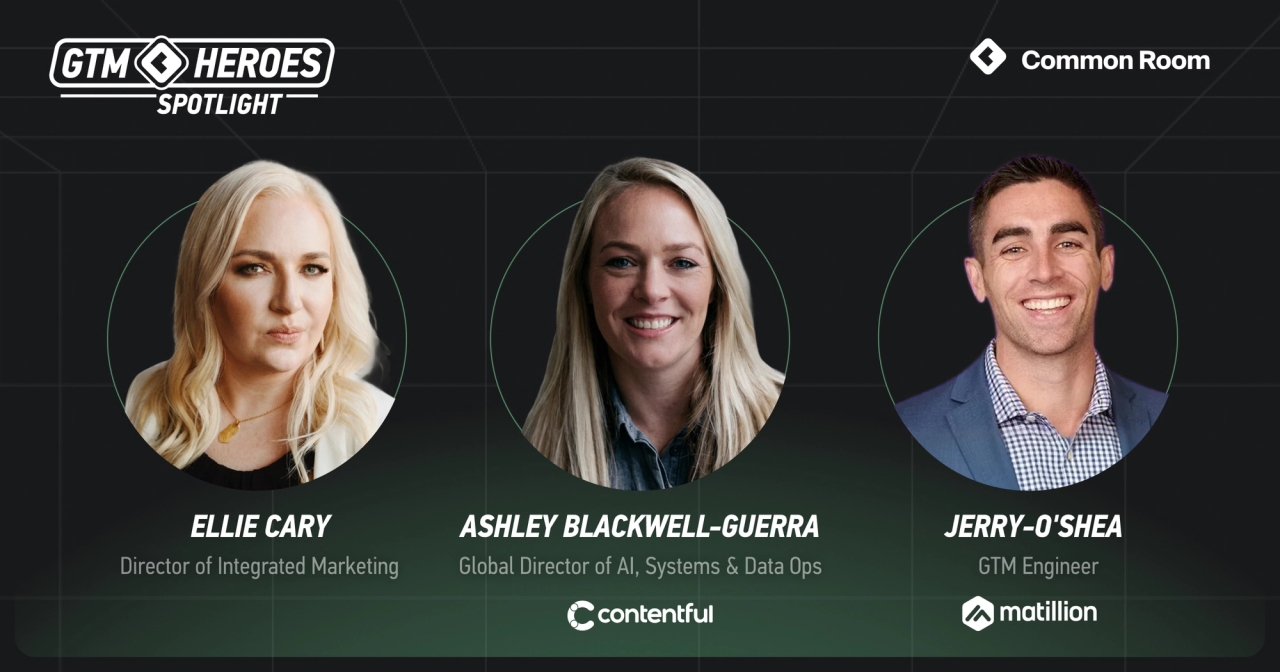
We spoke with three operators who are doing exactly that:
- Closed-lost pipeline reactivation. Jerry O'Shea, GTM Engineer at Matillion, built a workflow to detect when closed-lost accounts start visiting their website again so reps can re-engage at the right moment.
- Competitor account prioritization with signal stacking. Ashley Blackwell-Guerra, Global Director of AI, Systems & Data Ops at Contentful, stacked signals to pinpoint which competitor's customers to target, and doubled reply rates.
- Signal-to-sequence prospecting automation. Ellie Cary, Director of Integrated Marketing at a Common Room customer, automated the path from buyer activity to Outreach enrollment so her reps could stop researching and start executing.
Here are their stories.
Closed-lost pipeline reactivation with Jerry O'Shea
GTM Engineer at Matillion
Using Common Room segments, Jerry built a workflow to detect when closed-lost accounts started visiting Matillion’s website again.
The challenge
Jerry's team at Matillion has launched dozens of segments since going live with Common Room. But the one they keep coming back to is their closed-lost reactivation play.
The idea came from a simple observation. "If you go to your CRM, most teams have two primary closed-lost reasons: no decision or bad timing." Those aren’t hard "no" outcomes; they're timing problems. And the accounts behind them are not dead. They're just waiting.
Those aren’t hard "no" outcomes; they're timing problems. And the accounts behind them are not dead. They're just waiting.
The problem was that before this workflow, there was no systematic way to know when one of those accounts started showing interest again. They just sat in the CRM until someone remembered to check.
The workflow
Using Common Room segments and signal tracking, Jerry’s team built a workflow to catch accounts showing renewed buyer activity. The criteria are clean: any account with a closed-lost opportunity older than three months where someone at the account has been visiting Matillion's website in the past 45 days. That is the trigger.
But the segment is just the starting point. From there, the team layers in context. "It really is just about being able to couple intent signals, curate wider information around why they actually lost, and help reps prioritize and identify people that have a higher propensity to buy."
The outcome
That combination of current activity paired with historical deal context gives reps a much sharper picture of which accounts to prioritize and how to approach them. Instead of recycling stale lists, the team is meeting buyers where they actually are in their journey.
"We're just trying to capitalize on some of those opportunities, to be able to identify people who are maybe looking to re-engage, maybe doing some passive research. Really just meeting them where they are in the customer journey."
The payoff is focus. Reps spend their time on accounts that have genuinely woken back up, and the team has a repeatable way to recover pipeline from deals that were lost to timing, not lost forever.
Signal stacking to prioritize which competitor's customers to target with Ashley Blackwell-Guerra
Global Director of AI, Systems & Data Ops at Contentful
Using Common Room to unify signals from multiple data providers, Ashley’s team built a clearer view of which competitor accounts were most likely to enter a buying cycle.
The challenge
When Contentful launched Common Room, Ashley's team decided to test it on one of the hardest outbound plays there is: going after accounts that were already using a competitor's product.
But instead of blasting a broad list, they wanted to get surgical. They stacked multiple GTM signals to determine which accounts were most likely to switch and give themselves the best chance to win them over.
The approach started with accounts already in Salesforce where penetration had been limited. The bet was that stacking the right signals on top of existing relationships would give their BDRs something they never had before: a complete, multi-dimensional view of account readiness.
The workflow
Inside Common Room, the team pulled together information from multiple data providers into one view. "Our BDRs were able to see information from a few different data providers, specifically around tech stack analysis, which was really helpful to bring together that ultimate list of accounts that we wanted to go outbound to."
But it went deeper than tech stack. Ashley's team stacked additional signals on top: digital initiatives mentioned in public filings, leadership changes like a new CMO or VP of Digital joining in the last six months, and broader indicators that suggested the account might be in a buying cycle.
"What were the external indicators that showed not only that they might have been Sitecore-specific customers, and also that they might be indicating that they're in a buying cycle, that they have the right people at that account, and there might be general company interest in changing their technologies?"
The outcome
That stacked view did two things. It gave reps the context to prioritize the right accounts and reach out with relevant messaging. And it helped the team work more closely with product marketing to tighten the message, because they finally had shared visibility into who they were going after and why.
The results spoke for themselves. "We actually saw our historical campaign numbers, which hovered around 4% in terms of reply rates (and ultimately conversion into meetings), jump to 8% with this particular campaign." Research time per account dropped from about four hours to about one.
As Ashley put it: "It gave our hunters and our gatherers the information that they needed."
Automating signal-to-sequence prospecting with Ellie Cary
Director of Integrated Marketing at a Common Room customer
Ellie used Common Room segments and workflows to automatically move qualified prospects from signal detection into Outreach sequences and Salesforce campaigns.
The challenge
Before Common Room, Ellie's sales team was deep in the weeds of manual prospecting. The process looked the same every time: go to LinkedIn Sales Navigator, find the right people at target accounts, push them into Salesforce, then manually add them to Outreach. One contact at a time. Every time.
"You can imagine how much time people are probably spending having to do that," Ellie said. On top of the time cost, every rep was making their own calls about who to enroll and when, so the criteria were inconsistent. And because campaign tracking happened separately (if it happened at all), attribution was a mess.
Ellie wanted to fix all of it at once. "Make prospecting more responsive without making reps do more work."
The workflow
She built a custom workflow in Common Room that starts with a segment, a set of criteria she defines around the "why now." That might be a technographic fit, a specific activity, or a job change play.
"That's where I build my criteria usually. Whether it's wanting to see people with a specific technographic, or certain activity, or even a job change play, that's really easy to build in specific segments. And I can always go back and tweak that segment as needed."
When a contact matches the segment and has a verified business email, they're automatically added to the right Outreach sequence. At the same time, they get added to a Salesforce campaign, so attribution is baked in from day one, not patched together later.
The outcome
The shift was immediate. Reps went from doing manual, one-to-one enrollment to just checking what was already running. "We were able to actually automate that experience. The sales team can just check and see what's going on, as opposed to having to manually start this one-to-one outreach."
And because the workflow handles both Outreach enrollment and Salesforce campaign tracking in the same motion, Ellie's team can see ROI cleanly as the play runs.
"Not only are we able to get the ball rolling on the outreach side, but we're also able to identify our segment target criteria and enroll them in our Salesforce campaigns pretty seamlessly, so we can start tracking ROI and activity."
As Ellie put it: "Definitely a time saver and definitely an ease saver for sure."
See what's possible with Common Room
This month's operators showed three distinct ways to turn better context into action:
- Signal-to-sequence automation: Ellie Cary eliminated manual prospecting by auto-enrolling matched contacts into Outreach sequences and Salesforce campaigns in one motion.
- Closed-lost reactivation: Jerry O'Shea built a segment to catch former opportunities showing renewed website activity, giving reps a repeatable way to recover pipeline lost to timing.
- Signal stacking for competitive targeting: Ashley Blackwell-Guerra stacked tech stack, hiring, and digital-initiative signals to prioritize which competitor's customers to go after, resulting in reply rates doubling.
Every month, we share more stories like these: real operators, real workflows, real results. If you are building something that is working, we want to hear about it.
Submit your story at commonroom.io/spotlight and you could be featured in a future edition!