
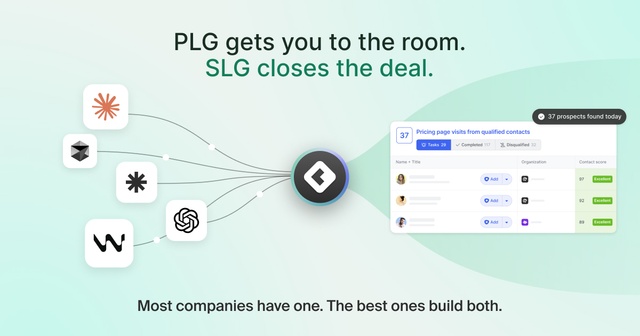

At a recent event in San Francisco, I watched a room full of go-to-market leaders have the same quiet realization at the same moment.
Colin Netal, Head of Demand Generation at Otter AI, was on stage walking through how his team had layered a sales motion on top of one of the most successful product-led growth stories in the market. Forty million users. A hundred million in ARR. Eighty-five percent of the Fortune 500 already using the product.
And a sales team that had no idea where to start.
After his talk, I had some version of the same conversation five times.
"That's us."
"We have the users. We just can't see which ones are ready."
"We've been trying to figure out how to do exactly what he described."
This is the moment PLG companies are living in right now. Not a crisis. An opportunity - with a closing window.
PLG is the advantage. The question is what you build on top of it.
Let's be clear about something: product-led growth is not a mistake to fix. It's one of the defining go-to-market innovations of the last decade, and the companies that did it well built something genuinely hard to replicate - scale, brand, and a product that sells itself.
That's not nothing. That's most of the battle.
But at a certain scale, self-serve stops being a growth engine and starts being a signal factory - one that most companies don't have the infrastructure to read. You have more users than your team knows what to do with. Your brand awareness is strong. Your NPS is good. And somewhere inside your product, the accounts that could define your next phase of growth are already there, completely invisible to your sales team.
The companies that win in B2B SaaS right now aren't choosing between product-led and sales-led. They're building both. PLG creates the scale. SLG converts it. Together they compound in ways neither motion achieves alone.
The question isn't whether to add a sales motion. It's whether you build it before or after your competitors do.
The data is there. The motion isn't.
Otter's situation was clarifying precisely because the numbers were so stark.
Forty million users sounds like a sales team's dream. In practice, it was a prioritization nightmare. Which accounts were ready for an enterprise conversation? Which had buying intent? Which had executives actively using the product right now?
Nobody knew. And in the absence of signal, reps do what reps do - they cherry-pick the obvious ones and let everything else fall through. This is not a character flaw. It's a rational response to an impossible ask.
Colin's team fixed this by going back to first principles.
They ran a comprehensive win-loss analysis across every closed deal. Not just win rates - deal velocity, ACV, the industries and job titles that converted, the behavioral patterns that showed up before a deal closed.
They discovered that the Head of IT often buys large contracts on behalf of other departments - which means you have to map who owns the budget separately from who owns the implementation. Two different people. Two different conversations. Most companies are only having one of them.
Then they built a scoring model. Seventy percent behavioral data - number of users per org, meeting minutes recorded, advanced feature usage. Thirty percent firmographic fit. Most companies do this backwards, then wonder why their scoring model doesn't work.
From that foundation, they defined five signal-based outbound plays. Executives who recently signed up. Workspaces showing consolidation patterns. Sudden surges in team signups. Power users who hadn't discovered key features yet. Each play had its own messaging logic, its own AI-generated personalization, its own enrollment workflow.
The result: a clear path to $200M ARR, built entirely on top of users they already had.
Why this moment is different
The companies that move at the right moment build advantages that compound. The ones that wait spend years catching up and writing post-mortems about why they didn't move sooner.
This is one of those moments.
Your product usage data is the one thing competitors can't buy. Website intent, third-party signals, contact databases—everyone has access to the same sources. Your own usage data is uniquely yours, and the outreach environment is only getting noisier.
AI-generated sequences have saturated inboxes and generic outbound is dying. The accounts that could define your next three years are already in your product, expanding usage, pulling in colleagues. They're just waiting for someone to show up with the right conversation at the right moment.
The window is real. PLG + SLG is not a new idea, but most companies are still figuring it out. In twelve months this conversation will be about who fell behind, not who's figuring it out.
What building the SLG layer actually looks like
The companies doing this well share a few things in common.
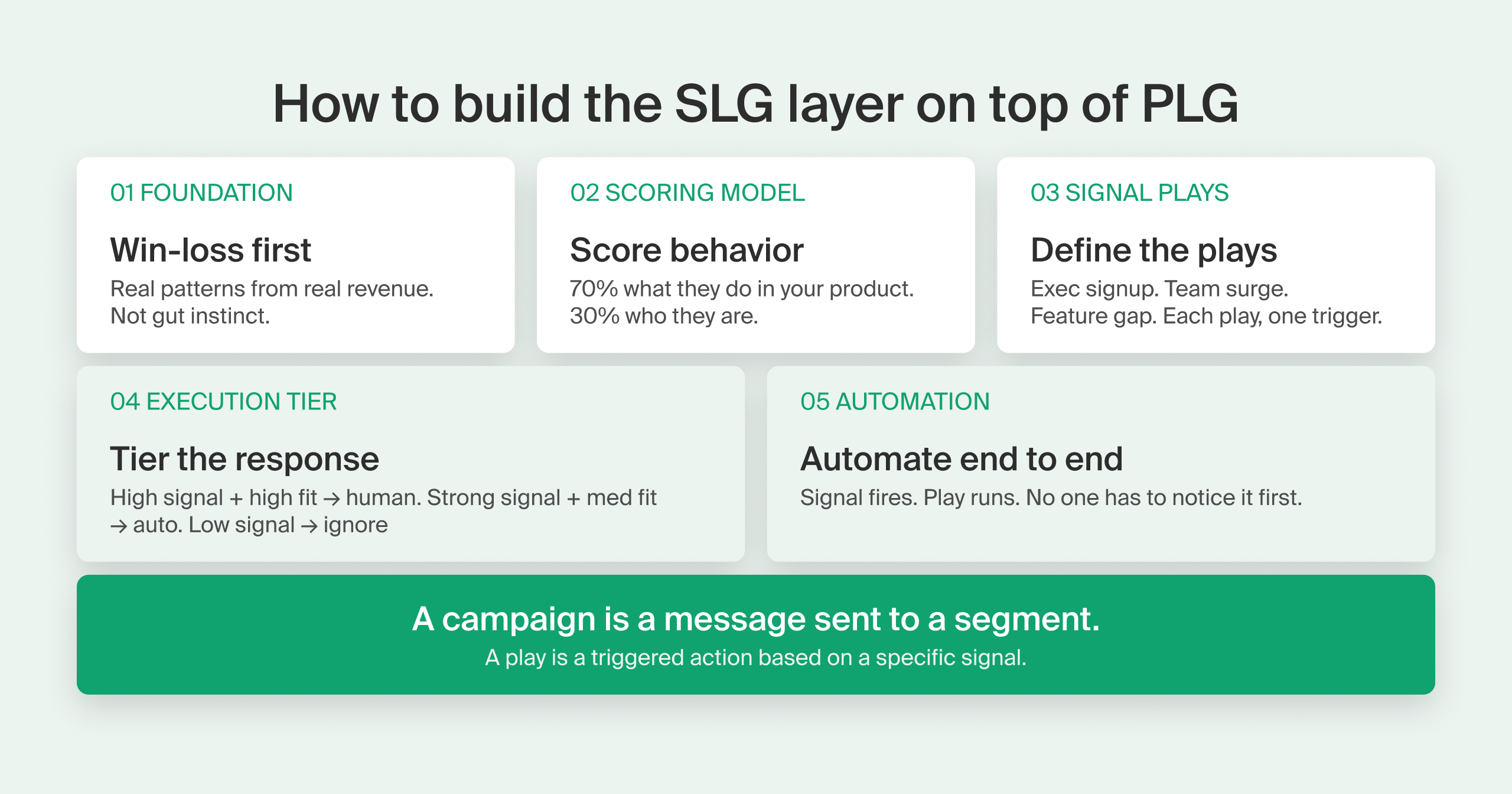
Start here: a campaign is a message sent to a segment. A play is a triggered action based on a specific signal. Plays are timely. Campaigns are approximate. Approximate is a polite way of saying it mostly doesn't work.
They start with win-loss, not gut instinct. Real patterns from real revenue, not personas built in a conference room by people who haven't talked to a customer in six months.
They weight behavior over demographics. What someone does in your product tells you far more about buying intent than their job title. The scoring models that work are predominantly behavioral.
They tier execution by signal strength. High signal plus high fit gets a human in the loop. Strong signal and medium fit runs automated. Low signal gets ignored. Not everything deserves a sequence.
And they automate the workflow end to end, so when the signal fires, the motion runs without someone having to notice it first.
This is the series
What Colin described on that stage in San Francisco isn't a one-company story. It's a pattern - and it's accelerating across every category of B2B SaaS.
Over the next several weeks, I'm going to dig into each layer of this transition in depth. The win-loss frameworks that surface your real enterprise ICP. The scoring models that actually predict conversion. The signal-based plays that create pipeline from users you already have. The automation architecture that makes it scale. And the organizational changes that have to happen alongside the technical ones.
Because the companies figuring this out aren't just adding a sales motion.
They're building the infrastructure that turns product scale into enterprise dominance.
You've already built the PLG machine. Now build what goes on top of it.