
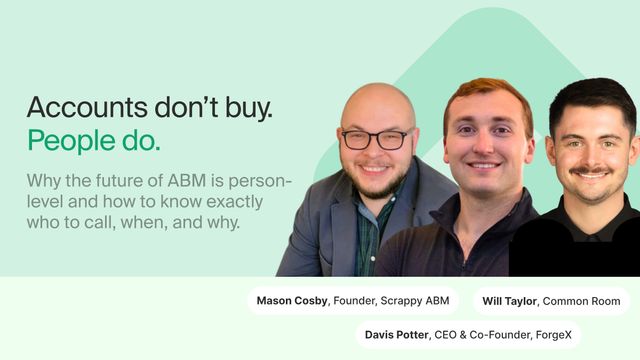
Mason Cosby, Founder of Scrappy ABM, and Davis Potter, CEO and Co-founder of ForgeX, joined Common Room's Will Taylor to break down why person-level ABM wins: how to identify the buying committee behind your target accounts, spot the gaps in your coverage, and reach the right person with the right context.
Watch the full session:
Your ABM platform says an account is hot. Now what?
That is where most ABM programs stall. Sales asks why the account is hot, marketing points to a score, and trust evaporates on the spot. As Mason put it in our recent webinar:
"You get an account that's hot, and then sales says, well, why is this account hot? And marketing responds back with, well, it's 80 points. At that point, sales immediately loses trust, doesn't actually know who to reach out to, and everything kind of falls apart in that exact moment."
- Mason Cosby, Founder, Scrappy ABM
The running joke in the ABM world makes the problem obvious: an account can show sky-high intent because somebody viewed 80 blog posts on your website. That somebody might have been the janitor. It might have been the CEO. The account score will not tell you.
Meanwhile, buying groups keep getting bigger. LinkedIn research puts 12 to 14 people in the average B2B buying group, each with different roles, motivations, and levels of engagement. One person is not making the purchase decision, and an account-level score cannot tell you who is.
“Organizations who are implementing a buying group centric approach are seeing multiple times stronger results than others.”
- Davis Potter, CEO & Co-founder, ForgeX
Why the account is the wrong unit of measurement
Davis traced how we got here. First came the MQL hamster wheel: gather form fills, throw individual contacts at sales, repeat. ABM fixed the alignment problem by unifying teams behind a target account list, but then it introduced a new one. Accounts hit a scoring threshold, get labeled an MQA, and get tossed over the wall as if the job is done.
The industry's answer is buying groups: zeroing in on the actual people inside qualifying accounts, identifying them, validating them, and re-engaging them throughout the buying process.
Davis was clear that this is not a pendulum swing. You do not throw out account-based measurement and go all-in on buying groups. The teams winning right now blend both: account-level prioritization to focus resources, person-level intelligence to actually run the plays.
The 8 roles in every buying committee
Mason grounded his argument in his own data: 338 sales cycles over three years, 118 closed won, and one pattern that separated the two groups. The deals he lost were single threaded. One interested person took pricing to their boss and the deal died quietly.
Mapping the deals he won, Mason identified eight standardized roles that show up in nearly every decision group:
- Decision maker: decides whether the purchase happens
- Economic buyer: controls budget and negotiates terms
- Champion: drives the deal internally
- Key influencers: typically manager-level voices who shape the evaluation
- Technical or implementation team: often IT, and often where deals get blocked
- Blockers: quiet skeptics who sow doubt behind the scenes
- End users: the people who determine whether the second and third sale ever happens
- Gatekeepers: protectors of time and access, worth befriending
The payoff for mapping and marketing to the full committee is not theoretical. In Mason's data, deals where more of the buying committee engaged with marketing before the first meeting closed in 30 days. Deals without that early engagement took 60.
How to find the buying committee when sales has minimal knowledge
An audience question put the panel on the spot: what if sales cannot tell you who is on the buying committee? Mason's answer was a practical, budget-friendly stack:
- Start capturing data now. A call recorder and an entry-level CRM cost about $20 a month each. BCC sales emails into the CRM and you can finally see who sales is actually talking to, and just as importantly, who they are not.
- Interview your customer-facing teams. Run internal interviews with sales, customer success, and your happiest customers. Ask which champions had to pull off internal heroics, who the blockers were, and who had to be convinced.
- Use AI to fill the gaps. Mason shared his CRIT prompt framework: give the model Context on your situation, assign it a Role, ask it to Interview you to fill in gaps, then set the Task of producing an objective buying committee map you can enrich with real data.
Davis added a warning for enterprise teams: buying groups change by industry, business unit, and maturity. A title-level view across a large bank is misleading when siloed business units hold competing contracts. The committee is not static either. People rotate in and out, so validation is continuous work, done in partnership with sales
Rapid fire: the best play in ABM
Will closed with a lightning round. A few highlights:
- The single best ABM play?
- Mason did not hesitate: closed-lost. "This is the bucket where you have the most data that is first party. You know exactly why they didn't buy, and it's a perfect sample group."
- Davis loves highly curated virtual roundtables and small events.
- The biggest red flag? Both agreed: a champion who will not make an introduction is not really a champion.
- Most ABM programs would fix themselves overnight if they just...?
- Davis: built a stronger relationship with the sales team.
- Mason: started with one product, one market, for one year.
See what's possible with Common Room
The through-line of the whole conversation: account signals tell you something is happening, and person-level intelligence tells you what to do about it. Three moves any team can borrow:
- Treat the person, not the account, as the unit of action. Account scores prioritize; people buy.
- Map all eight roles, not just the champion. Single-threaded deals are the ones you lose.
- Engage the committee before the first meeting. Early multi-threaded engagement cut Mason's sales cycles in half.
This is exactly what Common Room is built for. Buying group identification is baked into the platform, with more ABM functionality on the way, so your team can see every person behind an account signal, spot who is engaged and who is missing, and reach out with context that earns a reply.
🚀 Ready to move from hot accounts to real buyers? See how Common Room powers person-level ABM.
Watch the full session on-demand.
👉 About the speakers. Mason Cosby is the founder of Scrappy ABM, where he has built roughly 100 ABM programs in three years, driving $250M in pipeline and $130M in revenue for clients. Davis Potter is CEO and Co-founder of ForgeX, a research and advisory firm specializing in account-based go-to-market and AI. Think Forrester or Gartner, purpose-built for ABM.