
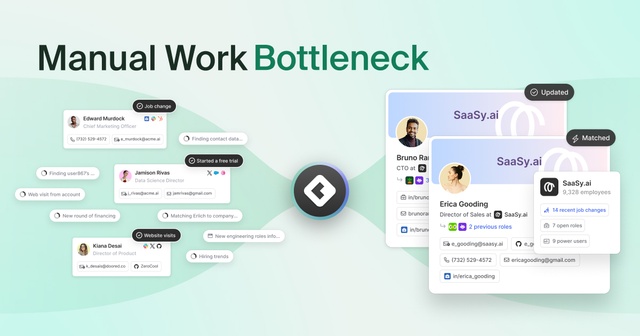
Outbound volume is up, results are down, and somewhere in the middle of that gap is where your team lives.
Because they're building lists manually, researching accounts one by one, and writing sequences that feel personal but take forever to produce. They might even be following up on signals they found three days after the window closed. In other words, by the time a rep gets to the actual conversation, half the day is already gone.
This isn't a talent problem—your reps are capable. The problem is the system they're running on was designed for a different era of outbound, and it was never designed to scale.
The AI-native SDR playbook exists to fix that by removing everything that's slowing your reps down.
The way most teams run outbound (and why it's breaking)
Picture a Monday morning on a typical SDR team.
A rep opens their CRM, looks at their task queue, and starts building context. They pull up a LinkedIn profile, open a few browser tabs, check the company's website, scan for recent news. Fifteen minutes later they have enough to write one email. They send it, move to the next account, and repeat.
By noon they've touched maybe 20 accounts. Their manager wants 60 activities a day. Nobody mentions this gap out loud. Everyone knows it's there.
Meanwhile, the accounts worth calling this week, the ones who visited the pricing page twice, the ones where a new VP of Sales just started, the ones whose trial activity spiked over the weekend, aren't on anyone's radar. The signal exists—but nobody surfaced it, and nobody acted on it.
This is the real problem with outbound in 2026. It's not that reps aren't trying, it's that the gap between knowing who to reach and actually reaching them is filled with manual work that shouldn't require a human at all.
But bolt AI onto a broken foundation and you don't fix the foundation, you just produce more noise, faster. More sequences. More activity. More output from a system that's still pointed at the wrong accounts.
That’s because the teams starting to outperform aren’t just adding more activity or slapping AI software somewhere and hoping it makes magic, they’re working hand-in-hand with the right AI-supported tools to rebuild their foundation.
What a modern AI-native outbound system looks like
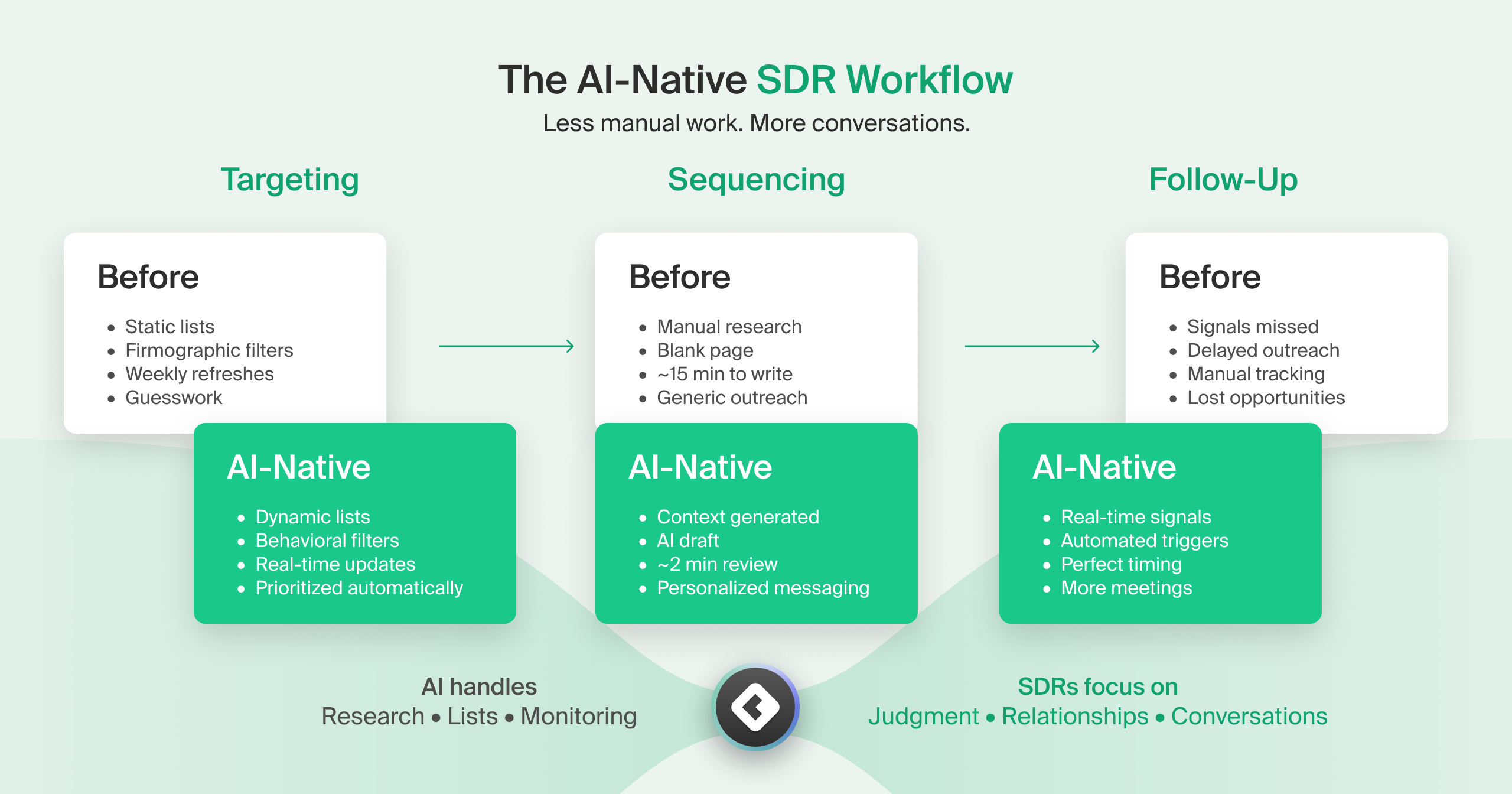
A modern AI-native SDR workflow is all about removing the manual work that keeps your reps from doing what only they can do: having real conversations with the right people at the right moment.
Here's what that system looks like in practice, across the three parts of outbound that matter most.
Targeting: stop building lists, start working signals
The first place manual work kills SDR teams is list building. Reps spend hours pulling contacts from enrichment tools, filtering by firmographic criteria, and hoping the output is fresh enough to be useful. It rarely is.
An AI-native targeting system flips this. Instead of building lists from static criteria, it builds them from live signals. Which accounts are showing buying behavior right now? Which contacts just changed roles into positions with purchasing authority? Which companies are in a growth pattern that matches your best customers?
The targeting layer isn't a spreadsheet you refresh once a week. It's a continuously updated view of who deserves your team's attention today, not who looked good in a ZoomInfo pull three weeks ago.
For SDR managers, this means something important: your reps stop making subjective decisions about who to go after. The system surfaces the right accounts automatically. Your job becomes making sure they work the list, not define it.
This is where the gap between your top reps and everyone else starts to close. Top performers have always had a feel for who to prioritize. An AI-native system gives every rep that same feel, except it's not intuition. It's data.
Sequencing: context before contact
The second place manual work kills outbound is sequencing. Specifically, the research that has to happen before a rep can write something worth sending.
Generic sequences don't work anymore. Buyers can tell and they're merciless about it. They get dozens of "I noticed you're in [industry]" emails every week. They delete all of them without finishing the first sentence.The only outreach that breaks through is the kind that feels written for one person, at one moment, for one specific reason.
The problem is that writing at that level takes time. And time is the one thing SDR teams don't have.
AI-powered sequencing solves this by doing the research before the rep ever opens a compose window. It pulls together what's happening at the account, what's changed recently, what the contact's background suggests about their priorities, and it generates messaging that's grounded in actual context.
Your rep's job is no longer to research and write. It's to review, refine, and send. That shift alone can turn a 15-minute pre-email process into a two-minute one.
And the output is better. Not because AI is a better writer than your rep, but because AI has done the synthesis work your rep didn't have time to do properly.
Follow-up: stop missing the window
The third place manual work kills outbound is follow-up. Specifically, the timing of it.
In outbound, timing is almost everything. A prospect who visited your pricing page an hour ago is a fundamentally different conversation than the same prospect who visited three days ago. A contact who just joined a target account as VP of Sales is a live opportunity. The same contact six months into the role is a much harder call.
Most SDR teams miss these windows not because they weren't paying attention but because the signal lived in one tool and the follow-up had to happen in another. By the time that information traveled to whoever needed it, the moment was already gone.
An AI-native follow-up system closes that gap. When a signal fires, a task gets created. When a contact hits a trigger, a sequence starts. The workflow runs automatically, so the rep is working the right account at the right moment without having to notice the signal themselves.
For managers, this means your team's follow-up stops being a function of which rep happened to check their dashboard on the right day. It becomes systematic. Consistent. Scalable.
What changes when the system works
Here's what the same Monday morning looks like when the system is built the way it should be.
A rep opens their queue. The accounts sitting at the top aren't there by accident. They're there because something real happened over the weekend. Activity spiked. A contact changed jobs. A trigger fired. The system knows, and the rep's queue reflects it.
For each account, the context is already there. What's happening at the company, why now is the right moment, what angle is most likely to land. The rep reads it, adjusts the tone, hits send.
By noon they've touched 50 accounts. Not because they worked faster, but because the system handled everything that didn't require a human. Research. List building. Signal monitoring. Initial drafts. All of it.
What's left for the rep is the part that actually moves deals: judgment, relationship, conversation.
This is what AI as leverage actually means. Not replacing reps. Not automating the whole motion. Handling the infinite, mechanical work, so the human can focus on the work that only a human can do.
Building the AI-native SDR workflow with Common Room
Common Room is built for exactly this system.
On the targeting side, Common Room continuously monitors first-party signals and real-world buyer activity, surfaces the accounts showing buying behavior, and keeps that view updated automatically. Your reps aren't pulling lists. They're working a prioritized queue that reflects what's actually happening in their territory right now.
On the sequencing side, Common Room's AI agents pull together account and contact context before outreach, so your reps are starting from a brief, not a blank page. The messaging they send is grounded in real signal, not just firmographic fit.
On the follow-up side, Common Room's workflow automation means signals translate directly into tasks. When a trigger fires, the motion runs. Your reps don't have to notice it. They just show up and the work is already organized.
The result is a team that works the same number of hours and produces significantly more output. Not because they're doing more, but because the system is finally doing what systems are supposed to do.
The SDR manager's job just changed
Running an AI-native outbound team requires a different kind of management.
You're not spending your one-on-ones asking reps how their list building is going. You're reviewing the quality of their conversations. You're coaching on messaging, on objection handling, on the moments in a call that determine whether a prospect books a meeting or doesn't.
You're not troubleshooting data problems or chasing down why a rep is working the wrong accounts. The system handles prioritization. Your job is to make sure reps are executing well once they're in front of the right people.
That's a better job. It's also a harder one because when the manual work is gone, there's nowhere to hide. The only output that matters is conversations and pipeline. And those require actual skill. No system can fake that for you.
The good news is that when the system is working, your best reps get better. And your average reps start performing more like your best ones, because they have the same targeting, the same context, and the same workflow.
That's the actual promise of AI-native outbound. Not more activity. Better outcomes from the activity you're already doing.
Common Room is the AI-native GTM platform that helps SDR teams turn buyer intelligence into outbound execution. If your team is still building lists by hand and chasing signals across five different tabs, we'd love to show you what Monday morning looks like when it isn't.