
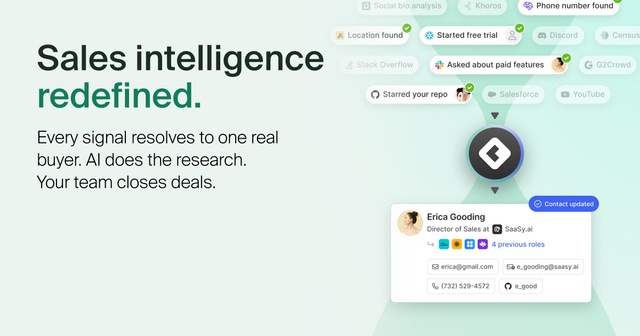
Picture your best rep on a Tuesday morning.
Eight tabs open. A CRM that hasn't been touched since the last SKO. An intent tool blinking "high interest" on an account with no name attached to it. A LinkedIn profile pulled up next to a Slack thread next to a spreadsheet somebody built in 2023 and never updated.
That rep isn't short on data. They're drowning in it.
This is the quiet joke sitting at the center of most GTM stacks: we built "sales intelligence" tools for a decade, and somehow reps still open every call with a guess.
It's time to say the quiet part out loud. Sales intelligence redefined is about finally connecting the signals you already have to a real person, in real time, so your team can act instead of investigate.
What "sales intelligence" used to mean (and why it stopped working)
For years, sales intelligence meant a firmographic database with a fresh coat of paint. Company size. Industry. Maybe a job title or two.
Then you could bolt on an "intent score," call it AI, and ship it.
Here's what's true: intent data tells you someone at a company is researching your category. Cool. Who? The economic buyer? The intern doing a Wednesday afternoon Google search? Someone rage-clicking G2 at 11 p.m. because their current vendor just raised prices?
Old sales intelligence answered "is this account interesting?" It never answered "who exactly should I call, and why today?"
That gap is where deals go to stall.
In reality, GTM teams don't lack information, they lack a system that turns information into a next step.
Reps today are stitching together CRM records, product usage exports, LinkedIn activity, community chatter, and a Slack channel of "did anyone talk to this account recently?" That's not intelligence. That's detective work with a quota attached.
And here's the part nobody wants to admit: a lot of the AI layered on top of this mess just adds more noise dressed up as insight. More dashboards. More scores nobody trusts. More tools that require a specialist to actually operate.
If a tool requires a dedicated "AI operator" to get value out of it, it has already failed the one test that matters: does this make my team faster, or does it just look impressive in a demo?
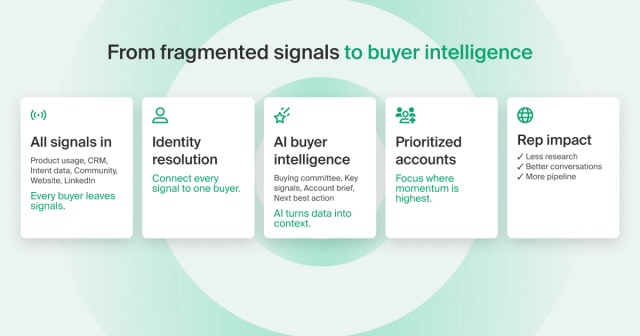
Sales intelligence redefined: from fragmented signals to a living system
Real sales intelligence starts with a simple idea. Every signal about a buyer, whether it's a product login, a website visit, a job change, a GitHub star, or a CRM field, should resolve back to one real person and one real account. Not a row in a spreadsheet. A person.
That's identity resolution doing the heavy lifting behind the scenes, so your reps never have to.
Once that foundation exists, three things change:
Prioritization becomes obvious, not guessed. Instead of a static list ranked by a scoring model nobody updated since Q1, reps see accounts prioritized against what's actually happening right now: who's active, who's gone quiet, who just brought on a new decision-maker.
Research disappears into the workflow. AI agents built on that same foundation can pull together an account brief, map the buying committee, and surface the one thing worth mentioning in an email, before the rep even opens their first tab.
Data stays honest over time. CRM decay is the silent tax on every sales org. Duplicate accounts, stale titles, dead contacts. A system that continuously checks its own work catches that drift before it costs you a quarter.
This is the difference between a tool that shows you information and a system that tells you what to do with it.
AI should give your reps leverage, not another login
Here's a belief worth holding onto as every vendor rebrands their roadmap "AI-powered": AI should increase what a human can do, not replace the judgment that makes them good at their job.
Machines are excellent at the infinite, repetitive work: watching every signal across every account, cross-referencing a hundred data points, catching the duplicate record before it becomes a bad conversation. Humans are excellent at reading a room, building trust over three calls, and knowing when to push and when to wait.The best version of this doesn't ask your reps to become data analysts. It hands them the research already done and gets out of the way.
That's a very different outcome than the pattern we've seen play out across enterprise software for twenty years: a genuinely powerful tool that only pays off once you hire someone new to run it.
CRM admins became bottlenecks. Marketing ops became a queue.
If your sales intelligence stack needs a dedicated "AI prompt person" to be useful, you haven't upgraded your GTM motion. You've just added a new tollbooth.
What this looks like when it's working
Cleaning up account duplicates used to be a manual slog. incident.io fixed it by running CRM data continuously against real identity signals, cutting duplicate accounts from 3% down to 0.3%. That's not a vanity metric. That's every rep's pipeline report finally matching reality.
Notion's reps generate 30% more meetings per month once buyer intelligence told them who to reach out to and when.
Semgrep turned product usage, web visits, and GitHub activity into warm outbound, growing pipeline 74% in a single quarter. Their reps didn't work harder. They stopped wasting cycles on accounts that were never going to convert.
None of those results came from adding another dashboard. They came from unifying the data that already existed and letting AI turn it into action.
The bottom line
Ask your team this: when a rep opens an account, do they get a next step, or do they get a research project? If the answer involves opening more than one tool, pinging RevOps, or waiting on a specialist to "pull a report," you're not looking at intelligence. You're looking at a very expensive filing cabinet.
Sales intelligence redefined isn't a bigger database or a shinier dashboard. It's buyer intelligence that's complete, trusted, and connected to AI agents that do the unglamorous work, so your reps can do the part only humans can do: build the relationship, read the moment, and close the deal.
Your reps don't need more tabs. They need one system that already knows who to call, and why.