
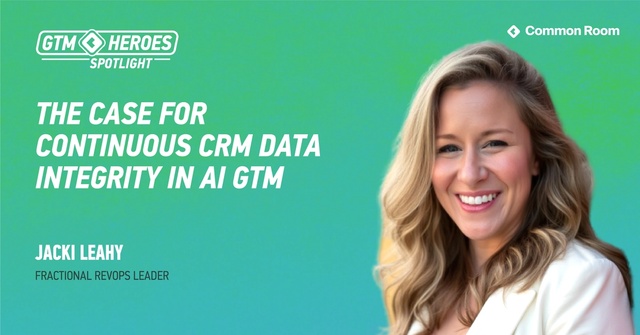
AI doesn't just need clean data. It needs a continuously maintained universe of truth. Without it, every error scales at machine speed, and your buyers notice.
The new failure mode no one planned for
Every revenue team is under pressure to move faster, prioritize better, and engage with more precision. AI is supposed to help. Intelligent routing, automated outreach, signal-based prioritization, AI-assisted research: the promise is that machines will do what humans cannot do at scale.
But there is a problem hiding underneath all of it.
The CRM data that powers these workflows is silently decaying. Contacts change jobs. Accounts duplicate. Titles go stale. Enrichment ages. Records that looked accurate six months ago now point to the wrong person, at the wrong company, with the wrong context.
This has always been a nuisance. Now, with AI in the loop, it is something worse.
AI does not pause and double-check. It takes whatever data it has and executes. When that data is wrong, every downstream action, from the email copy to the account prioritization to the personalized intro line, inherits the error. And it does so at scale, across hundreds or thousands of touches a day.
The result is not just inefficiency. It is a new category of reputational damage: outreach that looks almost right, but feels unmistakably wrong.
Few people have a clearer view of this shift than Jacki Leahy. A fractional RevOps leader and GTM operator, Jacki has spent years inside the CRMs of high-growth B2B companies, building the systems that route leads, score accounts, and power outbound. She has lived through every iteration of the data hygiene problem, from manual cleanups to rules-based dedupe to AI-assisted enrichment, and she is one of the loudest voices arguing that AI has fundamentally changed the stakes.
"The only thing worse than not reaching out is reaching out with the uncanny valley wrong. Where it's like, ‘Jacki, you know that I left that company six months ago. Now I know this is automated and it's more offensive.’"
— Jacki Leahy, Fractional RevOps Leader
This is what Jacki describes as the “uncanny valley” of AI outreach. And it starts in your CRM.
The real problem is not "dirty data"
Most teams frame this as a data hygiene issue. Run a cleanup. Deduplicate. Normalize fields. Move on.
But Jacki Leahy, who has spent years in RevOps building and fixing the systems that power go-to-market execution, sees it differently. The real work, she argues, isn't just cleaning data. It's defining your universe. Pick the five to ten fields that actually matter, be maniacal about those, and scaffold the rest of the operating model around them.
The distinction matters. Cleaning data is a project. Defining and continuously maintaining a universe of truth is an operating discipline.
And most teams do not have one.
Instead, they rely on episodic fixes: quarterly audits, spreadsheet exports, consultant-led scrubs, rules-based deduplication. These are snapshots in time. They cannot keep up with the pace at which CRM records drift, because the drift is continuous. People move companies. Accounts get acquired. New data sources introduce inconsistency every day.
As Kyle Riddle, who works with Common Room customers on data integrity, puts it:
"AI is only as powerful as the data foundation it's built on. If you can't trust the foundation, you can't trust anything AI does on top of it."
— Kyle Riddle, Senior Solutions Consultant at Common Room
The old model, where teams clean data periodically and hope it holds, was adequate when humans were the primary operators. Humans compensate. They notice a wrong title, skip a bad record, adjust on the fly.
AI does not compensate. It compounds.
What uncanny execution actually looks like
The consequences of operating on decayed CRM data are not abstract. They show up in the day-to-day execution of every go-to-market team.
From the operator's seat, Jacki sees the same patterns recur: prospects getting multiple LinkedIn DMs because their records didn't merge, outreach referencing companies people left months ago, AI scoring BDRs as high-priority contacts because their LinkedIn titles appear more senior than they actually are. The normalizing work, she says, never ends.
These are not edge cases. They are the natural output of a system where identity is fragmented, records are stale, and AI workflows are pointed at whatever data happens to exist.
The damage compounds in layers:
- Outreach credibility collapses. Prospects receive messages that reference old roles, old companies, or irrelevant context. Even when the underlying intent is good, the execution signals carelessness: what Jacki calls coming across as "an automated monster."
- Scoring and routing break. When titles are wrong, when duplicates inflate signal counts, when accounts are misassociated, the prioritization engine feeds reps the wrong targets. Activity goes up, but outcomes suffer.
- Deliverability degrades. Emails sent to old domains bounce. Domain reputation drops. The technical infrastructure of outreach erodes alongside the strategic infrastructure.
- AI makes it worse, faster. Every bad record becomes a bad decision at scale. Personalization that references a two-month-old conversation the prospect already corrected. Research summaries built on merged data from three different people. Segment definitions polluted by ghost records.
The goal of every GTM motion is the right message, to the right person, at the right time. Decayed data inverts all three at once, and at that scale, it doesn't read as a mistake. It reads as offensive.
The cost is not just wasted activity. It’s lost trust, both with buyers and within the organization.
The RevOps reality: reactive, forensic, emotionally expensive
For the people responsible for CRM integrity, the experience is not just operationally painful. It is emotionally draining. Every "Salesforce is broken" Slack kicks off a familiar triage loop: is this a one-off complaint, or the first of dozens of tickets about to land? As Jacki points out, that judgment call alone is emotional work.
The process that follows is what she calls "forensic adminning": not fixing the problem, but diagnosing it. Tracing the source. Determining the blast radius. Figuring out which integration update went rogue, which field got overwritten, which merge created a cascade of bad data.
Until now, operators have had no equivalent of what Jacki calls a "Datadog for RevOps." No monitoring layer that alerts you when data integrity degrades. No dashboard that shows the blast radius before the tickets start flowing in. The result is a constant low-grade panic. A data integrity failure could surface at any moment, and when it does, it takes at least an hour just to understand the blast radius before anyone can start fixing it.
The consequences extend beyond the RevOps team. The technical impact (lost time, surfaced errors) is the surface-level cost. The deeper damage shows up in how teams relate to each other once the data can't be trusted.
"Trust is speed. With a lack of that trust, any error you see, there's this initial panic: is this sabotage? Because the trust has been lost."
— Jacki Leahy, Fractional RevOps Leader
When trust in the system breaks down, everything slows. Reps second-guess the data. Marketing questions the segments. Leadership loses confidence in reporting. The organization starts working around the CRM instead of through it.
The shift: from episodic cleanup to continuous trust
The old model for CRM data integrity is built around episodes. Something breaks. Someone notices. A project gets spun up. Data gets cleaned. And then it starts decaying again the next day.
Jacki's favorite analogy for this is laundry. You will never be done. Even if you spend a whole day washing, folding, and putting it all away, look down: you're not naked. The work regenerates the moment you stop. The only sane response is to operationalize it: either you block a recurring time to handle it yourself, or you hire a service that runs in the background and gives you a dashboard to glance at over coffee, instead of bracing for the next ticket to land.
"You will never be done. The goal is not to have your laundry 100% done because you'll never get there."
— Jacki Leahy, Fractional RevOps Leader
This is the core shift the market needs to make.
Data integrity is not a project. It is an operating system. It requires continuous detection, continuous resolution, and continuous visibility, not because the problem is new, but because the consequences of ignoring it have changed.
When AI is in the loop, every hour of undetected drift produces more bad decisions, more uncanny outreach, more eroded trust. The cost compounds at machine speed.
And the alternative tools most teams rely on — rules-based deduplication, normalization scripts, manual waterfalls — cannot keep up. As Jacki describes it, normalizing even a single field through a Clay waterfall is hard enough to reproduce; doing it across ten fields, and back-tracing every time something looks off, isn't sustainable for any human operator.
The tools are not the problem. The model is. Episodic, reactive, manual data management cannot protect a system that AI depends on continuously.
What continuous data trust looks like in practice
This is the environment Common Room's DataAgent is built for.
DataAgent is not a cleanup tool. It is a continuous data integrity layer that identifies where CRM records no longer reflect reality and helps teams resolve those issues before they cascade into execution failures.
It works because of what sits underneath it: Common Room's Person360 identity resolution engine. Person360 continuously reconciles identity across data sources, connecting the same individual across different emails, different jobs, different systems, into a single unified profile. It knows when Brian changed roles. It knows when a contact record points to a company someone left six months ago. It knows when two records are actually the same person.
DataAgent uses that intelligence to surface three categories of CRM integrity issues:
Outdated contacts
Contacts whose CRM records no longer match reality. Job changes, company changes, title changes, departed employees. DataAgent flags these automatically, based on what Person360's identity resolution detects, not based on rules an admin had to define upfront.
Duplicate contacts
Multiple records for the same individual, often created as new data sources are connected or as enrichment introduces slight variations. DataAgent identifies these using identity resolution rather than simple field matching, catching duplicates that "same first name + same last name + company" rules would miss.
Duplicate accounts
Redundant account records that create CRM bloat, fragment reporting, and confuse ownership. DataAgent surfaces these so teams can consolidate without losing the context and history attached to each record.
What makes this different from the cleanup tools most teams have tried is the operating model.
DataAgent doesn’t wait to be told what "bad" looks like. It does not require teams to define matching logic, set up filter rules, or schedule periodic scans. It runs continuously, always on, surfacing issues as the data changes rather than after the damage is done.
As the capability matures, DataAgent is expanding into direct actionability: letting teams configure how outdated contacts are handled, how duplicates are merged, and who wins a merge, with full audit trails and notification workflows so RevOps teams always know what changed and why.
This is the "Datadog for RevOps" that Jacki described wanting. A system that monitors continuously, alerts proactively, and gives operators the confidence to tell the rest of the org: yes, there's an issue, we already see it, we're on it.
"DataAgent is going to give us that continuous trust in our data instead of onesie-twosie fixes."
— Jacki Leahy, Fractional RevOps Leader
What changes when CRM data can actually be trusted
The payoff of continuous data integrity is bigger than fewer bounced emails or cleaner reports. It changes how the entire go-to-market motion operates.
When data integrity shifts from reactive to continuous, the downstream effects are not incremental. They are structural.
Routing becomes accurate. Scoring becomes credible. Segmentation reflects reality. AI recommendations start producing outputs that reps actually trust and use.
But the less obvious impact may be the more important one. When the fire drills recede, teams can actually focus on building. Reps stop getting blocked, settle into rhythm, and start spotting patterns instead of patching errors. Cleaner data and more reliable execution sound boring on paper until you've worked without them.
The operational benefits are real: fewer bounced emails, fewer wasted enrichment credits, fewer fire drills consuming RevOps bandwidth. But the human benefits are what compound over time.
Trust returns between departments. Reps stop questioning the system and start using it. RevOps leaders shift from forensic adminning to strategic enablement. And AI initiatives, the ones that stalled because the data foundation was not reliable enough to act on, start moving again.
"AI is so fun and cool, but the problem is always in the data set. If that's busted, the whole thing is just an arts and crafts activity."
— Jacki Leahy, Fractional RevOps Leader
Continuous CRM data integrity is no longer optional
In an AI-powered GTM motion, the CRM is not a system of record anymore, it’s the execution layer. That changes the strategic case for data integrity.
AI is becoming the execution layer for go-to-market. It powers prioritization, personalization, research, outreach, routing, and reporting. Every one of those workflows depends on the CRM reflecting reality.
When it doesn’t, the consequences are no longer just operational friction. They are scaled reputational damage, eroded buyer trust, and AI initiatives that stall before they deliver value. Iteration cycles are accelerating. People are changing companies faster. No human operator can keep pace with that drift manually, and as Jacki puts it, what used to be a luxury is becoming a necessity.
Common Room built DataAgent because continuous CRM integrity is not a nice-to-have in an AI-powered GTM world. It is the foundation.
Person360's identity resolution gives Common Room a view of buyer identity that is more accurate, more adaptive, and more continuously maintained than rules-based tools, scheduled cleanups, or manual workarounds can provide. DataAgent turns that intelligence into an operational capability: always monitoring, always surfacing, always protecting the data that every AI workflow depends on.
The question is no longer whether your CRM data has problems. It does. The question is whether you have a system that finds them before your buyers do.
See how DataAgent protects the data foundation your AI GTM depends on. Get started with DataAgent →