
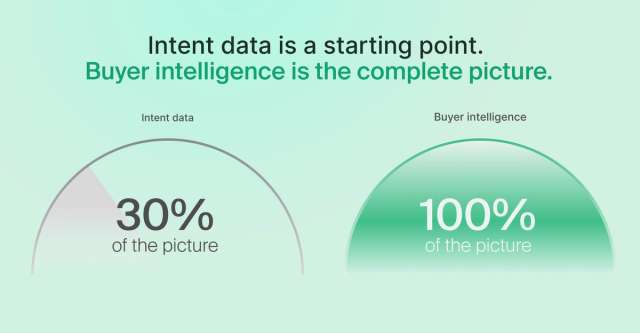

Most B2B teams are running intent data as their primary prioritization signal. Off the record, they'll tell you it's not working the way it was supposed to.
The accounts that score "high intent" don't convert at the rate promised. Reps reach out and hear nothing.
Intent data isn't broken, it's just being asked to do something it was never designed to do. There's better framing that most teams haven't fully made the switch to yet.
This is about the difference between intent data and buyer intelligence: what each one actually is, where one stops and the other starts, and why it matters for whether your pipeline converts.
What is intent data? And what was it designed to do?
Intent data consists of measurable information that reveals a prospect’s actions and behaviors, helping businesses infer their likelihood to buy based on observable signals like website interactions and content engagement. It’s the digital footprints that indicate someone is considering a solution like yours.
Marketing and sales teams leverage intent data to identify high-intent accounts, prioritize outreach, and tailor campaigns for more effective engagement.
This data extends to product usage patterns, email engagement, community participation, event attendance, partner ecosystem activity, and data collected from various sources such as third-party websites and social media platforms.
Types of buyer intent data
Businesses can invest in different kinds of intent data, the primary sources are listed here.
First-party intent data comes from your owned channels like your website, product, community, events, and support, offering real-time, detailed insights close to buying decisions.
Second-party data, from partners like co-marketing or marketplaces, is less common.
Third-party intent data is sourced from external publishers, review sites, ad platforms, and other websites. Third party sources include social media and content platforms, providing broader market visibility by capturing user interests and behaviors across multiple web sources beyond your own site. Third-party data is typically account-level, delayed, and less specific.
First-party data is the most actionable and reliable foundation, with third-party signals enhancing market reach.
When used well, intent data helps sales and marketing teams get ahead of the buying cycle. In practice, that looks like:
- Identifying which topics, pain points, and solutions prospects are researching before they've engaged with your brand directly
- Tracking changes in research intensity over time to gauge whether an account is in early exploration or approaching a decision
- Prioritizing outreach toward accounts showing high-intent behaviors like visiting pricing pages or searching for vendor comparisons
The core premise is straightforward: if a company is researching your category, they may be in market. Surface those accounts early enough, and your team can get there before the competition.
That premise holds. Intent data genuinely moved B2B GTM forward, from purely reactive inbound to proactively identifying accounts in active buying cycles. For top-of-funnel prioritization, campaign activation, and giving reps a starting point for outbound, it's a real improvement over working from static lists and gut instinct.
The problem is that most teams stopped there.
Where intent data falls short
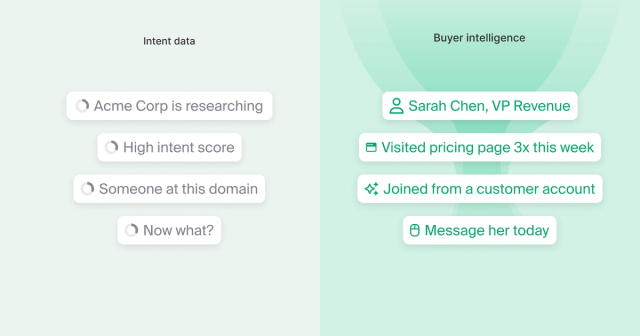
Most intent data providers deliver account-level visibility with slow, modeled signals. By the time a “topic surge” appears in your dashboard, the research phase may be weeks old.
Intent data provides signals, but lacks the context needed to act on them effectively. Here's where the gaps show up.
1. Limited identity resolution
Intent data typically operates at the account or domain level. You might know a company is researching your category, but not who is actually involved, whether they're a decision-maker, or how many stakeholders are engaged.
The operational cost is significant. SDRs spend hours combing through CSV exports, running manual LinkedIn searches, and reconciling Salesforce reports that don’t match intent scores.
2. Lack of context
Not all research signals are equal. Intent data doesn't tell you why the activity is happening, whether it's exploratory or urgent, or how it connects to actual buying behavior.
A new budget cycle, a leadership change, a failed competitive product: the triggering event is often the most important context in the first conversation. Intent data has nothing to say about any of it.
3. Delayed or inferred signals
Third-party providers aggregate and model most intent signals rather than observing them directly. This introduces lag between activity and visibility, false positives, and overgeneralization. By the time a topic surge registers, the research phase is often already advanced. You're identifying buyers after they've started, not before.
4. No clear next step
The biggest limitation: intent data doesn't tell you what to do.
It answers "this account might be interested." It doesn't answer "who should I engage, and how, right now?" A rep who knows only that an account has a high intent score still doesn't know who to call, what to say, or whether the timing is right.
The core gap: most tools aggregate intent signals but don’t connect them to real people, existing customers, or active product users. Without identity resolution intent data remains a partial picture.
Intent data vs. buyer intelligence: the clearest way to see the difference
| Intent Data | Buyer Intelligence | |
|---|---|---|
Scope | External research signals | Full view of buyer activity |
Data sources | Primarily third-party | First-party + third-party unified |
Identity | Account-level (limited) | Person + account-level |
Context | Minimal | Rich, multi-touch |
Timing | Often delayed | Real-time or near real-time |
Actionability | Low | High |
Intent data and buyer intelligence are different categories of information entirely. Intent data is a signal type: it tells you a company is researching your category and helps gauge buying intent by tracking changes in research intensity over time.
Buyer intelligence is the system built around the signals, adding the person-level context, relationship data, and timing triggers that turn "this account might be interested" into something a rep can actually act on.
What buyer intelligence actually adds
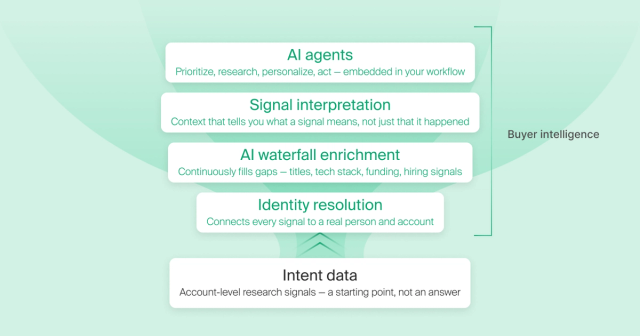
Buyer intelligence starts with intent data and builds a stronger layer of understanding on top of it. It connects your signals to the infrastructure that makes them useful: clean data, resolved identity, enrichment that fills the gaps, and AI that can actually act on what it sees.
Unified, continuously updated data
The average GTM team relies on 10+ disconnected tools across enrichment, intent, and engagement platforms. Every handoff between systems creates gaps. Buyer intelligence unifies first-party customer data with real-world buyer signals into a single, continuously updated view.
Instead of a snapshot, you get a living system that reflects what's actually happening with your buyers right now.
AI-powered identity resolution
A signal is only useful if you know who it belongs to. Buyer intelligence resolves every interaction (a web visit, a job change, a G2 review, a product trial) back to a real person and a real account.
This is the difference between: "a company at this domain visited your pricing page" and "the VP of Revenue at Acme Corp visited your pricing page for the third time this week, and she joined six months ago from a company that runs your product."
Person-level and org-level identity resolution turns anonymous activity into actionable context.
AI waterfall enrichment
Data goes stale fast. Titles change, companies restructure, contacts go dark. Buyer intelligence uses AI-powered enrichment waterfalls to continuously fill in missing context like job titles, tech stack, company size, recent hires, funding signals etc. and keeps that data current.
With it, your reps work from a system that maintains accuracy automatically, so the intelligence behind every decision is trustworthy.
Signal interpretation in context
Raw data isn't insight. A job change alert means something different if it's the economic buyer moving to a company already using your product versus a junior IC switching industries.
Buyer intelligence interprets signals in the context of the full account picture (who else is engaged, what's changed recently) so sales teams understand not just what happened, but what it means.
AI agents that turn intelligence into action
Once the intelligence foundation is in place, AI agents handle the work that used to eat a rep's morning: prioritizing accounts, mapping the full buying group, surfacing the warmest path, drafting outreach. All of it embedded directly into the tools where teams already work.
Why this difference matters for your team
When teams rely only on intent data, the consequences are predictable. They prioritize accounts too early or too late. They reach out to the wrong stakeholders because they're working from company details alone, with no visibility into who's actually involved. They send generic, poorly timed messages because there's no real buyer context behind them. All of it is wasted effort on accounts that were never going to convert.
When GTM teams operate with buyer intelligence, they can:
- Prioritize more accurately, focusing on accounts with real, observable activity rather than inferred interest.
- Engage the right people, because person-level signals identify the actual buyers rather than just the domain.
- Improve timing, reaching out when activity indicates genuine momentum rather than based on a modeled score.
- Increase conversion, because better targeting and better timing produce higher-quality pipeline.
Buyer intelligence is how teams stop chasing signals and start finding the right accounts. The rep's job is judgment and relationship. The system handles the rest.
How Common Room approaches buyer intelligence
Common Room is built on the belief that AI is only as useful as the data foundation it operates on. AI without context is just noise.
That's why Common Room unifies first-party customer data with real-world buyer signals into a continuously updated system of complete and trusted buyer intelligence.
Through AI-powered identity resolution — Person360 and Org360 — every signal is connected to a real person and a real account.
AI waterfall enrichment continuously fills in missing context and keeps data accurate over time. And Context360 interprets signals across the full account picture, so every recommendation reflects what's actually happening with a buyer, not just what a model inferred from a topic cluster.
On top of that foundation, AI agents go to work across the GTM workflows where teams already operate. Account prioritization that updates continuously as buyer activity changes. Contact research that maps buying groups and surfaces the warmest paths in. Outreach personalization built from real buyer context.
All of it embedded directly into CRM, Slack, email, and browser, so reps don't need to change how they work.
For RevOps, that means deploying AI plays in hours rather than weeks, without GTM engineers or brittle integrations. For sales, it means starting every day with clarity on who to contact and why, rather than spending the morning rebuilding context from scratch.
For both, it means AI that actually works. Because the intelligence behind it is complete, trusted, and continuously updated.
The bottom line
Intent data was a genuine step forward for B2B GTM. It moved teams from purely inbound-reactive to proactively identifying accounts in active buying cycles. That was meaningful progress.
The next step is recognizing that "in-market" is a starting point, but not a complete picture.
The teams converting at the highest rates aren't the ones with the best intent data. They're the ones who know what to do with it, and who have the person-level, relationship, and timing signals to turn an intent-scored account into a genuine pipeline opportunity.