
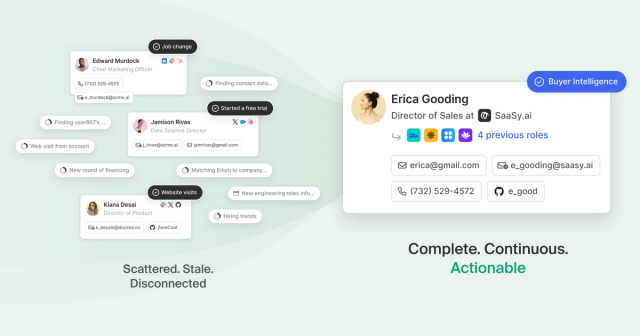

Your SDR team gets the alert: “Acme Corp is in-market.” They spend 45 minutes across LinkedIn and CRM trying to find the right contact, send a generic email, and hear nothing. Meanwhile, the actual buying committee—a Director of RevOps who signed up for your product last week, three AEs actively using it, and a VP of Sales who just joined from one of your customers—never gets touched.
This is the issue costing modern go-to-market teams pipeline.
Buyer intent data reveals which accounts are actively researching solutions, providing insights into timing for outreach efforts. But knowing “someone at Acme is interested” doesn’t tell you who, why, or what to do next. Salesforce research shows sales reps spend over 60% of their time on activities other than selling.
That gap, between signal and action, is exactly the problem buyer intelligence solves.
What is buyer intelligence?
Buyer intelligence is the unified, real-time view of who your buyers are, what they’re doing right now, and which signals should trigger action from your go-to-market team.
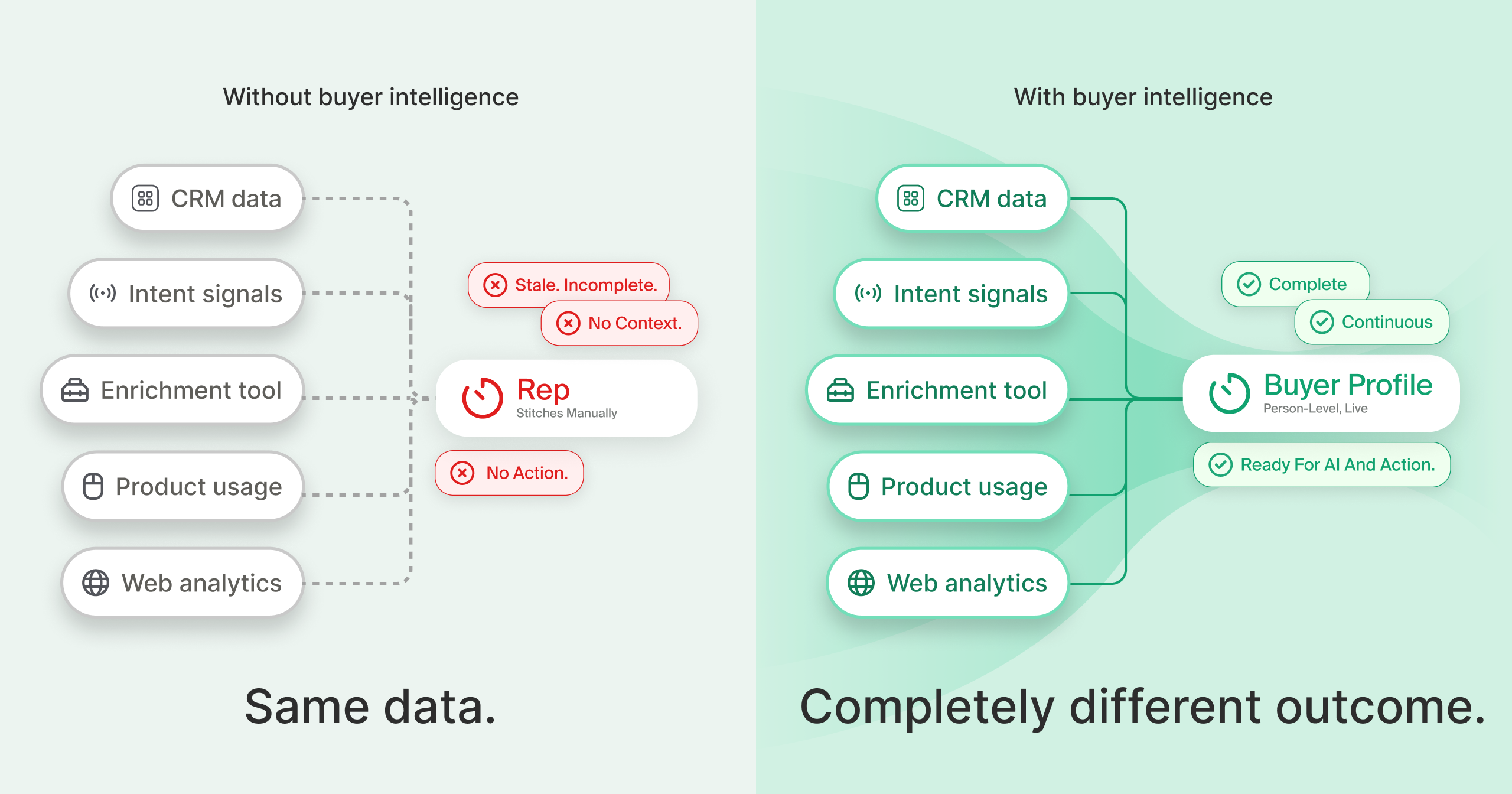
It operates across three layers:
- Identity: Who are your buyers, specifically? Not just "someone at Acme Corp." But, which person, in which role, with what history, at what stage of the buying process. Buyer intelligence resolves identity at the person level, not just the account level.
- Signals: Interpreted behaviors and patterns. What behavioral, firmographic and technographic, and relationship signals is that person showing? Are they visiting your pricing page? Did a new VP just join the account? Is the company posting SDR job listings? These signals, read together, tell a story.
- Context: Prioritized, actionable recommendations for your team. A pricing page visit means something different if it's the third visit this week, the account just raised a Series B. Context is what turns a signal into an insight.
Traditional methods like intent data mostly track anonymous research activity at the account level without telling you which person to contact or what action to take.
Buyer intelligence replaces that partial view with a single picture of your buyer across firmographic, technographic, behavioral, product usage, social, and relationship data.
Buyer intelligence vs. buyer intent data
Legacy vendors trained go-to-market teams to focus on buyer intent as the primary signal. It’s useful, albeit narrow.
Buyer intent data includes signals like third-party data from search behavior, content downloads, and review site visits, indicating an account may be researching your category.
Buyer intelligence goes further, combining that external activity with first-party data, identity resolution, and real-world context to tell you who specifically is in-market, what they're doing, and when to act.
Here’s how they compare:
| Dimension | Intent Data | Buyer Intelligence |
|---|---|---|
Level | Anonymous, account-level | Identified people + accounts |
Timing | Batch-delivered, often lagging | Real-time across channels |
Actionability | “This account might be interested” | “This buyer did X, trigger Y action now” |
Consider this scenario: Intent data flags Acme Corp as “in-market.” Buyer intelligence adds: the Director of RevOps created a workspace 3 days ago, product usage is spiking in their West Coast region, and their VP Sales just changed jobs from a company that was your customer. That’s the difference between a cold guess and a warm, relevant play.
Why intent data alone isn’t enough anymore
Intent data helps find “who might be interested.” It doesn’t answer “who specifically, why now, and what should we do next?”
The structural limitations are clear:
- Account-level blind spots: Intent can’t reliably identify champions, blockers, or the buying committee. Modern enterprise deals average 6-10 stakeholders, but realistically, you need person-level intelligence.
- Anonymous and vague: Privacy-safe but disconnected from real people in your CRM. You see activity without attribution.
- Lagging and batch-based: Signals arrive after buyers have already talked to peers or started competitor pilots.
The most complete picture of a buyer has two halves: what's happening inside your systems (product usage, CRM activity, email engagement) and what's happening outside them (job changes, funding news, competitor activity, community behavior).
Most tools give you one or the other. Buyer intelligence is what you get when both halves are unified and interpreted together.
The components of buyer intelligence
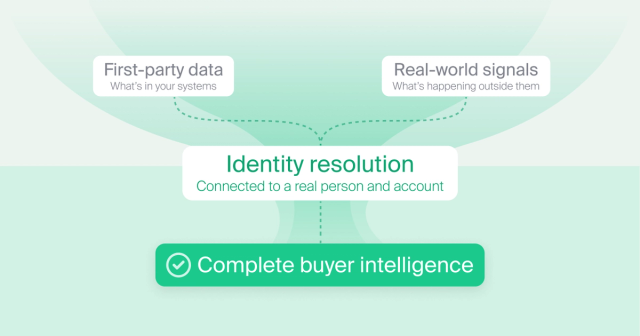
Buyer intelligence draws from multiple sources, including what's already in your systems and what's happening outside them.
First-party data
This is everything you already know: CRM records, product usage, email engagement, call recordings, and marketing automation activity. It's the history of every interaction a buyer has had with your business.
The problem for most teams is that this data is fragmented across systems, inconsistently maintained, and rarely connected to a single person-level view.
First-party data is your foundation. Without it, external signals have no home to land in.
Example: A prospect creates a workspace, invites two colleagues, and visits your pricing page. All activity your systems have already captured, but never surfaced together.
Real-world buyer signals
This is what's happening outside your four walls. Job changes, funding news, hiring patterns, technographic shifts, community activity, web visits, and intent data. These signals tell you what buyers are doing when they're not talking to you (which is most of the time!).
The five types that matter most are:
Firmographic: company size, growth stage, funding, headcount trends. Your baseline ICP filter. A firmographic match tells you the door is worth knocking on, but not when to knock.
Technographic: what tools they use, what's in their stack, what they're actively building out. If a target account just added a new CRM and is hiring for RevOps, something is changing in their GTM infrastructure. That's a buying trigger. [Link: technographics]
Behavioral: web visits, product activity, content engagement, pricing page views. Your strongest timing indicators. They tell you when a buyer is actively evaluating, not just passively in-market.
Social and community: forum activity, LinkedIn engagement, event attendance, open source contributions. Particularly powerful for identifying champions early, before the formal evaluation starts.
Relationship: job changes, new hires, promotions, org restructuring. People carry preferences between companies. A champion who loved your product at their last job is a warm prospect the moment they land somewhere new.
Identity resolution: the layer that makes it all work
First-party data and signals isn’t the hard part. Connecting them to the right person, at the right account, without duplicates or stale records, is where most systems fall apart.
Identity resolution is the mechanism that turns a collection of signals into a coherent picture of a buyer. It collapses multiple CRM records into one verified profile, links external activity to real people in your system, and keeps that picture current as buyers change roles, companies, and behavior.
Example: Your former champion at a closed-lost account just became VP of Sales at a company that fits your ICP perfectly, and your system already knows it, because it tracked the job change, matched the identity, and surfaced it automatically.
How buyer intelligence works in real go-to-market workflows
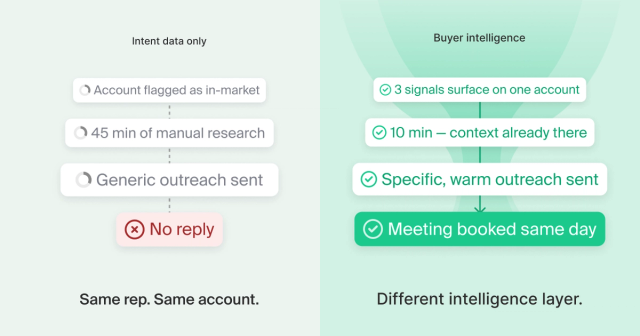
The difference between working with intent data alone and working with full buyer intelligence is clearest in how reps actually spend their time.
Before (intent-only): An SDR at a mid-market SaaS company gets a weekly list showing “ACME LOGISTICS” is surging on category keywords. They spend 30-45 minutes across LinkedIn and CRM guessing contacts, send a generic “saw your company researching X” message, and hear nothing.
After (buyer intelligence): Same account, surfaced because: the Director of RevOps created a workspace 5 days ago, three AEs joined, activity spiked 40% week-over-week, and a known champion just joined from a Common Room customer. The system identifies best-contact personas, proposes a tailored message referencing their growth and open SDR roles, and routes a task to the right rep while triggering targeted ads.
Modern buyer intelligence often utilizes AI platforms that track billions of digital signals. AI-powered buyer intelligence leverages advanced algorithms to analyze and interpret vast amounts of customer data, enabling teams to craft more effective strategies.
The integration of AI in buyer intelligence allows for real-time analytics, enabling businesses to respond swiftly to changing market conditions and buyer behaviors.
SDRs get prioritized daily account and contact lists with recommended talk tracks. AEs see account-level intelligence inside CRM, including product usage and community history. Marketing triggers sequences based on signal combinations like new workspace plus pricing page visits.
Who needs buyer intelligence across the GTM org?
McKinsey data indicates companies that integrate multiple data sources across the buyer journey significantly outperform peers on revenue growth. Buyer intelligence isn't just a sales tool. It's a shared foundation for every team that touches the revenue funnel.
Here’s how it can be leverages cross-functionally.
Sales teams
Sales teams use buyer intelligence to prioritize accounts based on real signal activity rather than ICP fit alone. With it, they can personalize outreach with specific context, and time follow-ups to signal spikes rather than arbitrary cadences.
The result is higher connect rates, faster ramp for new reps, and less time wasted on accounts that aren't actually ready. Sales development teams benefit most directly from person-level signal context.
Marketing and Demand Gen
Marketing teams use buyer intelligence to build accurate ICP audiences, trigger campaigns based on behavioral signals rather than demographic proxies, and measure account engagement in ways that actually inform pipeline.
Demand generation built on buyer intelligence converts at higher rates because the targeting is based on real-time behavior, not assumptions.
RevOps teams
RevOps teams are the architects of the buyer intelligence system, building the signal stack, maintaining lead scoring models, and ensuring data quality across the stack.
According to Salesforce's State of Sales research, 79% of sales ops teams are being asked to increase productivity while managing tool sprawl. Buyer intelligence consolidates that complexity rather than adding to it. RevOps leaders use it to build the foundation that sales and marketing operate from.
Customer success teams
Customer success teams use buyer intelligence to monitor expansion signals, identify at-risk accounts before churn becomes visible in lagging metrics, and surface champions for case studies, references, and advocacy programs.
How to build your buyer intelligence foundation
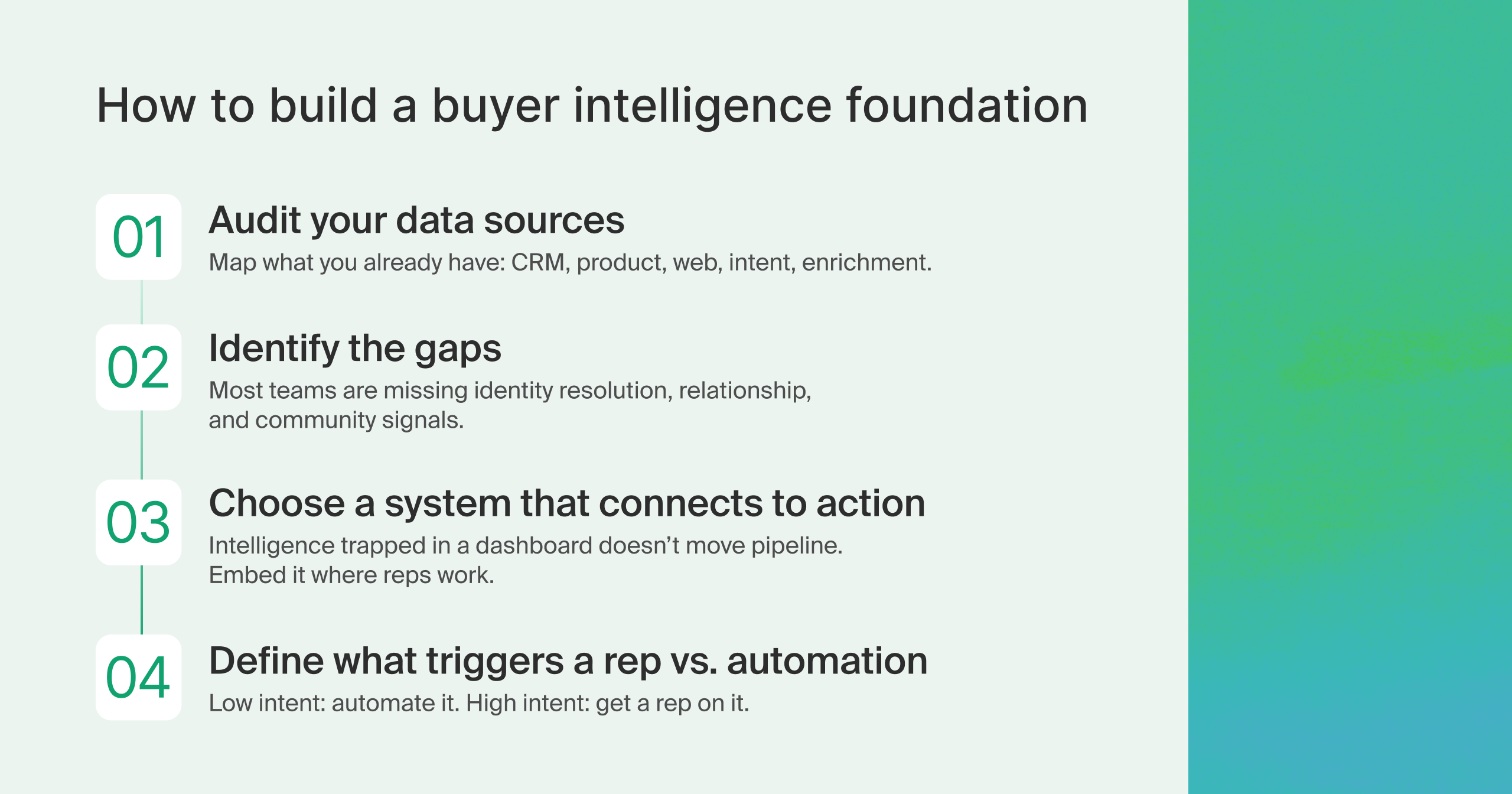
You don’t need perfect data to start. Buyer intelligence is iterative, and most teams already have valuable signals trapped in silos. The challenge isn't getting more data; it's connecting what you have and filling the gaps that matter.
You don’t need perfect data to start. Buyer intelligence is iterative, and most teams already have valuable signals trapped in silos. The challenge isn't getting more data; it's connecting what you have and filling the gaps that matter.
Step 1: Audit your current data sources
Map what you're already capturing. CRM activity, product usage data, web analytics, marketing automation, and any intent or enrichment subscriptions you're paying for.
Be honest about what's actually relevant and up to date. Industry benchmarks suggest roughly 25-30% of B2B contact data goes stale every year. A CRM that hasn't been actively maintained is already materially wrong.
With AI being layered on top of this data, this matters more than most teams realize. AI built on duplicate records, stale contacts, and mismatched identities consistently produces bad recommendations. The data quality problem doesn't disappear when you add an AI layer on top. It just becomes harder to see.
Step 2: Identify the gaps
Most teams have reasonable firmographic coverage and some behavioral data. What's usually missing are things like verified contact information, complete job histories, real-time company context, and any view of what buyers are doing outside your systems.
That's where enrichment comes in. A good enrichment layer continuously fills in missing context like current and verified emails and phone numbers, org structure, and funding history, so your profiles stay complete without requiring manual upkeep. The goal isn't a one-time data append. It's a foundation that updates as the world changes.
The gaps in your data are the gaps in your reps' context.
Step 3: Choose a system that moves insight to action
Look for a buyer intelligence platform that unifies your data, resolves identities at the person and account level, scores and prioritizes, and pipes intelligence into tools your team uses. Surfacing dashboards alone isn’t enough; the system should support automated workflows without heavy engineering.
A buyer intelligence platform will move insight to action rather than keeping it hostage in a dashboard. Common Room's AI agents are built specifically to activate buyer intelligence across GTM workflows, not just surface it.
Step 4: Define what triggers rep action versus automated workflows
Not every alert warrants a personal rep touchpoint. A pricing page visit might trigger an automated sequence. Three pricing page visits plus a job change signal in the same week warrant a rep’s action.
Building clear thresholds around your data keeps reps focused on the accounts that need them most and prevents alert fatigue.
The teams that build this foundation well, like Notion, and Zapier, don't just see better data. They see more pipeline, shorter cycles, and reps who actually trust the system they're working from.
Step 5: Measure and iterate
Track meetings booked from buyer intelligence workflows, conversion rate of signal-qualified accounts versus standard MQLs, and sales cycle time. Businesses leveraging buyer intelligence report significant lifts, with some noting a 20-30% increase in pipeline conversion rates.

“Once our reps got their hands on Common Room, the response was unanimous: ‘Buy it, please.’ We sourced pipeline right away running plays from product usage, web visits, GitHub activity—you name it.”

Jason Klumpp
Director of Sales Development
How Common Room approaches buyer intelligence
Common Room unifies first-party customer data with real-world buyer signals into a single, continuously updated picture of your buyer. AI identity resolution, waterfall enrichment, and Context360 keep that picture accurate and complete as your buyers move and markets change. AI agents use that foundation to help teams prioritize, research, and execute across every GTM workflow.
Weaviate had plenty of data: 13 million downloads, active GitHub repos, and social conversations. What they didn't have was a way to connect any of it, or a single place for reps to act on it.
Director of RevOps Soham Maniar put it simply: "We had tons of open-source signals. But we needed to figure out which signals mattered: what to prioritize, when to prioritize, how to tackle it, and who to tackle it with."
Common Room became Weaviate's GTM command center. First-party CRM data from HubSpot sat alongside open-source activity, web visits, and job listing data — all resolved to unified person-level profiles through waterfall enrichment.
RevOps built scoring models on top of that foundation. Reps got a prioritized, always-current view of their book of business without toggling between tools.
Six months in, pipeline had tripled.
From intent to intelligence
Intent data was a helpful first step. But knowing "someone at Acme is interested" was never enough to win the deal.
The teams that are pulling ahead aren't the ones with more data. They're the ones with a complete, continuously updated picture of their buyers and a system that turns that picture into action before the window closes.
Buyer intelligence is what makes everything else work — the AI, the outreach, the pipeline. Get the foundation right and the rest follows.