
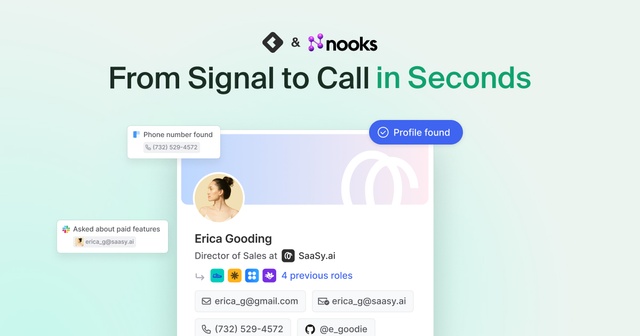
Picture your best SDR on a Monday morning.
She opens Nooks ready to dial. Her call list is full. She starts working through it. Some calls connect. Most don't. By noon she's made 40 calls and booked one meeting.
Was the list wrong? Probably. But she didn't know that. Nobody told her which accounts had just visited the pricing page, which contacts had changed jobs at a target account, or which companies had spiked in product usage over the weekend. That intelligence existed. It just never made it into the dialer.
That's the gap nearly every outbound team lives with and it’s costing them pipeline every single day.
It’s not a data problem. It’s not a dialing problem. It's not a data problem. It's not a dialing problem. It's a connectivity gap: a missing link between knowing who deserves a call and actually making it.
Today, that gap closes.
Two platforms. One motion.
Common Room and Nooks have always been solving adjacent problems. Common Room figures out who's worth reaching and why. Nooks makes it effortless to reach them. The two platforms are used by the same teams, serving the same reps, chasing the same goal.
Until now, they just weren't talking to each other.
Common Room is the AI-native GTM platform that turns complete and trusted buyer intelligence into action. It unifies first-party customer data with real-world buyer signals, resolves identity through Person360, and runs AI agents that help revenue teams understand who to prioritize, what's changed, and what to say. The result is a continuously updated view of your buyers: who's in market, who just triggered a signal, who deserves a call today instead of next quarter.
Nooks is the Agent Workspace for intelligent outbound, where AI agents and reps work together end-to-end. Instead of juggling prospecting, sequencing, enrichment, and calling across tools, agents surface the right prospects, draft signal-driven outreach, and keep sequences fresh—all in one workflow.
"Nooks is built to make reps as effective as possible the moment they start dialing. What they've been missing is knowing which accounts are actually worth dialing in the first place. Common Room solves that. Together, we're closing the loop between intelligence and execution in a way that neither platform could do alone." — Tasha Reasor, CMO, Common Room
The integration is live. And for outbound teams running both platforms, the workflow just got a lot smarter.
What changes for your team
Before this integration, the intelligence Common Room generates stayed in Common Room. Reps would have to manually export lists, rebuild context in a separate tool, and hope the signal was still relevant by the time they got to the call. In a world where timing is everything, that lag is expensive.
ServiceTitan felt it directly when they replaced Outreach with Nooks as their primary sequencer and dialer.
That before-and-after plays out differently for every team, but the pattern is consistent: intelligence that stays trapped in one platform never makes it to the rep at the moment it matters. When ServiceTitan replaced Outreach with Nooks as their primary sequencer and dialer, reconnecting their Common Room prioritization workflow to their new execution layer wasn't optional—it was the whole point.
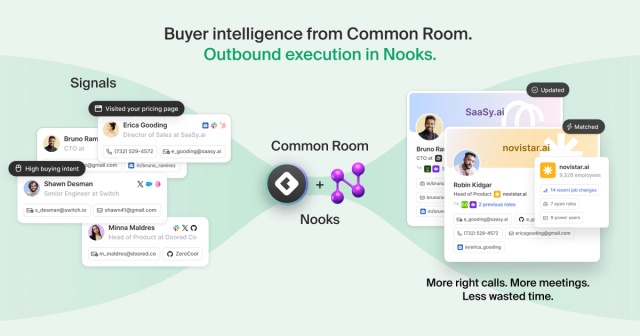
For the AE who spots a trigger in Common Room. Let’s say it’s a VP of Sales that just joined a target account, visited the pricing page twice this week, and works at a company whose product trial activity just spiked. Today, this integration means she can go from signal to sequence in under 60 seconds. From the contact profile in Common Room, she clicks "Add to Nooks," selects her sequence, confirms the mailbox, and the contact lands in her Nooks queue with full context already populated. The signal is fresh. The outreach is immediate. And she never had to rebuild anything manually.
For the SDR team, it means the RevOps-built Common Room segment of high-intent accounts (pricing page visits, product trial activity, job changes at ICP companies) flows directly into a Nooks sequence without anyone rebuilding it manually. From there, Nooks generates the call tasks automatically. Reps start dialing the highest-signal targets from the first call of the session with no list-building required, and no duplicate data entries.
And for RevOps, it means the whole workflow can run automatically. Map Common Room segments to Nooks AI sequencer, and contacts entering a high-intent segment are pushed into the corresponding sequence on a configured sync cadence. Nooks handles the rest by generating call tasks, prioritizing the queue, and keeping the list current without manual intervention. And the best part? Nobody has to remember to pull from Common Room because the system handles it.
“One of our biggest priorities is ensuring our reps are focusing on the right contacts and the right accounts. Common Room helps us see where they should be spending their time, and Nooks is where they execute. Before the integration, those workflows weren’t connected. Now they are, and it’s making it easier to get those signals we’re surfacing directly into the hands of the reps taking action.” — Christina Smears, SVP Global Sales Development & Enablement, ServiceTitan
Sequencing with a reason
Most SEP integrations push contacts into sequences. That's table stakes. What matters is what those contacts bring with them when they arrive.
Most integrations bring a name, an email, and a job title. Common Room brings context. Not just who this person is, but what their company has been doing, why now is the right moment to reach out, and what’s most likely to make the conversation land. That's the difference between sequencing at someone, and sequencing with a reason.
Airbyte's SDR team knows this better than most.
“My reps live in Nooks. That’s just the reality. So if the intelligence from Common Room isn’t showing up there, it might as well not exist. Since we connected the two, our SDRs are starting every session with a list that’s already been prioritized for them. The context is there before they dial, and we’re spending a lot less time figuring out who’s worth calling.” — Justin Bangay, Sales Development Manager, Airbyte
Right message. Right person. Right time. That's the goal every outbound team is chasing. It sounds simple. In practice it requires two things working in concert: a system that continuously identifies who deserves your attention and why, and a tool that makes it effortless to act on that. Common Room is the first half. Nooks is the second. The integration is what makes them one motion.
“We’ve been trying to close the loop between signal and execution for a long time. Common Room helps us identify the right accounts and buying signals. Nooks is where our team takes action. The integration is the bridge we were missing. What I like most is that it’s not another workflow for reps to manage—it just works in the background and helps ensure the right prospects make it into the right sequences.” — Mario Moscatiello, VP of Marketing, Airbyte
The best call of the day starts before you dial
Go back to that SDR on Monday morning.
Same rep. Same Nooks. Different list. This time, it's built from everything Common Room knows: which accounts spiked in activity over the weekend, which contacts just moved into roles that make them worth reaching, which companies are showing the kind of buying behavior that turns a cold call into a real conversation.
She still makes 40 calls. But the list is actually right, and context travels with every contact. So that the first call of the day is the highest-signal account on the list, not whoever happened to be sitting at the top for no good reason.
That's what happens when knowing and doing finally connect.