
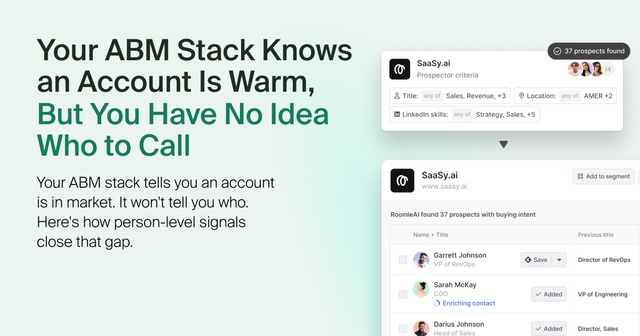
Somewhere in your tech stack right now, a dashboard is lighting up green.
"Account X: surging intent." A little flame emoji, maybe. Your account intent platform did exactly what you paid it to do: it looked at a company and said, with real confidence, this one is warming up.
Then an AE opens that account page and asks the only question that actually matters.
Who?
Silence. The dashboard doesn't know. It was never built to know. It scored a company, not a person, and a company has never once picked up a phone.
This is the gap sitting quietly at the center of most ABM stacks: they're brilliant at telling you where to look, and nearly blind to who's actually looking back.
Your account intent tool isn't broken. It's just half the story.
Let's give account-level intent its due. Knowing that Acme Corp just spiked in research activity, pulled competitor comparisons, or lit up a review site is genuinely useful. It's the flare shot into the sky that says something is happening over there.
The problem is that a flare tells you a direction. It doesn't hand you a name, a title, or a reason to reach out today instead of next Tuesday.
Most GTM teams solved part of the equation years ago. They know which accounts to watch. What they still don't know, reliably, in real time, is which person inside that account is the one worth calling first.
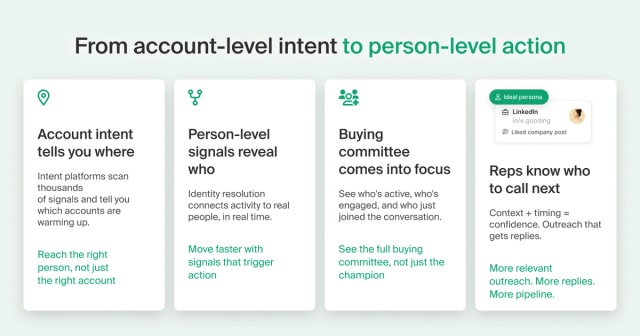
An account is not a person, no matter how good the dashboard looks
Here's a fact that sounds obvious until you look at how most GTM tools actually behave: nobody has ever bought your product. A person did. A specific human, with a title, a Slack handle, a LinkedIn profile, and an opinion about your last product update.
Account-level intent treats a company like a single blinking dot. In reality, that "account" is dozens of people, each doing something different at the same moment. One is reading a case study. One just changed jobs into the role that owns the budget. One left a comment on a community post about the exact problem you solve. One hasn't looked at anything in six months and is actively a distraction.
Account-level data can't tell those people apart. It wasn't built to. Person-level signal is what turns a glowing account into an actual next move.
Why "in market" doesn't mean "ready to talk"
Account intent answers a market-sizing question: is there smoke somewhere in this building? Person-level signal answers the only question your rep actually cares about: which room, and who's standing in it?
Without that second layer, "in market" becomes a coin flip disguised as insight. Reps burn cycles reaching out to the wrong contact, get a lukewarm reply from someone with zero buying authority, and quietly conclude that the intent score was noise all along.
It wasn't noise. It was a partial signal, treated like a whole one.
What person-level signal actually adds to a stack you already trust
You don't need to rip out your account intent platform to fix this. You need a layer that sits on top of it and answers the question the account score was never designed to answer.
Person-level signal means:
- Every activity, from a product login to a LinkedIn comment to a support ticket, resolves back to a real, named individual, not an anonymous "visitor."
- You can see who inside a surging account changed roles recently, engaged with content, or showed up somewhere new, and when.
- The buying committee stops being a guess. You can actually see who's active, who's gone quiet, and who just joined.
dbt Labs ran into this exact wall. Buying-committee visibility only matters if it gets to a rep before the moment passes, and account-level scoring alone couldn't get them there fast enough. Once the signal resolved down to a named person the moment they showed intent, speed to lead stopped being a metric they were chasing and started being the default.
This is the difference between a heat map and a map with your name on the pin. One tells you a region is warm. The other tells you exactly where to stand.
How to layer this in without starting over
The good news: this isn't an "and now throw away everything you built" story. Most teams don't need to replace their account intent platform. They need to connect it to a system that resolves activity down to the person, then feeds that context back into the workflow reps already use.
Keep the account-level intent signals coming in; they're still useful for prioritizing where to look. Layer in identity resolution that connects product usage, CRM activity, and public signals to a real person, not just a domain. Then give reps the buying committee view alongside the account score, so "in market" comes with a name attached, automatically, before they ever open a new tab.
Done well, this doesn't add a step to your process. It removes the guesswork from the step you're already taking.
The question every ABM team should be asking this quarter
Not "which accounts are in market." You already know how to answer that.
Ask instead: when an account lights up, do we know, within minutes, exactly who to reach and why? If the honest answer is "we'd have to go look," that's the gap.
Account-level intent got GTM teams this far. Knowing the person in the room is what gets them the meeting.