

Most outbound starts with a list.
Someone pulls a segment from the CRM, loads it into a sequence, and sends it into the world. The timing is whatever day it happened to be when someone got around to it. The relevance is approximate. The response rate reflects that.
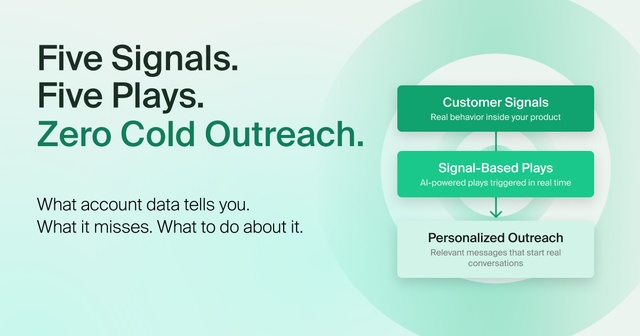
Signal-based plays work differently.
Instead of starting with a list and hoping the timing is right, you start with a signal—something that actually happened inside an account that makes now the right moment—and build the play around that trigger.
The difference sounds subtle. The results aren't.
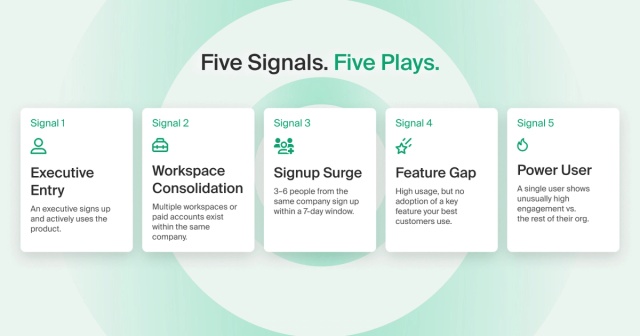
When Otter AI built their SLG motion on top of 40M users, they didn't create a list of target accounts and start dialing. They defined five specific signals that, when they fired, indicated an account was ready for a conversation. Each signal had its own play. Each play had its own message logic. Each message was personalized to exactly what was happening in that account at that moment.
Here's what those five plays look like, and why each one works.
Play 1: The Executive Entry
The signal: An executive at a target account signs up and starts actively using the product.
This is one of the highest-intent signals in the entire PLG motion (and one of the most underused). Mostly because it requires someone to notice it, and noticing things at scale is not a human's strong suit.
When a VP, Director, or C-level contact joins the product on their own, they're not responding to outreach. They're expressing genuine curiosity. They found the product, decided it was worth their time, and started using it.
That's a warm lead that most companies let go cold because nobody was watching.
The play isn't a generic sequence. It's a triggered outreach that acknowledges what they're doing and opens a conversation about whether there's a broader opportunity for their team. The message almost writes itself because you know exactly what they just did. That specificity is what makes it land and what separates it from the seventeen other emails they got that day.
Play 2: Workspace Consolidation
The signal: Multiple separate paid accounts or workspaces exist within the same company.
This one hides in plain sight.
As PLG products grow through self-serve, it's common for different teams inside the same company to spin up independent accounts. The marketing team has one. The sales team has another. Engineering has a third. Nobody planned it that way, it just happened organically as the product spread and nobody was coordinating.
From a revenue perspective, this is an enterprise deal that's already paying you—just in disconnected pieces, at self-serve pricing, with none of the stickiness that comes with an actual enterprise contract.
The consolidation play surfaces these accounts and opens a conversation about bringing them together. The message isn't a cold pitch. It's a practical observation: you have eight workspaces running independently across your org—here's what a consolidated setup would look like, and here's what it unlocks.
Otter's team found that the aggressiveness of the message should match the scale of the fragmentation. Eight workspaces gets a direct conversation about consolidation. Two or three gets a lighter touch. The signal is the same. The urgency is different.
Play 3: The Signup Surge
The signal: Three to six people from the same company sign up within a seven-day window.
Organic team adoption is one of the clearest buying signals in PLG. It means someone liked the product enough to tell other people about it, and those people liked it enough to sign up. No prompting. No nurture sequence. Just word of mouth doing what word of mouth does.
That momentum is real, and it has a shelf life.
When one person signs up, it might be curiosity. When three to six people from the same company sign up in the same week without any outreach from you, something is happening inside that account. The window between organic spread and a buying conversation is short. The outreach needs to reach the right person—not necessarily the first person who signed up, but the person most likely to own a team-level decision—while the energy is still there.
Wait two weeks and you're following up on something they've already moved on from. Or decided on. Without you.
Play 4: The Feature Gap
The signal: High usage volume but no adoption of a key feature that your best customers use.
This play is about value expansion hiding inside an existing relationship.
Your power users are already getting something real from the product. They're hitting usage thresholds, running workflows, clearly embedded. But they haven't discovered the feature—AI summaries, integrations, collaboration tools, whatever it is in your product—that your highest-retention customers almost universally use.
The outreach here isn't a sales conversation. It's a helpful one. You noticed they're using the product heavily but haven't tried the thing that users like them usually find most valuable. Here's why it matters. Here's how to turn it on. Here's what it unlocks.
Done right, this play drives both retention and expansion. It deepens the relationship before the renewal conversation happens. It also frequently surfaces teams or use cases you didn't know existed inside the account, which tends to lead to interesting conversations.
Play 5: The Power User
The signal: A single user with unusually high engagement relative to the rest of their organization.
Power users are your best enterprise champions. Most companies never talk to them.
They're the person who figured out how to get the most out of your product before anyone else at their company did. They're using features nobody else has discovered. They're running workflows the product team would love to hear about. And they're usually one good conversation away from going to their manager and saying this thing needs to be part of our standard stack.
The play here is recognition and enablement. Acknowledge what they've built. Ask what they'd want if they could get their whole team using it the same way. Give them something—a template, a resource, an introduction to your team—that makes them feel like an insider rather than just another user number.
Power users who feel recognized become champions. Champions open enterprise conversations you couldn't have opened any other way. It is a remarkably underutilized leverage point.
The automation layer that makes it scale
Defining the plays is the strategy. Automating them is what makes it a motion rather than a good idea that requires constant manual effort to execute.
Each play needs four things to run at scale: a trigger condition that fires when the signal appears, a prompt that pulls the relevant account variables into a personalized message, an enrollment workflow that routes the right accounts to the right sequence, and a tiering rule that determines whether a human reviews before anything goes out.
Otter built AI prompts for each of their five plays that pull live variables directly into the message - number of workspaces, meeting minutes recorded, feature usage patterns, days since signup. The message isn't templated in the traditional sense. It's generated from what's actually happening in that account at that moment.
High signal plus high fit gets a human in the loop before it sends. Strong signal and medium fit runs automated. Everything else gets low-touch nurture or nothing at all.
The result is a motion that runs continuously in the background, surfacing the right accounts at the right moment, with the right message, without requiring a rep to notice the signal first.
That's the difference between a sales team that reacts to pipeline and one that generates it.
Next in the series: not all signals are equal - how to build a signal hierarchy that tells you when to activate, who to target, and what to ignore.