

- Supercharge your prospecting and account research with enhanced technographic insights: Common Room's partnership with BuyerCaddy leverages incredible breadth and depth of technographic signals.
- Technographic signals include niche signals for precision targeting: installed technologies and vendors, when an install occurred, and how many verified installs we can identify (intensity).
- Action on technographic signals in a number of different workflows: Run competitive displacement plays, build dynamic segments to define your 'best fit customers,' and understand the tech stack maturity of your accounts for more precise scoring and prioritization
Common Room helps GTM teams act on the signals that actually move revenue, who is engaging, what they care about, and where momentum is building. Under the hood, that only works when you have a trustworthy identity foundation, so every signal rolls up to the right person and the right account, in real time.
Today we’re excited to announce the evolution of prospecting with Common Room that augments our best-in-class signals with refined technographic insights via our partner, BuyerCaddy.
This means you can now identify, segment, score, and orchestrate outreach based not only on who is showing intent, but what technology they use, when they installed it, and intensity of utilization.
The result is: tighter ICPs, sharper plays, better timing, and more pipeline with less guesswork.
The problem: “the right accounts” still feel fuzzy
Most teams can name the kind of companies they want (cue: “I’d love to have that logo” from execs.) However, we recognize that it’s harder for teams to reliably answer questions such as:
- Which target accounts are already running the stack we integrate with?
- Which accounts just adopted a competitor, or are likely to churn from it?
- Which segment is ready for an upgrade, based on stack maturity?
- Where do we actually have white space, and where are we saturated?
Without solid technographic data, you’re left with manual research, stale enrichment, and broad targeting that dilutes messaging. Even worse, your systems drift: scoring models degrade, segments fall out of date, and reps lose confidence in the “why now”.
What’s new in Common Room
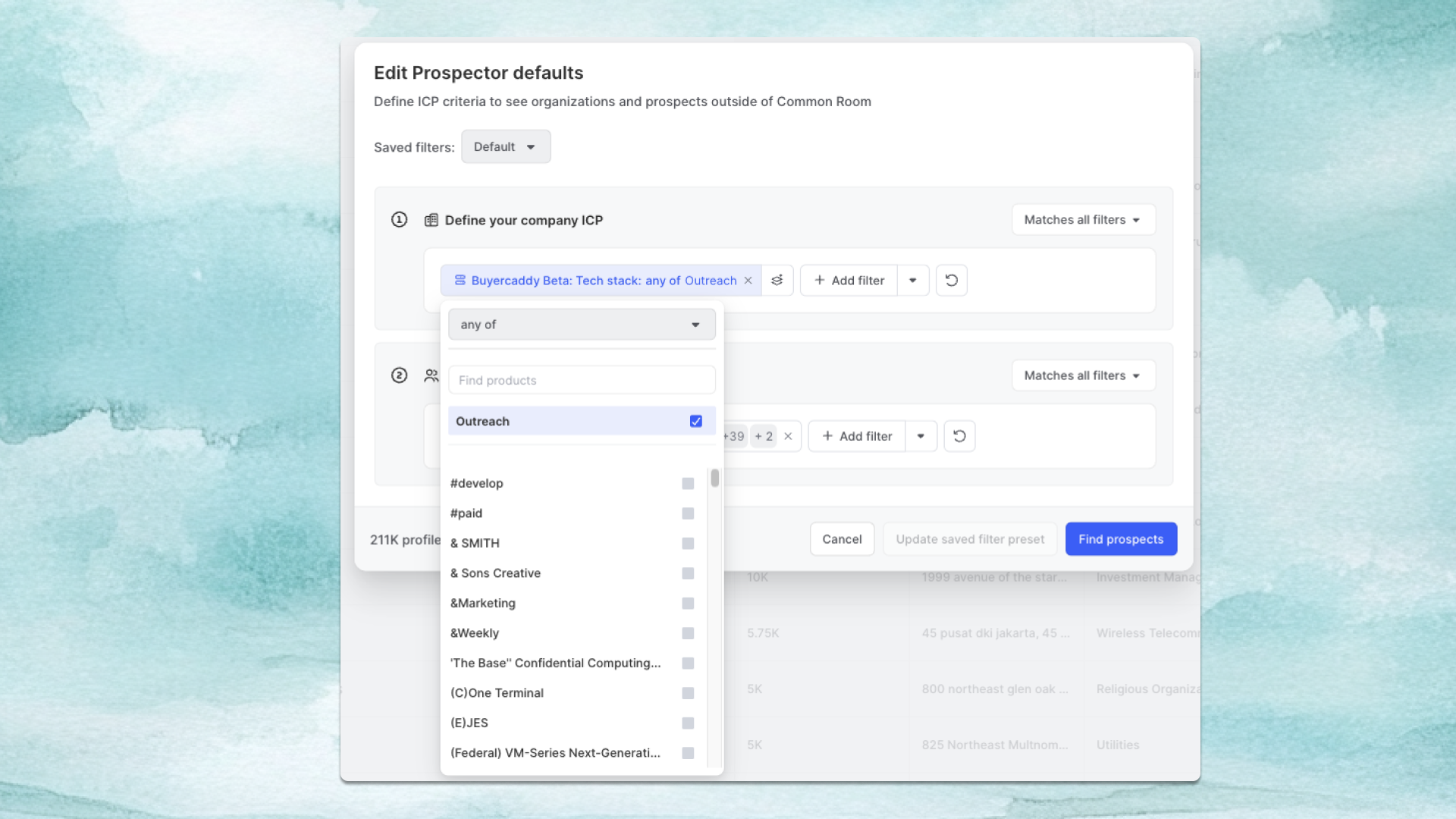
1) Technographic signals, built into Person360 and prospecting workflows
Common Room is built on Person360, our dynamic identity layer that unifies signals, interactions, and identities into a single universal profile, so teams can take action with confidence across sales and ops workflows.
With Common Room Prospector, technographics become first-class signals in that same system of record:
- Installed technologies and vendors
- Time signature of install (when it likely appeared)
- Intensity (how many verified installs we can see)
Additionally, we make sure that technographics are living inputs into segments, scoring, and orchestration into sales plays as opposed to one-off spreadsheet exercises.
2) Technographic coverage at the scale contemporary GTM needs
Our partnership with BuyerCaddy brings the following technographic coverage into Common Room:
- 180,000 products
- 92,000 vendors
- 31 million companies across 50 countries
- 10+ years of history
- Mapped to G2 taxonomy
BuyerCaddy’s approach is built to detect new products in real time, with expansive product coverage that helps teams avoid blind spots by using a combination of large-scale processing and continuous web discovery:
- LLM-based processing across 1B+ resumes, professional profiles, and job postings that uses specialized Name Entity Recognizer (NER) algorithms to detect products and vendors in unstructured text.
- AI agents and human-in-the-loop workflows that crawl web-base sources including case studies, white papers, press releases, developer forums, and even logos from vendor websites to find and process customers of a new product in real time.
Okay that’s great, how can I actually use this?
Below are the most common ways teams will use technographic signals inside Common Room, mapped to workflows we see across Sales and Ops.
1) Tighten your ICP and TAM with evidence, not assumptions
Use case: TAM / ICP exercises
Workflow: Build dynamic segments of accounts that match your “best fit stack”, then compare against your current pipe, customers, and whitespace.
How this works with Common Room:
- You can define ICP attributes based on actual tech adoption, not proxy firmographics.
- You can run “what percentage of our pipeline matches ICP stack criteria?” in minutes.
- You can keep segments continuously updated as companies adopt new tools.
Outcome: cleaner targeting, better conversion rates, fewer wasted touches.
2) Run competitive displacement plays with timing and precision
Use case: Competitive product displacement campaigns
Workflow: Identify the subset of accounts that installed a competitor, or show stack patterns that suggest vulnerability, then launch multi-touch plays across sales and marketing.
How this works with Common Room:
- You can detect adoption signals earlier, and segment faster.
- You can tailor messaging to the account’s current reality, including their likely toolchain and maturity.
- You can prioritize accounts where the “switch story” is strongest.
Outcome: higher reply rates, more meetings from the same outbound volume, better win rates against competitive deals.
3) Improve propensity scoring and prioritization with stack maturity
Use case: Client propensity scoring, tech stack maturity assessments
Workflow: Combine technographics with Common Room signals (engagement, relationships, buying group activity) to score accounts and route plays.
How this works with Common Room:
- Scores become more resilient because they are grounded in durable attributes like stack fit and maturity.
- Reps get a clearer “why this account” and “why now”, which boosts adoption.
- Ops teams can reduce manual list curation and constant model tinkering.
Outcome: better focus, higher efficiency, less operational overhead.
4) Benchmark your market position and sharpen sales narratives
Use case: Market share analysis, benchmarking competitors
Workflow: Compare product adoption patterns across segments, regions, and industries to validate positioning and arm the field with proof points.
How this works with Common Room:
- You can quantify where a competitor is most entrenched.
- You can identify segment-level patterns that inform messaging and packaging.
- You can equip reps with credible context for outreach and discovery.
Outcome: stronger campaigns, better discovery calls, clearer differentiation.
How this fits into the way Common Room customers already work
Common Room’s partnership with BuyerCaddy powers GTM execution across key GTM personas.
For Sales: better prospecting and account engagement
The job is harder than ever: personalize at scale, multi-thread into unknown buying groups, and generate predictable pipeline. The reality is fragmented tools, shallow insights, and data that goes stale.
With Common Room, technographics enhance the workflows sales teams already run in Common Room:
- Outbound prospecting: target accounts that match your best-fit stack and prioritize those with the strongest “why now”.
- Account development and multithreading: identify the right stakeholders, then engage with context that matches the account’s environment.
- Inbound engagement: qualify and route faster with technographic context alongside engagement signals.
What sales teams get: higher inbound conversion, more efficient outbound execution, deeper account engagement, more predictable pipeline.
For RevOps: stronger guardrails with less manual work
Ops teams are asked to create systems that scale, without slowing the business down. But manual workflows pile up, CRM trust drops, and scoring models degrade.
With Common Room, technographics become a durable input for:
- Continuous data hygiene: cleaner records and better alignment across systems.
- Dynamic scoring and segmentation: always up-to-date targeting without constant rebuilding.
- Sales play development: better guardrails for “who to reach, when, and why”.
- Workflow orchestration: fewer brittle rules, more confident automation.
What ops teams get: better funnel conversion, more scalable plays, reduced operational overhead.
Why this matters: signals are only useful when you can act on them
Technographic data is not new. What’s new is making technographics actionable in the same system where your GTM teams already prioritize, route, orchestrate, and execute.
Common Room’s offer enhanced technographic signals in our GTM execution platform so you can go from “interesting” to “in motion” with far less friction.
This is great, now what?
Enhanced technographics are available now, no change on your side needed. If you’re already using Common Room, your team can start building technographic segments and plays immediately. If you’re new, we’ll show you how Common Room’s Prospector fits into your prospecting, scoring, and orchestration workflows end to end.
If you’re ready to start, book a meeting and we’ll walk through:
- Your ICP stack and highest-impact segments
- Your top displacement opportunities
- A few plays you can launch this week
~and~ register for our product release webinar at the end of the month.