
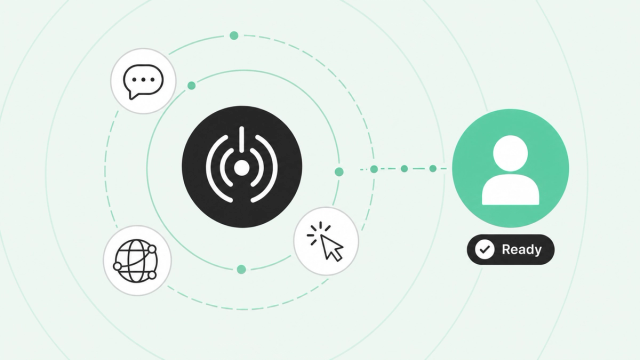
Your buyers rarely tell you they're ready to buy. According to Gartner research, B2B buyers spend only about 17% of their purchase journey with any potential supplier—and 75% prefer a rep-free experience altogether. The clearest signs of intent now show up as behavior across dozens of channels, not a handshake or a scheduled call.
That's where buying signals come in. When you know what to look for—and where—you can reach prospects at the exact moment they're evaluating options, before your competitors even know there's an opportunity.
Here are 30+ concrete examples of buying signals, organized into three categories, with guidance on what each one means and how to act on it.
Key Takeaways
- Buying signals are actions or attributes that indicate a person or account is moving toward a purchase
- They fall into three categories: verbal/conversational, behavioral/first-party, and third-party/dark-funnel
- The strongest insights come from stacking multiple signals, not reacting to any single one
- Speed matters: responding within an hour dramatically increases your odds of qualifying a lead
- Modern intent is person-level and cross-channel, which is why unified signal capture outperforms point tools
What Is a Buying Signal?
A buying signal is any action, behavior, or attribute that indicates a person or account is moving toward a purchase decision. These signals can appear at any stage of the funnel—from early research to final vendor selection—and range from explicit (a direct request for pricing) to implicit (repeat visits to your security documentation).
Buying signals are indications of intent, not guarantees. As sales consultant Richard Harris puts it, "You don't know if they're ready to buy until they tell you…look for a strong indication of intent."
It's worth distinguishing buying signals from raw intent data. Intent data—like topic searches or content consumption tracked by third-party providers—is one type of input. But buying signals are broader: they include what prospects say, what they do in your product, and what they're doing in communities, review sites, social channels, and job boards that you may not be monitoring at all.
The Three Types of Buying Signals
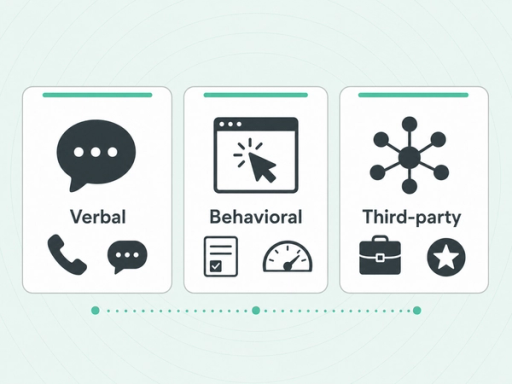
Most teams think of buying signals as what happens on their website or in a sales conversation. But that's only part of the picture. A useful framework organizes signals into three categories:
- Verbal and conversational signals — what buyers say in calls, emails, and meetings
- Behavioral and first-party signals — what buyers do in your owned channels (website, product, forms)
- Third-party and dark-funnel signals — what buyers do everywhere else: social platforms, communities, review sites, job boards, and peer conversations
Signal strength varies within each category. A pricing question in a call is stronger than a single blog visit. A job-change notification involving a former champion is stronger than a generic social like. The key is knowing where to look—and recognizing that the dark funnel is where most teams are flying blind.
Verbal and Conversational Buying Signals
These are the signals that surface when you're already in conversation with a prospect—on calls, in emails, or during demos. They're often the strongest indicators because the buyer is actively engaging with you.
Asking about pricing, discounts, or contract terms
When a prospect shifts from "tell me about your product" to "what does this cost," they've moved from exploration to evaluation. Questions about volume discounts, payment terms, or annual vs. monthly pricing suggest they're building a business case internally.
Asking detailed product, implementation, or integration questions
Questions like "how does this integrate with Salesforce?" or "what does onboarding look like?" signal that the buyer is mentally picturing your solution in their environment. They're past the "is this relevant" stage and into "how would this work for us."
Asking tough or skeptical comparison questions
"Why should we choose you over [competitor]?" may feel adversarial, but it's actually a buying signal. The prospect is doing due diligence before a decision—not casually browsing.
Disclosing pain points or dissatisfaction with their current vendor
Forrester's 2024 State of Business Buying report found that 81% of B2B buyers are dissatisfied with the provider they chose—rising to 91% among Gen Z and Millennial buyers. When prospects volunteer frustrations with their current solution, they're signaling openness to change.
Requesting a tailored demo, custom proposal, or industry examples
Generic interest is "send me some materials." Active buying is "can you show me how this works for companies like ours?" Requests for customization indicate the prospect is seriously evaluating fit.
Asking about next steps, timelines, or onboarding
These questions signal the buyer is thinking past the decision. They're already imagining the post-sale experience—a strong sign you're in the running.
Mentioning a time-sensitive or deadline-driven need
"We need something in place before Q4" or "our contract renews in 60 days" tells you there's urgency behind the evaluation. Time-bound needs often accelerate deals.
Bringing new stakeholders into the conversation
When a prospect loops in their CFO, IT lead, or legal team, they're building internal consensus. More voices in the room means the deal is being taken seriously.
Behavioral and First-Party Buying Signals
These signals come from what buyers do in your owned channels—your website, product, and marketing touchpoints. They're often the easiest to track but require you to connect the dots across sessions and personas.
Repeat visits to high-intent pages
A single visit to your pricing page might be curiosity. Three visits in a week, combined with time on your security documentation, suggests active evaluation. Patterns matter more than pageviews.
Downloading gated content
When a prospect downloads a buyer's guide, ROI calculator, or industry whitepaper, they're investing time to learn more. The type of content matters: bottom-of-funnel assets like comparison sheets or implementation guides signal closer intent than top-of-funnel thought leadership.
Filling out a form or requesting a demo
This is explicit intent. The prospect is raising their hand. But not all form fills are equal—track which forms, at what time, and from which account to prioritize follow-up.
Signing up for a free trial or freemium account
Product sign-ups indicate the buyer wants to experience your solution firsthand. For product-led companies, trial activity is one of the richest signal sources available.
Product usage spikes, hitting plan limits, or connecting new integrations
Active usage is a signal of value realization. When a user hits plan limits, integrates new data sources, or invites teammates, they're expanding their footprint—and may be ready for a conversation about upgrading.
Rapid rise-and-fall in product usage
A user signs up, goes deep for a few days, then drops off. This pattern often indicates a proof-of-concept evaluation. They were testing whether the product fits a specific use case—and you should follow up while the context is fresh.
Multiple people from the same account engaging
When you see several personas from one company visiting your site, downloading content, or using your product, that's a buying committee forming. Account-level activity is stronger than individual activity.
Positive response to outreach or repeated email engagement
A reply to a cold email is obvious. But repeated opens and clicks—especially on follow-up messages—also signal interest, even if the prospect hasn't responded yet.
Third-Party and Dark-Funnel Buying Signals
This is where most teams have blind spots. Third-party signals happen outside your owned channels—on social media, in communities, on review sites, in job postings, and through peer conversations. These "dark funnel" signals are often the earliest and most predictive indicators of intent, but they're also the hardest to see without the right infrastructure.
Job changes: a former customer or champion joins a new company
When someone who's used your product before moves to a new organization, they often bring their stack with them. Champify's 2025 research found that opportunities involving contacts with prior experience of the product win at a 37–39% rate—compared to a roughly 19% SaaS average—and convert about 6.3 times more efficiently from first touch to closed-won. Job-change signals are among the highest-converting third-party signals available.
Hiring signals: job postings revealing initiatives or tech stack
A company hiring for "Salesforce admin" or "head of product-led growth" is telegraphing its priorities. Job postings reveal budget allocation, tech investments, and team expansion—all of which can indicate readiness for a solution like yours.
Funding rounds and new leadership appointments
Fresh capital often means new initiatives, expanded teams, and infrastructure investments. New executives frequently bring new vendors. Both are triggers worth tracking.
Social engagement: prospects commenting on your posts or competitors' content
When an ICP-fit person consistently likes, comments on, or shares content from your company—or your competitors—they're signaling category interest. Social engagement is a research behavior, and engaged prospects are warmer than cold outbound lists.
Community activity: new or active members in Slack, Discord, or forums
Many B2B buyers join communities to "try before they buy." TrustRadius's 2024 report found that buyers increasingly rely on existing users and prior experience before purchasing. A non-customer suddenly active in your community is often evaluating the product through the eyes of current users.
Review-site research: G2 and peer-review activity
G2's 2024 Buyer Behavior Report found that public product review sites are now the most-consulted source for 31% of B2B buyers—up from just 13% in 2021. When a prospect views your G2 profile, reads comparisons, or checks reviews, they're in active buying mode.
Open-source activity: stars, forks, and pull requests
For developer-focused products, GitHub activity is a strong signal. A company's engineers starring your repo, forking your code, or contributing to your project often precedes commercial interest.
Peer word-of-mouth and recommendations
Buyers consult each other constantly—in Slack channels, on LinkedIn, in private DMs. You won't always see these conversations, but when someone mentions your product in a forum or asks for recommendations in a community you can monitor, that's a signal worth capturing.
How to Prioritize Buying Signals (Weak vs. Strong)
Not all signals are equal. A single page visit or social like is low-strength. A pricing inquiry combined with a recent job change and community activity is high-strength. The key is to avoid treating every signal as equally urgent—and to avoid ignoring low-strength signals entirely.
Signal stacking is the practice of combining multiple signals to build a clearer picture of intent. One signal is a data point. Two or three signals from the same person or account—across different channels—start to tell a story. For example:
- Pricing page visit + job change + community question = strong outbound opportunity
- Free trial sign-up + multiple users from same account + usage spike = expansion signal
- Competitor mention on social + G2 comparison view + form fill = high-priority inbound
The strongest reads come from stacking signals with ICP fit. A flurry of activity from a poor-fit account is noise. A single high-intent signal from a perfect-fit prospect is worth prioritizing.
When you're overwhelmed by signal volume, map your signals by strength and conversion rate. Learn which combinations actually lead to pipeline—and build your plays around those patterns.
How to Act on Buying Signals
Seeing signals is only half the equation. The other half is acting on them—quickly and contextually.
Speed to lead is critical. Research from Harvard Business Review (2011) found that firms responding within one hour are roughly seven times more likely to qualify a lead than those waiting an additional hour—and sixty times more likely than those waiting 24 hours or more. An earlier MIT/InsideSales study (2007) showed that qualification odds drop by about 21 times when calling at 30 minutes versus five minutes. The window is narrow.
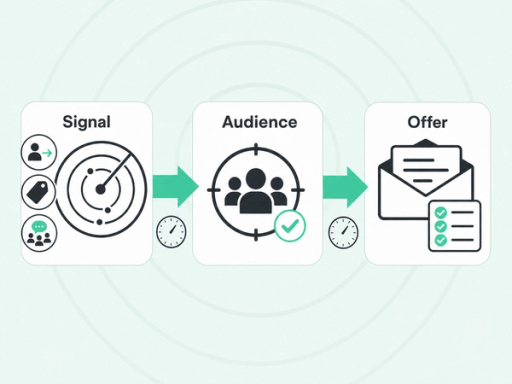
Use a signal → audience → offer framework. The signal tells you who to reach and why now. The audience defines which persona you're engaging and what they care about. The offer is your message and call to action—tailored to the signal's context. A job-change signal calls for a different message than a pricing-page visit or a product usage spike.
Personalize using the signal's context. Generic outreach wastes the intent you've captured. If you know someone visited your security docs and downloaded your compliance whitepaper, lead with that. If they just changed jobs from a customer account, reference their prior experience.
Use alerts and automation to catch signals at scale. No rep can monitor every channel manually. Automation surfaces the signal; the rep decides how to act. The goal isn't to replace judgment—it's to make sure high-priority signals don't slip through the cracks.
Treat AI as leverage, not replacement. Modern GTM tools can surface the highest-priority signals across dozens of sources and suggest next-best actions. But the rep still brings context, relationship history, and judgment. AI increases speed and coverage; humans close deals.
Frequently Asked Questions
What are examples of buying signals?
Examples include verbal cues like pricing questions and vendor dissatisfaction, behavioral signals like repeat website visits and product usage spikes, and third-party signals like job changes, G2 research, and community activity.
What is the difference between buying signals and intent data?
Intent data—such as topic searches or content consumption tracked by third-party providers—is one type of buying signal. Buying signals are broader and include verbal cues, first-party behavior, and dark-funnel activity across social, community, and peer channels.
What are verbal buying signals?
Verbal buying signals are things buyers say that indicate purchase intent: asking about pricing, requesting a tailored demo, disclosing dissatisfaction with a current vendor, or bringing decision-makers into the conversation.
Can buying signals vary between industries?
Yes. A job-change signal may be highly predictive in SaaS but less relevant in industries with lower employee mobility. Review-site activity matters more in categories with active G2 or peer-review ecosystems. Calibrate to your market.
How fast should I respond to a buying signal?
As fast as possible. Research shows that responding within an hour makes you roughly seven times more likely to qualify a lead than waiting two hours, and responding within five minutes is even better.
How do I know if a buying signal is genuine?
Look for signal stacking: multiple signals from the same person or account, across different channels, combined with ICP fit. A single low-strength signal may be noise. A pattern of signals tells a story.
The teams that win in modern GTM don't wait for buyers to raise their hand. They see the full picture—verbal, behavioral, and dark-funnel signals—at the person level, unified across every channel. And they act fast.
If you're ready to stop missing buying signals and start reaching the right people at the right time, request a demo to see how Common Room can help.