
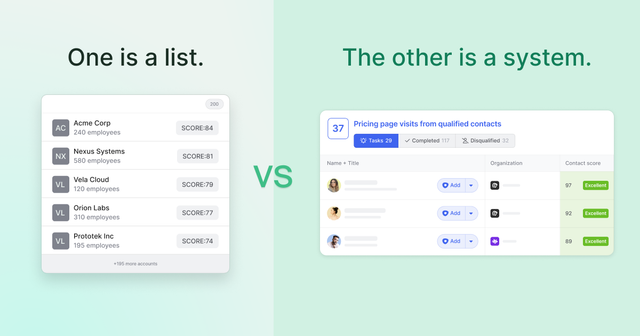
Your sales team has a Tier 1 account list with 150 to 300 accounts on it. And at any given moment, maybe 15 of them are actually worth calling this week.
The other 135? They fit your ICP and scored well in your model. But none of them are showing any signs of active evaluation.
Most teams treat the whole Tier 1 list as the priority list. Then wonder why reps are busy, but pipeline stays thin.
Account prioritization is the ongoing process of analyzing and ranking target accounts by fit, timing, and momentum so go-to-market (GTM) teams know which accounts to work, when to work them, and why now.
It's not just ranking accounts by company size, employee count, industry, or budget. It's deciding which right accounts deserve attention today because their behavior says they're active.
In GTM, flat headcount, rising quotas, longer buying committees, and digital buying behavior mean sales and marketing teams can't afford wasted effort on quiet logos. Account prioritization ensures teams spend time on leads most likely to generate high revenue, not just accounts that looked good in last quarter's spreadsheet.
This guide breaks down what a real account prioritization process looks like, why static scoring models keep failing GTM teams, and how signal-based prioritization actually works and changes how reps spend their time.
What is account prioritization?
Account prioritization is the process of determining which target accounts your sales team should focus on right now, based on their likelihood to convert or expand.
The key phrase is right now. Not which accounts could buy eventually, or which accounts look good on paper. Which accounts are showing real buying behavior at this moment and deserve your reps' time and attention before the window closes.
A strong account prioritization process answers three questions:
- Where should sales efforts be focused this week?
- Which accounts are most likely to move?
- What signal tells us it's time to engage?
Account prioritization vs. list building: what's the difference?
List building identifies which companies match your ideal customer profile. Tools like Clay, Apollo, or ZoomInfo help you generate a list of accounts that could be good fits based on firmographics, technographics, and company data.
Account prioritization is what happens after that. It ranks those accounts based on who is actually in market right now, using real-time buyer intelligence and buying group activity. It tells you which 15 of those 300 accounts your rep should contact this week and why.
Lead scoring is also related but different: lead scoring evaluates individual contacts based on demographic fit and behavioral signals.
Account prioritization operates at the company level by assessing organizational fit, buying signals, and multiple people from the same account showing up at once. One is about a person. The other is about momentum at an account.
Why most teams get account prioritization wrong
ICP fit doesn't tell you when
ICP fit answers: could this company buy from us? It doesn't answer: is this company buying now?
Two accounts can match your ICP perfectly and behave completely differently. One is three weeks from a budget conversation. The other just renewed with a competitor. Your scoring model sees them as equals. Your rep finds out the hard way.
Firmographic scoring goes stale fast
Firmographic data changes while your scoring model stays polite and motionless. The account you scored as Tier 1 in January looks identical in your CRM in April (even if their VP of Sales just left, hiring froze, and product usage dropped 40%).
Zombie Tier 1 accounts don’t just happen. According to Cognism, 30% of B2B firmographic data becomes stale each year. Your model just hasn't gotten the memo.
Quarterly list reviews are theater
Ops exports the list and leadership reviews it. Reps re-tier. Approvals drag on, lists get uploaded, sequences get built. By the time your Q2 list is live, the buying window at your highest-intent accounts may have already closed.
The list isn't wrong. It's just not current. Those are very different things.
The missing input: buyer intelligence
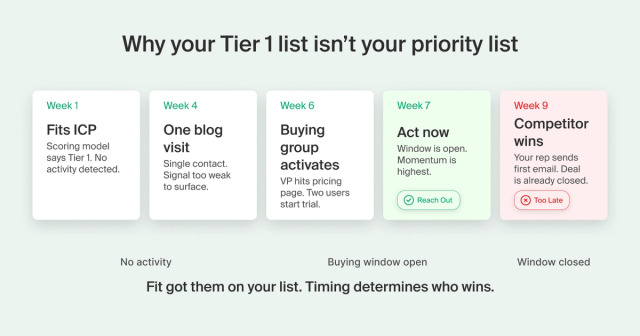
The best account to work is a good fit showing real buying behavior right now.
That requires buyer intelligence: a continuously updated view of what's actually happening at an account across every channel. Not a quarterly snapshot, or an intent score from a third-party network. A complete, person-level picture of who's engaging, what they're doing, and how that activity is changing over time.
How to prioritize accounts: fit + buyer intelligence + buying group momentum
1. Use ICP fit as a filter, not a score
ICP fit still matters, as it eliminates accounts that can never convert. But once an account clears that bar, fit alone can't tell you where to direct sales efforts. Use it to remove accounts that won't convert. Don't spend a month debating whether a company is an 82 or an 84.
2. Layer in first-party buyer signals
First-party data (activity on your own properties) is the highest-fidelity buyer intelligence you have. These are opted-in behaviors that reflect genuine interest. Some thresholds worth tracking:
- 3+ pricing page visits within 7 days
- 50%+ increase in active users over 14 days
- Dormant account reactivated after 90+ days
- Multiple stakeholders from the same account engaging with sales or marketing content in the same week
First-party signals deserve more weight than third-party intent because they're closer to purchase behavior.
3. Track the buying group, not just one contact
One person clicking an email is curiosity. Three people from the same account engaging across different roles in the same week is momentum.
Most account scoring models operate at the account level, which means they miss buying group dynamics entirely. When several people start engaging independently, that pattern is worth acting on immediately. Buyer intelligence that resolves identity to the person level is what makes this visible.
4. Evaluate recency, frequency, and depth, then apply signal decay
Three pricing page visits in the last four days should outrank a webinar registration from six weeks ago. Give signals from the last seven days roughly three times the weight of signals from 30 to 60 days ago. Decay anything older unless there's ongoing engagement that suggests a live evaluation.
5. Think in priority bands, not just tiers
Static tiers describe fit. Priority bands describe timing. The more useful question for a rep isn't which tier an account is in, it's whether to work it today, this week, or this month.
| Priority band | What it signals | What reps do |
|---|---|---|
Today | Multiple stakeholders engaged in last 48 hrs; pricing page visited; trial activity spiked | Immediate outreach: timing window is open now |
This week | 1-2 contacts engaged in last 7 days; single high-intent signal (pricing, demo, usage spike) | Personalized outreach within 2-3 days while momentum holds |
This month | Fits ICP; some engagement in last 30 days; no strong urgency signal yet | Monitor and nurture, act when signals intensify |
Accounts should move between bands as buyer intelligence changes. If no new activity appears for 30+ days, that account should free up capacity for accounts that are actually moving.
Static vs. intelligence-driven prioritization
Most account prioritization models were built for a world where data moved slowly, and buying happened in predictable stages. That world is gone.
The traditional approach: a Tier 1 list gets built quarterly, outreach runs on sequences and rep cadence, and visibility into real account activity is limited to whatever made it into the CRM. Reasonable for the information available. The information just isn't good enough anymore.
An intelligence-driven approach changes the inputs and the motion. Accounts are dynamically ranked based on fit and live buyer intelligence. Outreach is triggered by real engagement from real, identified people. And the system updates continuously, not at the next quarterly review.
| Traditional approach | Intelligence-driven approach | |
|---|---|---|
How accounts are ranked | Tier 1 list built quarterly, ranked by firmographic fit | Dynamically ranked based on live buyer intelligence + fit |
Outreach trigger | Sequence cadence and rep initiative | Triggered by real engagement from real, identified people |
Signal coverage | Limited: what's in the CRM | Complete: first-party data and external signals are unified |
Buying group visibility | Account-level scoring only | Person-level: who's engaging, what role, how often |
How it updates | Quarterly review cycle | Continuous: as new buyer intelligence comes in |
Where AI fits in
AI is what takes account prioritization from manual and inconsistent to scalable and continuous.
With the right foundation, AI can:
- Continuously rank accounts as new buyer intelligence comes in, no manual re-scoring required
- Surface high-priority opportunities before they hit a rep's radar
- Recommend next best actions based on what's actually happening at each account
- Trigger outreach workflows automatically when accounts hit priority thresholds
But AI only prioritizes as well as the intelligence underneath it. Feed it stale data and it'll confidently tell you to prioritize the wrong accounts. It doesn't know that the intent spike is from an intern. It doesn't know the champion left. It doesn't know the account went cold three weeks ago.
Quality buyer intelligence in. Effective AI out.
The foundation that makes AI work: identity resolution that connects every signal to a real person and account, unified first-party and external data, and continuous enrichment so buyer intelligence stays current as people change roles and buying windows open and close.
How Common Room does this
Common Room is built on the premise that account prioritization is only as good as the buyer intelligence underneath it.
Common Room unifies first-party customer data (product usage, CRM activity, web behavior, marketing engagement) with real-world buyer signals into a continuously updated system of complete and trusted buyer intelligence. AI-powered identity resolution connects every signal to real people and accounts, not anonymous visitors or duplicate records. AI waterfall enrichment keeps that intelligence current as buyers change roles, teams change, and markets shift.
On top of that foundation, AI agents continuously prioritize accounts, surface the ones showing real buying momentum, and deliver them to reps with the context they need to act: in Salesforce, Slack, email, or wherever your team already works. Not a dashboard to check. A system that tells you what to do next.
The result is prioritization that reflects what's actually happening with your buyers right now, not what was true when someone last refreshed the list.
Stop guessing. Start prioritizing.
If your sales team is working off a ranked list that gets refreshed once a quarter, you're not prioritizing accounts. You're guessing on a schedule.
Real account prioritization is a continuous system that's built on complete buyer intelligence, tracks the buying group, and surfaces the right accounts to your reps before the window closes. Which, for the record, it will.