
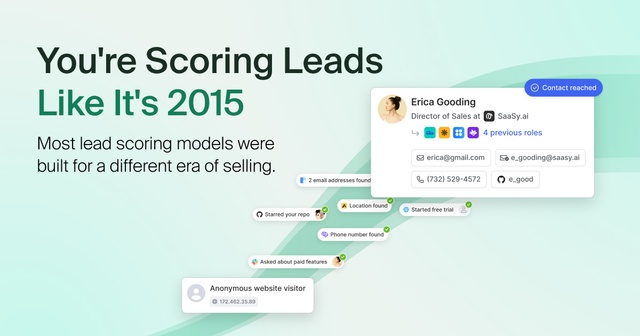

Most lead scoring models were built for a different era of selling.
Company size. Industry. Job title. Revenue band. Geography. Maybe a few firmographic overlays if someone got ambitious about it one afternoon and never revisited it.
The logic made sense when that was the best data available. If you couldn't see inside an account, you scored what you could see from the outside and hoped the pattern held.
But PLG companies have something that didn't exist when those models were designed.
They can see inside the account.
They know how many people are using the product. Which features they've adopted. How deeply the product is embedded in daily workflows. Whether usage is growing or stalling. Whether one power user is carrying the whole team or whether adoption is spreading on its own.
That data is sitting right there. And most companies are still scoring leads like it isn't.
The problem with scoring from the outside in
Firmographic scoring isn't useless. Company size and industry tell you something real about fit. A 5,000-person financial services firm is a different opportunity than a 12-person startup, and your model should know that.
But fit is not intent. And intent is not timing.
A company can be a perfect fit on paper and have no buying motion happening right now. They can match your ICP exactly and still be two years away from a conversation—happily using your free tier, never once thinking about enterprise pricing.
Firmographic scoring tells you who could buy. It tells you almost nothing about who is ready to buy.
That gap is where pipeline gets wasted.
Reps work accounts that look great on paper and go nowhere. High-fit companies sit in sequences for months with no response. The scoring model keeps surfacing the same names because the underlying data never changes - company size doesn't move, industry doesn't shift, the firmographic profile looks identical whether the account is actively evaluating or completely dormant.
Meanwhile, somewhere in your product, an account just had three executives sign up in the same week. Another one just hit a usage threshold that in your best deals has always preceded an enterprise conversation. Another one has eight different teams using the product independently and nobody has ever talked to them about consolidation.
Those signals are dynamic. They change every day. And a firmographic model will never surface them.
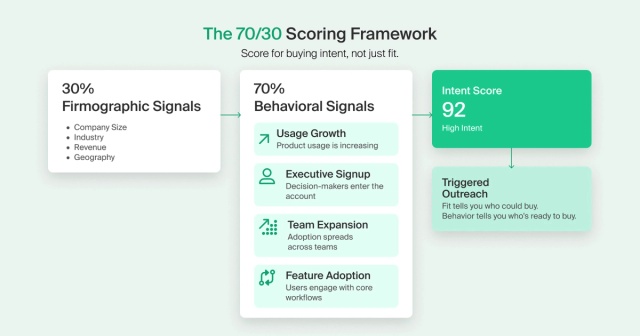
What 70/30 actually means in practice
When Otter AI rebuilt their scoring model, they flipped the ratio that most companies use.
Seventy percent behavioral. Thirty percent firmographic.
That sounds like a small adjustment. The implications are not small.
It means the primary question is no longer "does this company look like our customer?" It's "is this account doing the things that our best customers did right before they bought?"
Those are very different questions. And they produce very different lists.
Behavioral signals that actually predict conversion tend to cluster around a few categories.
- Depth of usage - not just whether someone is using the product, but how deeply it's embedded. Are they using advanced features? Have they built workflows around it? Is it something they'd notice if it disappeared tomorrow?
- Breadth of adoption - how many people inside the account are using it, and how is that number moving? A single power user is interesting. Three teams using it independently is a buying signal. Ten people added in the last two weeks is a trigger.
- Expansion patterns - accounts that are growing their usage without being asked are telling you something. They're showing you intent through behavior rather than words. Words lie. Usage data doesn't.
The specifics vary by product. But the principle holds everywhere: what people do inside your product is a more honest signal than any demographic proxy for what they might do next.
The scoring model most companies actually need
Good behavioral scoring isn't just about adding product data to an existing model. It's about rebuilding the model around a different question.
Start with your closed won deals from the last 12 to 18 months. Not your full customer base - your recent closed won deals, where you have the clearest signal about what a conversion actually looks like.
Map the behavioral patterns that appeared in those accounts in the 30, 60, and 90 days before the deal closed. What was usage doing? What signals fired? What changed in the account that preceded the conversation?
Then look at your closed lost deals from the same period. What did those accounts look like behaviorally? Where did the pattern diverge from your wins?
That analysis gives you the behavioral signature of a ready account - not a theoretical one, but one derived from your actual revenue data. It's not perfect. But it's significantly more honest than a model built on demographic proxies that haven't been revisited since someone built them in a hurry before a board meeting.
The list that changes everything
Here's what shifts when you get this right.
Your rep opens their prioritization list on Monday morning. Instead of a ranked list of companies that fit a demographic profile, they see accounts that are actively doing something - accounts where something changed in the last week that makes now the right time to reach out.
An executive just signed up and recorded three meetings in their first two days.
A team that's been self-serve for eight months just added five people in the last week.
An account with two separate paid workspaces just hit the usage threshold where consolidation conversations always land.
Each of those is a triggered play, not a cold outreach. The rep isn't guessing about relevance. The signal is telling them why this account, why now.
That's what behavioral scoring unlocks. Not just better prioritization - a fundamentally different kind of outreach, one that starts from something real rather than something assumed.
The accounts are already in your product.
The signals are already firing.
The only question is whether your scoring model is built to see them — or whether it's still asking the wrong question.
Next in the series: the five signal-based plays every PLG company should be running - and how to automate them end to end.