

Yesterday I was talking to the team at Northflank.
They're a developer platform that had done everything right on the PLG side. Self-serve. Strong product. 20x traffic growth in 18 months. Ninety percent inbound.
And they'd just walked away from an enrichment tool they'd invested in because it kept targeting the wrong people—the data was bad, the personas were off, and Outreach was going to contacts that looked right on paper but had nothing to do with how Northflank actually sold. Pipeline was thin, and deals weren't moving.
They weren't describing a sales problem. They were describing an ideal customer profile (ICP) problem—which is a more expensive problem—because you can optimize a bad sales process, but you can't optimize your way out of talking to the wrong people.
The assumption that breaks enterprise sales
Most companies define their ICP early, usually before they have enough data to do it right.
They look at their first customers. They talk to the people who championed adoption. They build personas around the users who are most engaged. They put it in a deck, present it to leadership, and call it done.
And then they go sell to those people at scale.
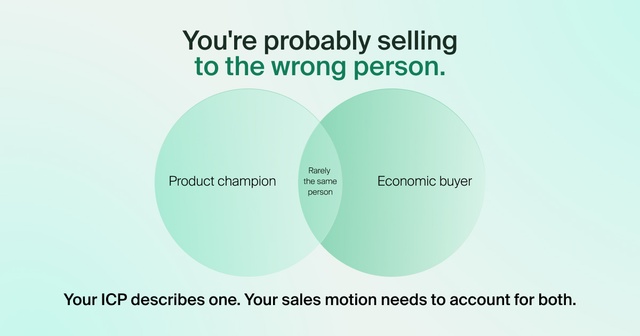
The problem is that in enterprise deals, the person who owns implementation and the person who owns budget are almost never the same. The person who loves your product rarely controls the contract. And the person who controls the contract often barely knows the product exists; they just got tagged in a Slack message three weeks ago asking if it was okay to expense it.
Otter AI discovered this when they finally did the analysis properly.
Their users were everywhere: executives, managers, individual contributors across dozens of departments. But when Colin Netal's team went back through every closed enterprise deal and mapped who actually signed, a different pattern emerged.
The Head of IT was closing large contracts; not for IT, but on behalf of other departments. They weren't the champions. They were the buyers. Two completely different roles, two completely different conversations, almost never the same person.
That single insight changed how they built their entire outbound motion.
Northflank found something similar. The developer persona that drove their self-serve growth wasn't the same person who owned enterprise contracts. Once they started tracking the right signals—five or more service deployments, specific infrastructure patterns, account-level usage depth—the picture of who they were actually selling to shifted completely.
What win-loss analysis actually looks like when you do it right
Most companies run win-loss as a post-mortem. Reactive, anecdotal, and designed to surface the patterns that are easy to explain rather than the ones that are actually true.
The version that changes how you sell looks different.
You pull every closed deal, won and lost, across a meaningful time period. Not just whether you won or lost, but deal velocity, ACV, industry, company size, geography, the job titles involved, and the departments that ended up owning the contract.
Then you look for patterns across all of it simultaneously.
Which industries close fastest? Which company sizes produce the highest ACV? Which job titles show up in the deals you win vs. the deals you lose? Where does the deal slow down, and who gets added to the conversation right before it stalls?
That last question is the one most companies skip. The person who gets added right before a deal stalls is often the person you should have been talking to from the beginning. They weren't in the room because nobody thought to put them there. They showed up because someone finally realized nothing was going to move without them.
The three things good ICP analysis actually tells you
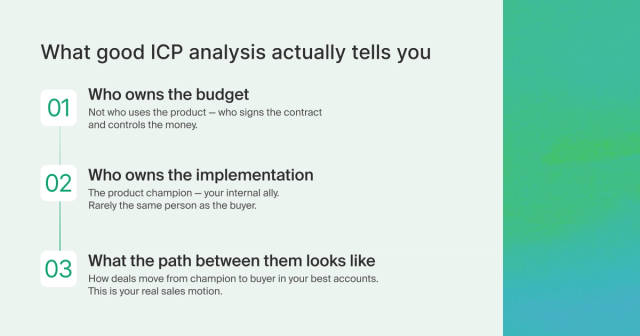
Who owns the budget. Not who uses the product. Not who loves the product. Who signs the contract and where the money comes from. In PLG companies this is almost always further from the product than you expect, and further from the people you've been talking to.
Who owns the implementation. The person who champions adoption internally, manages the rollout, and becomes your long-term relationship inside the account. This person matters enormously but they're rarely the same as the buyer, and treating them like they are is one of the most common mistakes in PLG + SLG motions.
What the path between them looks like. How do deals move from product champion to economic buyer in your best accounts? How long does it take? What triggers the conversation? Who introduces whom? This is your actual sales motion. Not the one in your playbook, the one that shows up in your data.
Most ICPs describe a single person. The ones that actually work describe a system.
The shortcut that isn't
I've talked to a lot of companies that have skipped this analysis because they think they already know their ICP. They've talked to their happiest users. They've looked at their logo list and pattern-matched from there. That's not ICP definition. That's confirmation bias with a spreadsheet.
The Northflank story is instructive here. They had a tool. They had data. They had outreach running. But because the underlying ICP was wrong, none of it was pointing at the right people. No amount of sequence optimization, no amount of messaging testing, no amount of rep coaching fixes a targeting problem. You have to go back to the source.
The deals that close fastest are rarely the ones that feel most obvious in advance. The buyers who move quickly are often not the ones you'd have targeted first. The signals that actually predict conversion are almost never the ones you'd have guessed.
The companies that build durable enterprise businesses from a PLG foundation do the work. They treat their own closed revenue as a data set. They look at what actually happened, not what they assumed was happening.
And more often than not, they discover they've been selling to the wrong person. The right one was in the account the whole time. They just didn't have the data to see it.
The right one was usually in the account the whole time.
Next in the series: why firmographic scoring fails at scale, and how to build a behavioral model that actually predicts who's ready to buy.