There's a version of the RevOps leader that nobody aspires to be.
They're the person every new workflow has to go through. The one whose Slack is a queue of requests from sales, marketing, and CS, all waiting on something they need before they can move. The one who shows up to the quarterly business review having spent the last 90 days maintaining systems instead of building them. The one who is, by every objective measure, indispensable, and miserable about it.
This is the gatekeeper. And in the age of AI, the risk of becoming one has never been higher.
AI scales fast, and without the right governance model underneath it, the natural response is to centralize control. Approve the workflows. Own the data. Review the outputs. Keep a hand on everything so nothing goes sideways.
It's a reasonable instinct. It's also a trap.
The problem with controlling everything
Here's what happens when RevOps tries to govern AI by owning every decision.
The requests come in faster than they can be processed. Sales wants a new scoring model. Marketing wants a new segment. The SDR team wants a new sequence trigger. Each one is reasonable. Each one requires someone who understands the data model, the integration layer, and the downstream effects of changing something in a system that seventeen other things depend on.
So they wait. And while they wait, they build workarounds. A spreadsheet here. A manual process there. A Zapier workflow that nobody documented and that will break quietly in six weeks when someone changes a field name in Salesforce.
The irony is that the RevOps leader trying to maintain control ends up with less of it. The official system becomes one of many systems. The governed workflow becomes one of many workflows. And the team that was supposed to be the source of truth becomes the source of delay.
The instinct to fix this by buying another tool runs into the same wall. More interfaces don't solve a trust problem. Another dashboard that centralizes access rather than distributing intelligence just creates a different kind of bottleneck. What breaks in most GTM stacks isn't a lack of interfaces, but rather a lack of trusted intelligence underneath the ones teams are already using.
This is the gatekeeper trap. And it has nothing to do with competence. It's a structural problem that gets worse as AI makes execution faster and governance slower.
The answer isn't less governance. It's a different kind of governance entirely.
What good governance actually looks like
The mental model most RevOps leaders are working from is approval-based. Someone wants to do something, they ask, RevOps reviews it, RevOps approves it or doesn't. This works at small scale. It collapses when the volume of decisions outpaces the bandwidth of the people making them.
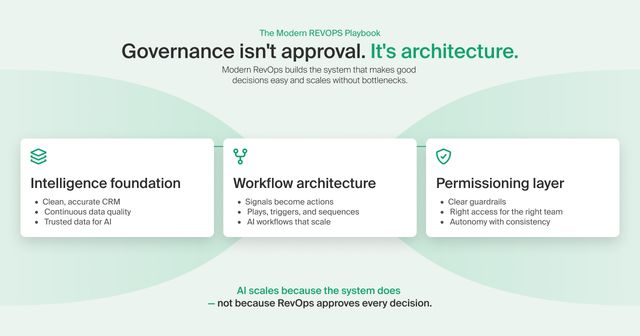
The mental model that scales is system-based. RevOps doesn't approve every decision. RevOps builds the system that makes the right decisions obvious and the wrong ones hard to make by accident.
The distinction sounds subtle. The operational difference is enormous.
In an approval-based model, RevOps is in the critical path of every workflow. Nothing moves without them. In a system-based model, RevOps designs the rails. Defines the scoring logic. Sets the permissioning. Establishes what good looks like and builds it into the platform so reps and managers can execute within it without needing to ask permission first.
This is what governance without gatekeeping actually means. Not abdicating control. Distributing it intelligently, with guardrails that ensure consistency without requiring centralized approval for every action.
The teams that have figured this out share a specific belief: standardization and autonomy are not opposites. You can have both. You just have to build the system that makes them compatible.
The three things modern RevOps actually owns
When governance shifts from approval-based to system-based, the RevOps leader's job changes. Not in scope. In nature.
The work stops being reactive maintenance and starts being intentional architecture. Three things sit at the center of it.
1) Intelligence foundation
Before any AI workflow runs, someone has to make sure the data underneath it is trustworthy. This is RevOps. Not enrichment as a one-time project, but continuous data quality as a system responsibility. Who's monitoring for duplicate records? Who's flagging contacts that have changed jobs? Who's making sure the CRM reflects reality closely enough that an AI agent pointed at it produces useful output instead of fast, confident mistakes?
This isn't glamorous work. It's also the work that determines whether everything else in the GTM stack functions. A scoring model built on bad data ranks the wrong accounts. A personalization agent built on stale contacts writes to the wrong people. The intelligence foundation is the thing all of it runs on, and RevOps owns it.
2) Workflow architecture
AI doesn't create consistency. Systems create consistency. The RevOps leader's job is to design the plays, define the triggers, map the sequences, and build the logic that turns buyer signals into rep actions without requiring a human to notice the signal and decide what to do about it manually.
This is where most RevOps teams are still operating below their potential. The workflows exist. The triggers are configured. But they weren't designed as a system. They were added one at a time, in response to requests, without a governing architecture that says here's how signals become actions across every motion we run. The result is a collection of workflows that each work individually and don't add up to anything coherent.
Modern RevOps builds the architecture first. The individual workflows are expressions of it, not exceptions to it.
3) Permissioning layer
This is the one that unlocks everything else. If the data is trustworthy and the architecture is sound, the question becomes who can do what inside the system. Not as a way to restrict access, but as a way to make execution safe enough to distribute.
Sales leaders can build plays within the architecture RevOps designed. SDR managers can adjust sequences within the parameters RevOps established. Marketing can activate segments within the data model RevOps governs. Everyone can move faster because the guardrails are built into the system, not enforced through an approval queue.
This is the governance model that doesn't create gatekeepers. It creates a system that makes the right behavior the easy behavior, and makes the wrong behavior hard to do by accident.
Why AI makes this more urgent, not less
Everything described above was true before AI. The difference is that AI makes the cost of getting it wrong much higher and the window for fixing it much shorter.
Without AI, a bad workflow produces bad output slowly. A rep working from a stale list calls the wrong people. A campaign built on a bad segment underperforms. The feedback loop is slow but it's legible. Something isn't working, you find it, you fix it.
With AI, a bad workflow produces bad output at scale, confidently, and fast. An agent built on a fragmented data model doesn't occasionally surface the wrong account. It surfaces the wrong account for every rep, in every territory, on every session, until someone notices and shuts it down. The volume of damage that can accumulate before the feedback loop closes is orders of magnitude higher than it was in a manual world.
This is why governance matters more in an AI GTM stack than it ever did in a traditional one. Not because AI is inherently risky. Because AI is inherently fast, and speed without structure doesn't produce better outcomes. It produces worse ones, faster.
The RevOps leader who builds the governance model before scaling the AI motion doesn't just avoid the downside. They unlock the upside. When the foundation is trustworthy and the architecture is sound, AI actually works the way the demos promised it would. Prioritization reflects reality. Personalization lands. Follow-up happens at the right moment for the right reason.
That's not the experience most GTM teams have had with AI. It's the experience the ones who got the governance right are having now.
The Revenue Control Plane: governance as a product
This is the model Common Room was built around, and it's worth being direct about what it means in practice.
The Revenue Control Plane is the centralized layer where revenue architects, the RevOps leaders, the system owners, the people responsible for how the GTM motion actually runs, design, govern, and scale AI-native workflows across the business. It's not a dashboard. It's not a reporting layer. It's the system that makes governance a product instead of a process.
Inside it, RevOps defines the scores. Builds the plays. Deploys the agents. Configures the permissioning that determines what sales can do, what marketing can do, what an SDR manager can adjust without opening a ticket. And then it runs. Not because someone is watching every output, but because the architecture makes the right behavior the default.
The result is a GTM motion that scales without RevOps becoming the bottleneck. New plays get deployed in hours, not weeks. New segments get activated without a data request. New scoring models get tested without a six-week implementation cycle. And critically: none of it requires reps to work somewhere new. The plays surface in Slack. The signals flow into Salesforce. The briefs arrive in the browser extension when a rep pulls up an account in their CRM. The AI assistants reps are already using get the same buyer intelligence the platform runs on. Through all of it, the governance holds, because it's built into the system rather than enforced through human review.
This is what moving from AI experimentation to AI production actually looks like. Not more tools. A control plane that makes the tools governable.
The RevOps leader's actual job in an AI GTM world
Here's the reframe that matters.
The RevOps leader who governs by approving everything is a bottleneck by design. The RevOps leader who governs by building systems is a multiplier.
The first version of the job is reactive. Someone needs something, they ask, RevOps responds. The second version is architectural. RevOps designs the system that lets everyone else move without asking.
Both feel like control. Only one actually is.
The modern RevOps playbook isn't about doing more. It's about building systems that make the right execution automatic, the wrong execution difficult, and the entire motion legible enough that when something breaks, you can find it before it scales.
That's governance. Not gatekeeping.
The difference is what you build when nobody's watching.
Common Room's Revenue Control Plane gives RevOps leaders the centralized governance layer to design, deploy, and scale AI-native GTM workflows without becoming the bottleneck. If your AI motion is scaling faster than your ability to govern it, that's usually where to start.