
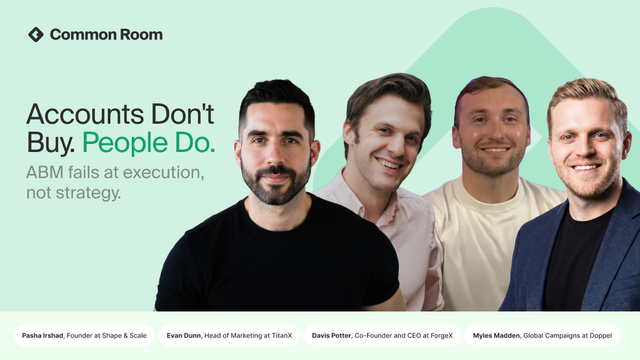
Account-level intent can tell you a company is in-market. It can't tell you who's buying. Four ABM operators on why person-level signals are the difference between a target account list and actual pipeline.
Most ABM programs can tell you which companies are in-market. Far fewer can tell you the thing reps actually need to know: who inside those companies is showing buying signals, and why.
Your ABM platform says an account is "in-market." Great. Now what?
Someone at a 4,000-person company read a blog post. Your reps still don't know who to call, what they care about, or whether the person researching is an intern or the VP who owns the budget. So they guess, and the outreach reads like it.
This is the pattern we hear most from GTM teams: account-level visibility, person-level blindness. The accounts are right. The execution stalls anyway, because accounts don't buy. People do.
The comfortable lie inside "account-based"
The classic ABM playbook treats an account like a single customer: pick target accounts, run air cover, watch account-level intent climb, then hand sales a "marketing qualified account." The model assumes the account moves through awareness, consideration, and decision as one unit.
It doesn't. Large companies aren't monolithic. They have multiple business units, and each unit has its own buying group with its own needs, priorities, and decision process. One business unit can be ready to buy while another is still researching. Gartner puts the typical B2B buying group at 6 to 10 stakeholders, and each of those people gathers their own information and forms their own opinion.
An account-level score compresses all of that into one number. It can tell you the building is warm. It can't tell you which floor, which team, or which person. And that gap is exactly where ABM programs stall: sales gets an "engaged account" with no idea who inside it is actually driving the evaluation.
Four operators who have run this playbook explain the shift to person-level, and what changes when reps can finally see the buyer.
"We forgot accounts don't buy, people do" (Myles Madden, Doppel)
Myles Madden ran headfirst into the ceiling of account-level ABM, and he's candid that the industry did it to itself.
"ABM failed because we forgot accounts don't buy, people do."
-- Myles Madden, Global Campaigns at Doppel
For years, he argues, the industry over-rotated on "account-level" everything: teams stopped caring about leads, stopped thinking about individuals, and blasted messages at entire companies hoping something would stick. Meanwhile, the people inside those buying committees were all at different stages: different levels of problem awareness, different understanding of the solutions, different priorities, and different potential to become champions.
He includes himself in the diagnosis: he was so focused on "moving the account forward" that he forgot about the humans making the decisions.
One person doesn't equal one opportunity (Davis Potter, ForgeX)
Davis Potter names the structural flaw underneath all of this: ABM treats an account as one entity when it's really a shifting group of people with different priorities.
When you treat the account as a single unit, you miss that one buying group can include eight people with completely different concerns, and that contact-level signals are what tell you who's actually engaged versus who's just along for the ride.
"One person doesn't equal one opportunity. Real pipeline comes from understanding the people behind the accounts, not just the accounts themselves."
-- Davis Potter, CEO of ForgeX
His conclusion: the best ABM strategies track first-party engagement signals from every individual in the buying group. Do that, and the account "score" stops being an abstraction and becomes a list of real people at real stages, which is something a rep can actually work.
Why person-level is finally possible (Evan Dunn, TitanX)
If person-based is so obviously better, why did everyone build account-based? Because until recently, person-level was operationally impossible at scale. Nobody could research and personalize for every individual in every buying group by hand.
Evan Dunn's take is that the constraint just broke:
"I don't think ABM really worked until LLMs entered the picture. The whole game is context at scale. That wasn't possible with firmographic targeting alone."
-- Evan Dunn, Head of Marketing at TitanX
Combine strong data vendors, person-level signals, and LLMs, and teams can now tell rich, accurate stories for every buyer, programmatically. The right message for the right person stops being a manual craft project and becomes a repeatable motion.
Target the twenty, not the thousand (Pasha Irshad, Shape & Scale)
Pasha Irshad pushes the same logic into targeting. Revenue, company size, and generic demographics are yesterday's data points: they tell you who could be a fit, not when a buyer is ready to move. Real-time signals do: a job change, a new funding round, a key hire. These shifts say more about a company's priorities than any static list.
"The teams that win are not the ones blasting outreach to thousands of companies, or even one hundred target accounts. They are the ones prioritizing the twenty that are showing buying signals right now."
-- Pasha Irshad, Founder at Shape & Scale
The takeaway: see the buyer, not just the building
Put the four together and the argument is hard to unsee:
- Account-level ABM broke because it ignored the humans inside the buying group (Myles).
- Real pipeline comes from tracking engagement person by person (Davis).
- The technology to do this at scale finally exists (Evan).
- Prioritization should follow real-time, person-level buying signals, not static lists (Pasha).
Account-based was step one. It answered "which companies?" It never answered "which people, and why now?" The teams generating pipeline from ABM today are the ones who can see the buyer, not just the building they work in.
That's the gap Common Room's approach to ABM closes: capture buying signals from every channel (web, product, community, social, hiring), resolve them to real people with Person360, and route reps to the right person with full context, not just an account name and a guess.
See what's possible with Common Room
- Person-level signal capture: know who inside a target account is showing intent, not just that "the account" is warm.
- Identity resolution: unify scattered signals into one person, one profile, one clear next step.
- Prioritized action: reps work the right people at the right accounts with context, instead of guessing from a static list.
<aside>
🚀
Want to see the people behind your account scores? Request a demo of Common Room.
</aside>