

A year ago, every GTM conversation I had started the same way. How do we become agentic? Where do we deploy agents? Which workflow goes first?
That question got answered. Fast.
Adoption is here. Agents research accounts, draft emails, score leads, summarize calls, and route inbound before anyone has finished their coffee. Some teams went agent happy. That's fine. It's how you find out what works.
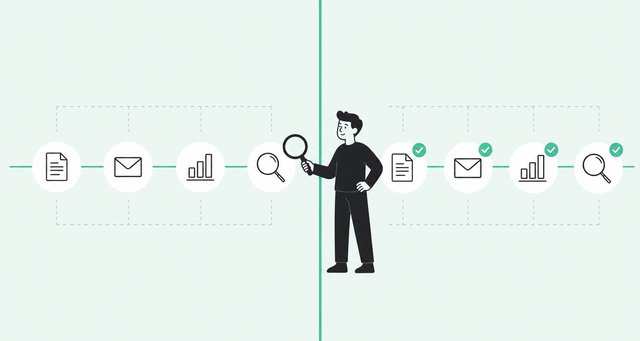
But today, we're still asking the wrong question. The question isn't where you deploy your agents anymore. It's where you deploy your humans.
And the answer is the same on every team: at the judgment line.
Execution got cheap. Judgment didn't.
A weekend and an API key now buys anyone a working agent. Every one of them produces an output in seconds, and for a lot of teams that output has become the finish line.
In reality, an agent's output is just the qualifying round.
The real question is whether the output is right, and AI is very good at sounding right. It hallucinates. It fills gaps with plausible fiction. Give it too little context and it guesses. Give it too much and it over-rotates, latching onto the loudest data point and building an entire recommendation around it. Either way, it delivers the answer with the same confidence.
Someone has to challenge that answer, make sure it's right. That's the job now.
What happens when nobody is standing at the line
I run our SDR team and our demand gen team, so I see this from both sides. Here's a week that could happen on any GTM team, including mine.
An SDR comes in ready to work her list. She calls the account at the top. High intent, recent activity, all the right indicators. But then, the person who picks up has no idea who she is. Her contact left seven months ago. Someone else is in that seat now, in a different role, with different problems.
She didn't know, because the system didn't know. So she called anyway. A waste of time, and a bad look.
That same week, demand gen launches an ABM campaign three weeks in the making. Good creative, tight targeting, real budget. Four of the accounts are already in active deals. One has told its AE it's going with a competitor. The campaign asks that account whether it's "still evaluating its options." The AE finds out when the prospect brings it up on a call.
Awkward.
Neither is a story about a bad rep or a bad campaign, or even a bad tool. The tools did exactly what they were told with the data they had.
What was missing was a human at the one point where someone needed to ask: is this still true?
Draw the line on purpose
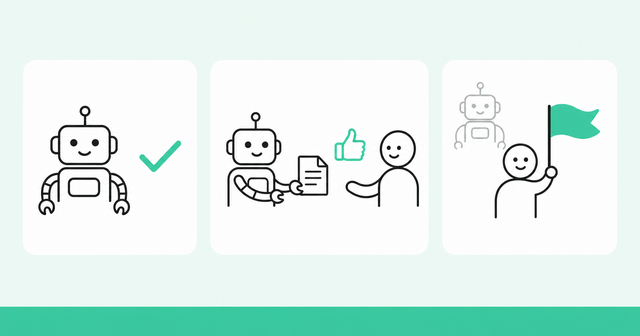
The teams getting this right aren't automating less. They're deciding, deliberately, where the machine stops and the person starts. Before you build anything, sort every decision into one of three buckets.
The agent decides. Mechanical, reversible, low-stakes work. Researching a contact, matching records, refreshing a field, logging a call outcome. If it's wrong, someone notices and fixes it in a minute.
The agent proposes, a human approves. Anything that touches a buyer's inbox or a rep's day. Which accounts to work this week. What the first line of the email says. Which audience goes to paid. This is where the agent has to show its work. A recommendation nobody can explain is a recommendation somebody will redo by hand.
The human decides. Whether a deal is really commit. How to handle an objection nobody has heard before. When to walk away from an account that looks perfect on paper. Who joins your team. Machines can inform these. They shouldn't own them.
If every decision a team makes lands in bucket one, that's a flag.
The line runs through every team
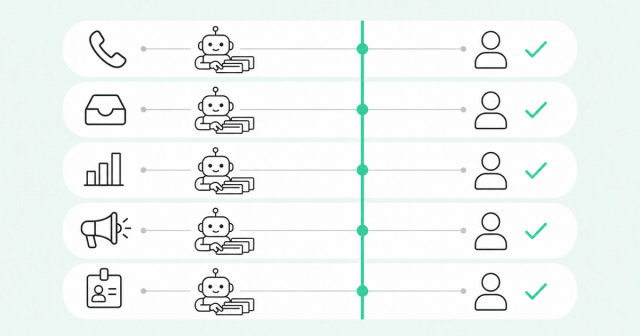
This isn't a sales problem. It's an operating model problem.
Outbound and prospecting. The agent builds the list and drafts the first touch. A human decides whether this is the right person, the right moment, and a message worth sending.
Inbound. The agent enriches and routes. A human notices when the "new lead" is actually an existing customer, a competitor doing research, or a former champion who just landed somewhere new.
Internal reviews. The agent summarizes the pipeline. A human decides what's real.
Marketing. The agent writes fifty variants. A human decides which one sounds like you, and whether any of them should ship.
Hiring. The agent screens. A human decides who you bring onto the team.
AI makes every one of these faster and smoother. None of them gets better unless someone is standing at the judgment line.
Your operating rhythm is out of date
If you deployed agents and didn't change how your team works, you made the old process faster, broken parts included.
Here's what that looks like on my own teams.
I run a content team of two. Both come from journalism, and both are strong storytellers. We move faster than the five-person content team I ran years ago, and that's because we went fully agentic. We deployed AirOps, gave it our context, and built the parameters it works inside. It surfaces ideas from real-time data, makes suggestions, and tracks what's performing. My team touches everything before it goes out. They aren't the drafters anymore. They're the judgment call.
My SDR team runs the same way, and a lot of it is headless. Through the Common Room MCP, an agent can pull every VP at an ICP account who hit the pricing page this month, confirm they're still in the role, build the list, and load it into the dialer for a call blitz. It keeps the records clean and logs what got done. The SDRs decide whether the list is right, whether it's the right moment, and what to say when someone picks up. Anything that goes out to a buyer, they review and approve first.
Both teams are fully AI assisted. Neither is AI dependent.
Your pipeline reviews, standups, QA, and enablement were built for a world where humans did the work. Now they need to be built around where humans make the call.
For every agent in your stack, you should be able to answer four questions:
- What does it decide on its own?
- What does it need to know to decide well, and where does that live?
- Where does a human override it, and does that take a ticket?
- How does it learn when it's wrong?
If the outcome never flows back, you've built a loop that never closes.
And train for judgment like it's a skill, because it is. Spotting a confident wrong answer takes practice. So does knowing when the agent had too much context and over-rotated.
The need for human judgment isn't shrinking as AI gets better. It's at an all-time high.
AI assisted, not AI dependent
AI assisted means the machine does the work and you own the call. AI dependent means you've stopped being able to tell when it's wrong.
Try this. Take the agent away for a day. Can your team still tell a good account from a bad one? Can they still write the email? Can they still smell a deal that's going sideways? If not, you're dependent.
Better data doesn't fix this on its own. You can have perfectly resolved identity, every buyer touchpoint, and every call transcript, and still run a bad play because nobody defined what a good one looks like. Plenty of teams automate a motion they never examined and encode their assumptions into software, where they stop being visible. Better data makes a good strategy faster and a bad one more efficient.
Your messaging, your personas, your view of what actually predicts a deal: that's yours. No vendor knows it better than your team does.
Where Common Room fits
A human at the judgment line is only as good as what's in front of them. Most bad calls in GTM come from three gaps: the wrong person (the champion who left in March), half the buyer (what they did lives in one system, what they said lives in another), and the wrong committee (you reached the champion, but procurement and IT were never in the room).
That's what we built Common Room and Zoom Revenue Accelerator to close. Who the buyer is, what they did, and what they said, in one view, so your people can challenge the machine instead of guessing alongside it. And we drew the line into the product itself. When an identity match is uncertain, it goes to a human. When a score moves, you can see why and overrule it.
If you're building your own agents, our MCP Server and CLI connect them to the same buyer intelligence. You own the logic. We maintain the picture.
Judgment is the job
AI will keep getting better at execution. Every model release will make the demo more impressive. None of it changes the fact that someone has to decide what's true, what matters, and what to do next.
The teams that win won't automate their people out of the decision. They'll deploy them right at it.
Your SDR already knows the VP she's reaching out to left in March. She doesn't need a better agent. She needs to be standing at the line.
See what a complete picture of the buyer looks like on your own accounts. Request a demo.