
Updated: October 1, 2026
The term "AI agent" has done a full lap around the hype cycle.
It started as a research concept. Then it became a product category. Then every tool in the GTM stack added "agentic AI" to its homepage, and now nobody's quite sure what the word means anymore or whether the thing they bought actually qualifies.
Here's a working definition that cuts through it: an AI agent is a system that takes a specific input, does something with it, and produces an output a human can act on. No magic. No autonomy theater. Just a machine doing a defined job well enough that the human on the other end can skip a step they used to do manually.
By that definition, AI agents for GTM are genuinely useful, but only when they're deployed against the right jobs. Most teams are getting that part wrong.
Why Most AI Agent Deployments Disappoint
The pattern is consistent enough to be predictable.
A RevOps team evaluates an AI tool, gets excited about the demo, and deploys it against the biggest workflow they can find. The agent starts running. Output increases. More sequences. Same close rate. And then, slowly, the team realizes the output isn't actually better than what they had before. It's just faster and more voluminous.
The sequences the agent writes are technically personalized but feel generic. The accounts it prioritizes aren't obviously better than the ones reps were already working. The research it surfaces is accurate but not particularly useful in a sales conversation.
The tool didn't fail. The deployment did.
Someone pointed the agent at the wrong job, or pointed it at the right job with the wrong inputs. This is the part the vendor demos don't show you.
An AI agent is only as useful as the data it operates on and the job it's been given to do. Point a research agent at a fragmented contact database and you get fast research on the wrong people. Point a personalization agent at account-level intent signals and you get personalization that sounds specific but isn't. Point a prioritization agent at a CRM full of stale records and you get a confident ranking of accounts that may not exist anymore.
The agent model that actually works starts somewhere else entirely.
Start With the Job, Not the Technology
Before deploying any agent, RevOps teams need to answer one question: what specific manual job is this agent replacing, and what does good output look like?
That sounds obvious. Most teams skip it.
The jobs worth automating in a GTM stack share a few characteristics. They're repetitive. They're data-intensive. They have a clear definition of done. And they're currently being done inconsistently across the team, meaning the best reps do them well and everyone else does them badly or not at all.
By that definition, three jobs in the GTM stack consistently create real leverage when automated. Not because they're the sexiest use cases. Because they're the ones where the gap between what a human can do manually and what a machine can do systematically is widest.
Research. Personalization. Data hygiene.
Everything else, the strategy, the relationship, the judgment call in the middle of a discovery call, stays human. These three don't need to.
The Research Agent: Context Before Contact
Product research is one of the biggest contributors to the non-selling work that eats up roughly 70% of a sales rep's time, according to Salesforce. Just picture it: a rep browsing LinkedIn tabs, company news, CRM history, recent funding rounds, and hiring patterns manually, account by account, before they can write a single word of outreach.
That's not selling. That's janitorial work that happens to require a college degree.
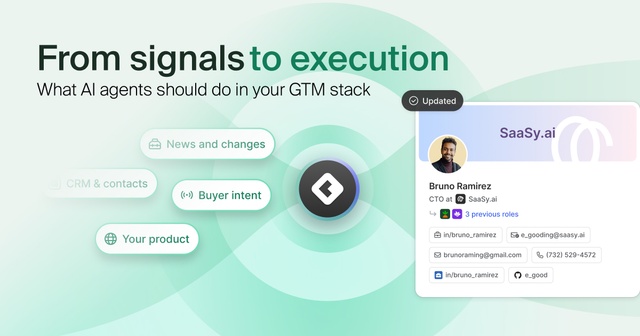
A research agent does this job differently. Not faster research. Different research. It synthesizes across sources, first-party signals from your own product and CRM, real-world buyer activity from outside your four walls, recent changes at the account level, and produces a brief that tells a rep not just what's happening at an account but why it matters right now.
The distinction matters. A research agent that tells you a company raised a Series B six months ago is producing information. A research agent that tells you the same company raised a Series B, has since hired three enterprise sales leaders, has had two contacts visit your pricing page in the last week, and matches the profile of your last six closed-won deals in the same vertical is producing context.
Context is what reps need before they pick up the phone. It's what most research agents, pointed at the wrong data sources, fail to produce.
Account-level intent tells you a company is in-market, but not which person is driving it. A research agent grounded in person-level identity resolution, with signals resolved to real people, surfaces the actual individual and why they matter right now.
For RevOps, deploying a research agent well means two things. First, making sure the agent has access to unified data, first-party and third-party, resolved to real people and accounts. Second, defining what a useful brief actually looks like for your specific motion, because "useful" in an outbound enterprise context looks nothing like "useful" in a PLG expansion context.
Get those two things right and the time between signal and send collapses from hours to minutes. Reps start from a brief instead of a blank page. Outreach gets more specific. Conversations start warmer.
Common Room's research agents pull from a foundation of unified buyer intelligence that combines first-party customer data with real-world buyer signals, resolve everything through Context360 to real people and accounts, and surface briefs that give reps the context they need before they ever open a compose window.
The Personalization Agent: Written for Someone, Not at Someone
Personalization has a bad reputation right now, and it deserves it.
The first wave of AI-generated outreach taught buyers to recognize, and immediately distrust, messages that used their first name, their company name, and a generic observation about their industry. That's not personalization. That's a mail merge with better syntax.
Hunter found that 69% of US-based decision makers say it bothers them when AI wrote the outreach.
Real personalization is specific to the person, the moment, and the reason for reaching out. It references something that actually changed. It connects that change to a real problem the buyer is likely feeling. It makes a case for why now is the right moment, not just why your product is good in general.
A personalization agent can produce that. But only if it's operating on the right inputs.
The inputs that matter are behavioral, not demographic. Not job title and company size, but what this person has been doing, what their company has been doing, what's changed recently, and what that pattern of behavior suggests about where they are in a buying journey. That's the context a personalization agent needs to write something worth reading.
Research first, personalization second. Reverse that order, which tool-first deployments do constantly, and you get output that's fast and forgettable. That means the personalization agent can't be a standalone tool. It has to sit downstream of the research layer, operating on context the research agent already surfaced, not context it goes looking for on its own.
Common Room's message personalization agent is built into this sequence. It combines buyer identity, intent signals, and real-time account context to draft outreach grounded in what's actually happening, not just who the buyer is on paper. Reps review, refine, and send. The agent handles the synthesis. The human handles the judgment.
The Data Hygiene Agent: The One Everybody Avoids
Data hygiene is the least glamorous part of the agent conversation. It's also the one that determines whether everything else works.
CRM data decays continuously. Contacts change jobs. Companies get acquired. Titles shift. Duplicate records accumulate with every enrichment import, every tradeshow list, every form fill. According to Validity, 44% of organizations lose at least 10% of annual revenue to low-quality CRM data.
When your research agent pulls from stale records, it produces stale briefs. When your personalization agent writes to the wrong person at the wrong company, the message lands in the wrong inbox. When your prioritization logic runs on duplicate accounts, it's making ranking decisions based on data that doesn't reflect reality.
Nobody's AI stack can outrun a bad foundation. They just generate bad output faster.
A data hygiene agent doesn't fix this with a quarterly cleanup project. It runs continuously, identifying records that no longer reflect reality, surfacing duplicates before they compound, flagging contacts that have changed roles, and organizing what needs attention into actionable cleanup workflows.
The difference between a cleanup project and a continuous hygiene agent is the difference between bailing water and fixing the leak. One keeps you afloat. The other lets you actually move.
Common Room's DataAgent continuously identifies outdated contacts, duplicate records, and gaps in account data, then surfaces them in prioritized cleanup workflows that turn stale data into accurate, deduplicated records while preserving activity history and relationship context through the process. Because a clean record that's lost its relationship history isn't actually useful. And a CRM your team doesn't trust is a CRM your team won't use.
How AI Agents for GTM Work Together as a System
Deployed in isolation, each of these agents creates some leverage. Deployed together, on a shared intelligence foundation, they compound.
The research agent surfaces the right accounts and the right people, continuously updated as signals change. The personalization agent uses that context to produce outreach specific enough to earn a response. The data hygiene agent keeps the foundation clean enough that the other two are working with accurate inputs.
The system runs in the background. Signals come in. Records get updated. Briefs get generated. Sequences get drafted to automate pipeline plays. Your reps show up to a queue that's already organized, already contextualized, already pointed at the accounts worth working today.
What's left for the rep is the irreplaceable part. The conversation. The relationship. The judgment call in the middle of a discovery call that no agent will ever make well.
That's what AI as leverage actually looks like. Not replacing the human. Removing everything that was getting in the human's way.
What RevOps Needs to Get Right
Three things determine whether this model works.
The foundation comes before the agents. Agents are only as good as what they're working from. Fragmented, stale, unresolved data produces fast, confident, wrong output. Fix the foundation first. The agents are the second step, not the first.
Define the job before you select the tool. Know exactly what each agent is replacing and what good output looks like before you talk to a vendor. The demo will always look good. The question is whether it looks good on your data, pointed at your motion, producing output your reps will actually use.
Adoption is a design problem, not a training problem. If reps aren't using agent output, it's because the output isn't showing up where they work or isn't specific enough to trust. Embed agents into existing workflows, Slack, CRM, email, wherever reps already live, and let reps query buyer intelligence in plain language where reps already work, including the AI assistants they already lean on. Make the output specific enough that a rep reads it and immediately knows what to do next. If they have to think about whether to trust it, you're not there yet.
Get those three things right and the agent model stops being a promising experiment. It becomes a durable advantage. The teams that figure it out first won't just have better tools. They'll have a system that gets smarter every time a signal fires, every time a rep sends a message, every time a deal closes or doesn't.
That's the compounding moat nobody puts on a roadmap slide.
Common Room is the AI-native GTM platform that deploys research, personalization, and data hygiene agents on a foundation of complete and trusted buyer intelligence. If your agent stack isn't producing the results you expected, the foundation is usually where to look first.