
A good forecaster doesn't wait for the storm to hand you a wet umbrella after the fact.
They watch pressure drop, wind shift, temperature fall, and they tell you to grab a coat before the first drop hits. That's the entire difference between reacting and knowing, and it's exactly the gap signal-based selling was invented to close in sales.
Except somewhere along the way, the term got borrowed by every vendor with a scoring model and a marketing deck. "Signal-based" now shows up on more homepages than it belongs on, which means the phrase needs an actual definition again, and a way to tell who's using it honestly.
What is signal-based selling?
Signal-based selling is a sales approach where reps prioritize and time their outreach based on real, observable behavior from a specific buyer, rather than a static list, a quarterly territory plan, or a title-based spray. Instead of asking "who fits our ideal customer profile," it asks "who is actively showing behavior that suggests they're ready for a conversation right now."
A signal, in this context, is any piece of observable activity that indicates buying interest or readiness: a product trial hitting a usage threshold, a job change into a budget-holding role, a spike in competitor research, a support ticket revealing frustration with an incumbent tool, a comment on a community post asking a pointed question.
The core idea is simple, even if the execution rarely is: sell to the moment, not the calendar. A rep working a static list is guessing which quarter is right. A rep working real signal is responding to a moment that's already happening.
If you want the fuller picture of where signal fits into the broader category, our guide to buyer intelligence walks through what GTM teams mean by the term and how it connects to everything below.
Where this actually came from
Signal-based selling didn't appear out of nowhere. It's the third act in a story that's been building for a decade.
Act one was the spray: big lists, broad titles, high volume, low precision, and it worked back when inboxes were quieter and buyers hadn't yet learned to ignore generic outreach on sight.
Act two tried to fix that with intent data, account-level signals aggregated across a category that promised to narrow things down. It helped, genuinely, but it answered a market-sizing question, not a "who do I call today" question, and an account glowing on an intent dashboard still left reps guessing which of the forty people inside it actually mattered.
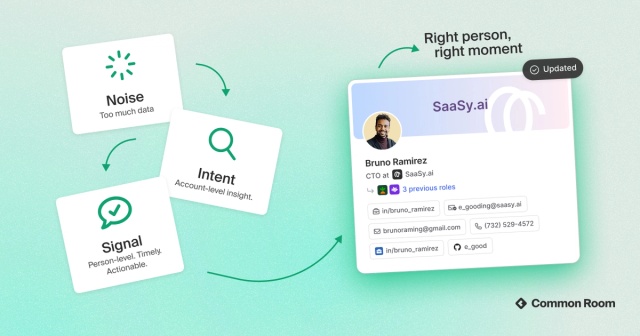
Act three, the one still being written, is signal-based selling in its fullest form: person-level, timely, and specific enough that a rep doesn't have to guess who to reach or why. It's the difference between knowing a storm is somewhere over the region and knowing exactly which street it's about to hit.
Not every data point is a signal, and that distinction matters
Here's where the term gets abused most often. A lot of what gets marketed as "signal" is really just activity, and activity without context is closer to weather noise than a forecast.
A real buying signal has three qualities that separate it from background noise. It's tied to a specific person, not an anonymous visit or an aggregated account score. It's timely, meaning it reflects something happening now, not a snapshot from three months ago still being treated as current. And it's actionable, meaning a rep can look at it and immediately understand what to do next, not just that "something happened."
A page view is activity. A newly promoted decision-maker who just logged into a product trial and left a comment about a specific feature gap is a signal. The first tells you a company exists somewhere in your funnel. The second tells you exactly who to call and what to say when they pick up.
For a deeper look at exactly where the line sits between account-level intent and person-level signal, this breakdown covers the distinction in full.
How to evaluate whether a platform actually delivers signal-based selling
This is where most category explainers stop short, and it's exactly where the real evaluation work begins. If a vendor claims to offer signal-based selling, here's what to actually check before believing it.
Does it resolve to a real person, not just a company? Ask to see an actual example. If the "signal" the platform surfaces is an account-level score with no name attached, it's intent data wearing a newer label, not signal-based selling.
How fresh is the signal by the time a rep sees it? A signal that's three weeks old by the time it reaches a rep isn't a signal anymore. It's a historical footnote. Ask specifically how quickly a real-world event, a job change, a product action, a competitor visit, shows up in the workflow.
Does the signal arrive where reps already work, or does it require a new tab? A platform that surfaces genuinely great signal, but only inside a separate dashboard nobody checks, hasn't actually solved the problem. Ask where the alert lands: CRM, Slack, inbox, or a login page that gets opened once during onboarding and never again.
Does it explain why the signal matters, or just that something happened? The best signal-based platforms don't just flag activity. They connect it to context: this person changed roles, previously worked at a customer account, and just engaged with a competitor comparison. That's a story a rep can act on. A raw activity log is not.
Can you trace a real outcome back to a real signal? Ask for a customer example that shows a signal leading to a specific, measurable result, more meetings, faster conversion, shorter cycles, not just a description of the feature. If a vendor can't point to an outcome, the "signal-based" language is doing more work than the product is.
The tell that separates real signal-based selling from a repackaged old idea
Here's the fastest gut check: ask what the platform did five years ago, before "signal-based" became a popular phrase to put on a homepage. If the honest answer is "the same lead scoring we've always done, now called something newer," that's not a category shift. It's a rebrand.
Real signal-based selling changes what a rep's morning actually looks like. Instead of opening a static list and guessing where to start, they open a workflow that already knows who moved, what changed, and why it matters today. That's not a feature update. It's a different relationship between a rep and the moment they're trying to catch.
The forecast is only useful if it reaches someone before the storm
Signal-based selling, done honestly, isn't a fancier word for lead scoring, and it isn't a synonym for intent data with better branding. It's the practice of selling to a real, specific, timely moment instead of a guess dressed up as a plan.
The next time a platform claims to offer it, ask the forecaster's question: does this tell me the storm exists somewhere out there, or does it tell me exactly which street it's about to hit, and hand me the coat before I need it? Only one of those answers is actually signal-based selling.
The other is just weather.