
Every GTM leader bought the tools. Almost none of them got the results. Almost none of them can explain, twelve months later, where the pipeline went.
The pitch was compelling and the logic seemed sound. AI would write the sequences. AI would surface the accounts. AI would tell reps who to call, when to call them, and what to say when they picked up. All you had to do was plug it in.
So teams plugged it in. Outbound volume went up. Reply rates went down. Pipeline stayed flat. And somewhere in a QBR this quarter, a VP of Sales is explaining to a board that approved seven figures in AI tooling why the number wasn't moving. Fun meeting.
This is the moment a lot of GTM leaders are living in right now. Not because AI doesn't work. Because they built it on a foundation that was never going to hold the weight.
The assumption everyone got wrong
The dominant belief going into the AI era of GTM was that the problem was execution. Teams weren't reaching enough people. They weren't personalizing fast enough. They weren't following up consistently enough. AI, the thinking went, would fix all of that by doing more of it, faster.
What nobody stopped to ask was whether the underlying data was good enough to build on.It wasn't. It isn't. That's the whole problem, and it's a boring one, which is probably why nobody wanted to talk about it.
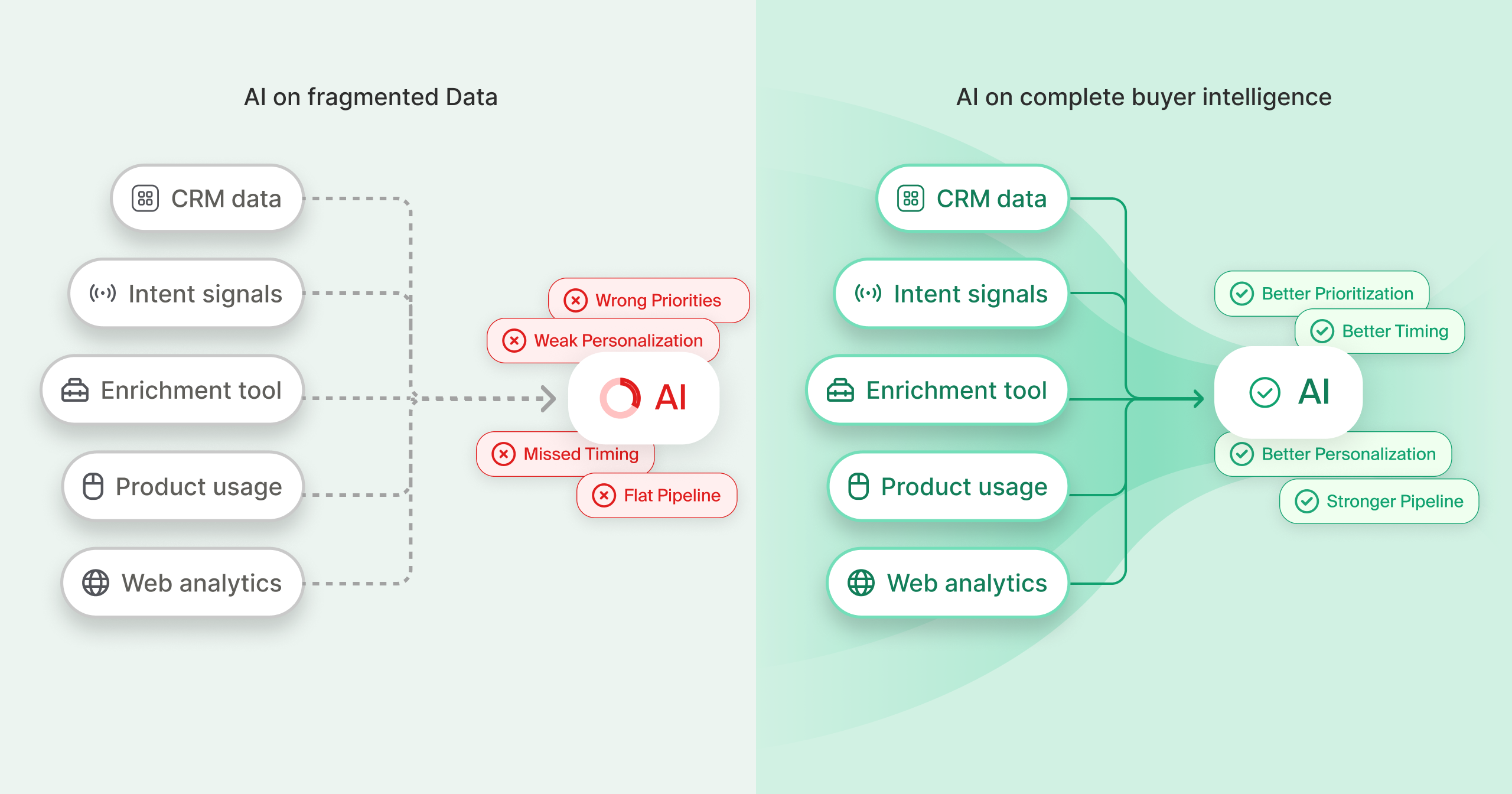
Most GTM teams are operating on fragmented data. Their CRM has one version of a contact. Their enrichment vendor has another. Their product database has a third. Their intent data has a fourth. None of these systems talk to each other in any meaningful way. None of them resolve to the same person. None of them update fast enough to reflect what's actually happening with a buyer right now. They're a collection of snapshots pretending to be a movie.
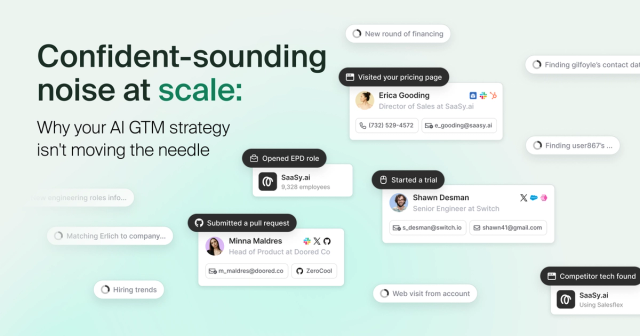
When you layer AI onto that foundation, you don't get intelligence. You get confident-sounding noise at scale. The sequences go out. The personalization tokens fire. The AI is technically working. And the buyer on the other end can tell, immediately, that none of it was actually written for them.
More activity. Less signal. A GTM motion that got louder without getting smarter.
What fragmented data actually costs you
It's worth being specific here, because the cost of bad data isn't just a CRM hygiene problem. It shows up everywhere a revenue team touches a buyer.
It shows up in prioritization. When your data is fragmented, your AI can't distinguish between an account that's genuinely in market and one that had an intern click a link three weeks ago. So it treats them the same. Reps end up working a list that's technically AI-generated and functionally identical to a random export.
It shows up in personalization. AI-generated messaging is only as relevant as the context it's built on. If the context is a job title and a company name, the message reads like a job title and a company name. The "personalization" becomes a liability, not because it’s wrong, but because its obviously templated, and buyers have seen enough of it to know the difference.
It shows up in timing. Buying windows are short. A contact who just moved into a new role is a live opportunity for about three weeks. A company whose product usage just spiked is worth calling today, not next Tuesday after the signal has been sitting in a dashboard nobody checks. Miss the window and the data point becomes trivia.
And it shows up in AI itself. Every agent, every workflow, every prioritization model in your GTM stack depends on the quality of what's underneath it. AI built on bad data doesn't produce bad-looking outputs. It produces confident-sounding outputs that send your team in the wrong direction. That's harder to catch and more expensive to fix than just being obviously wrong.
Why the tools aren't the problem
Here's the uncomfortable part.
The AI tools most GTM teams are running are fine. The sequencing platforms, the research agents, the personalization engines: most of them work reasonably well when they have something real to work with.The problem isn’t the tools.The problem is what they're working with.
Jake Biskar, who runs pipeline operations at Atlan, put it plainly when describing what he'd seen break across GTM teams trying to operationalize AI: the signals were there, but nobody could act on them. Not because the data was invisible, but because it wasn't connected to anything. A signal sitting in one tool, disconnected from the contact record in another tool, disconnected from the conversation history in a third tool, isn't a signal. It's a data point with nowhere to go.
"People want to disqualify signals," Jake said, "because if they qualify a signal, that means they have to go take action on it. The question isn't whether they trust the data. It's how do you coerce them to pull the thread? How do you stack signals and build a story on why an account is worth their time?"
That's the question most AI go-to-market strategies never answer. They optimize for output without ever solving for the foundation that makes the output meaningful.
The teams getting this right aren't running better AI. They're running AI on better intelligence.Small distinction. Huge difference in results.
What complete buyer intelligence actually means
Complete buyer intelligence is not a bigger database. It's not more intent signals. It's not a fancier enrichment waterfall.
It's a continuously updated, person-level understanding of who your buyers are, what they're doing, and why now is or isn't the right moment to reach them.
That means unifying first-party data, what's happening inside your product, your CRM, your marketing systems, with real-world buyer signals, job changes, hiring patterns, website behavior, content engagement, and external intent. It means resolving all of that to actual people and actual accounts, not just company domains and email addresses. And it means keeping that view current that runs continuously, not a quarterly enrichment project someone remembers to schedule..
When that foundation is in place, the AI starts to behave differently. Prioritization becomes meaningful because the model has real signal to rank against. Personalization becomes relevant because the context is actually specific to the person and the moment. Follow-up becomes timely because the system knows when something changed and routes the right action to the right rep before the window closes.
The difference isn't the algorithm. It's what the algorithm has to work with.This is not a thrilling insight. It is, unfortunately, the correct one.
The pattern the winning teams share
Across the GTM teams that have figured this out, a few things show up consistently.
They treat buyer intelligence as infrastructure, not a feature. The question isn't "which AI tool should we buy?" It's "what does our data foundation look like, and is it good enough to build on?" The tools come after that answer.Most teams skip straight to the tools.
They resolve identity before they run AI. Every signal, every interaction, every data point needs to connect to a real person at a real account before it's useful. Account-level data without person-level resolution is a map without street names. You know roughly where you are. You can't navigate.
They weight behavior over demographics. What a buyer does tells you more about intent than what their LinkedIn profile says. The scoring models that actually predict conversion are built primarily on behavioral data. Job title is a starting point. Usage patterns, content engagement, and hiring signals are the story.
They build for timing, not just targeting. Knowing the right account is half the problem. Knowing the right moment to reach them is the other half. And the moment is usually shorter than the sales cycle suggests.
The real question for your AI go-to-market strategy
If you're sitting on an AI investment that hasn't moved the number yet, the instinct is usually to optimize the tools. Better prompts. Better sequences. Better scoring model. Tinker until something works.
Before you do that, it's worth asking a simpler question: what is the AI actually working from?
If the answer is a fragmented CRM, a point-in-time enrichment export, and a collection of intent signals that don't resolve to real people, the tools aren't your problem. The foundation is. And no amount of prompt engineering fixes a bad foundation.
Common Room is built for exactly this. It unifies first-party customer data with real-world buyer signals into a continuously updated system of complete buyer intelligence. AI agents operate on that foundation to help revenue teams prioritize the right accounts, understand what's changing, and take action before the window closes, embedded directly into the workflows where reps already operate.
The companies that win the next phase of GTM won't have better AI than everyone else. They'll have a clearer picture of their buyers. And they'll have built their AI motion on top of that picture instead of hoping the AI would create it for them.
That's the strategy that actually works. It's not complicated. It's just not what most teams are doing.
Common Room is the AI-native GTM platform that turns complete and trusted buyer intelligence into action. If your AI go-to-market strategy isn't producing the results you expected, the foundation is usually where to look first.