
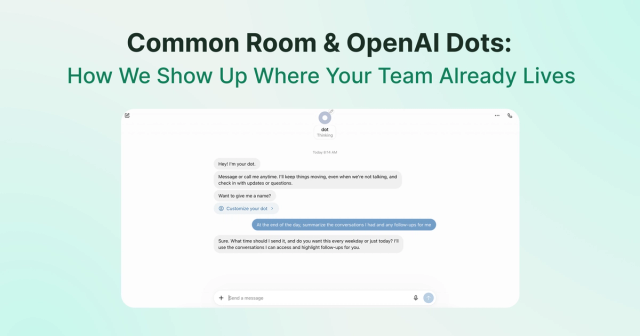

Ever wished you had a GTM assistant that already knew your accounts, had access to your prospect data, and understood which of your buyers to reach out to next? Well, now you can, with Common Room and Dots.
OpenAI's new Dots lets you chat with your connected systems straight from ChatGPT, Slack, or a phone call, so the answer shows up in the conversation you're already having, not in a tab you have to remember exists. Unlike opening a new ChatGPT window, Dots is connected to your data. You're not explaining your pipeline to a generic AI. The context is already there.
And it lets you set up recurring automations (like daily briefings or end-of-day recaps) using plain language. ChatGPT supports automations too, but Dots lets you configure them conversationally, without needing to know how to set up a workflow.
The great news for GTM teams? Common Room's connector is live in the ChatGPT plugin directory now, which means your Dots ccan do more with the buyer intelligence you need to inform deals. Here's what that actually looks like in practice.
"Every morning, send me a daily summary of changes in my accounts."
You wake up to the brief that matters: three accounts showed usage spikes, two had new stakeholders engage on LinkedIn, one just posted a job opening that signals expansion. No manual check-ins. No dashboard refresh. Just the delta, waiting for you before your first coffee, so you start the day already ahead.
"Every morning, analyze my calendar and pull in the recent details for accounts I'm meeting today."
Your 2pm with your newest prospect comes pre-loaded: the feature they adopted last week, the support ticket they opened yesterday, the competitor mention from last month's call. You walk into the meeting with context already staged, not because you prepped for an hour, but because the system prepped for you while you slept.
"At the end of the day, summarize the conversations I had and any follow-ups for me."
End-of-day recap used to mean hunting through call notes and trying to remember who said what. Now it's automatic: four calls, three objections flagged, two pricing questions that need a proposal by Friday, one warm intro request you almost forgot. The summary lands before you close your laptop, so nothing slips and tomorrow starts clean.
"Why did we lose deals last month?"
Ask and you get the actual pattern: budget freezes on four enterprise accounts, tool overlap on three mid-market deals, weak adoption showing up as the quiet killer on two more. Each theme ties back to specific accounts, and each account ties back to the call notes that explain it. This is the question every sales leader asks in a QBR and almost never gets answered in the room. Now it gets answered before you even enter the room.
"What changed on this account since yesterday?"
Account health usually means opening a dashboard and squinting for a delta. Now it means asking and getting told: new engagement from a VP who's been dark for three weeks, a usage spike on a feature tied to expansion, a signal that just flipped a deal from quiet to warm.
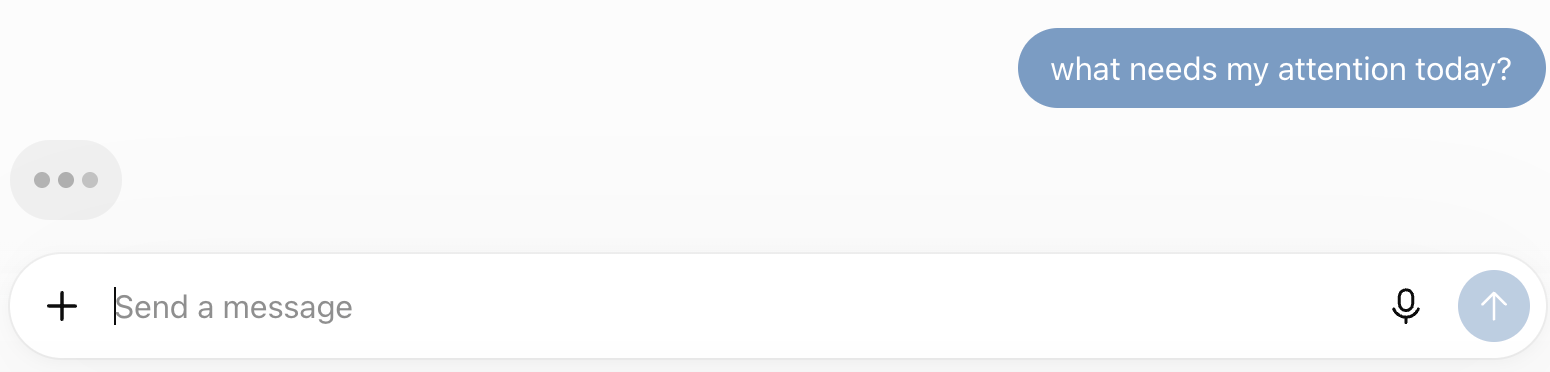
"What needs my attention today?"
Not everything does. Ask for the brief, and you get the accounts actually worth your first hour, ranked, not just listed alongside forty things that can wait.
It doesn't stop at the deal record
Since joining Zoom Revenue Accelerator, Common Room's buyer intelligence sits in the same shared layer as Engage sequences and Coach's live call guidance. That means the same conversation extends past "what's happening" into "what's being done about it."
Ask what's happening on an account and you get the answer: which conversations have taken place, what the AI analysis flagged, which objections came up, whether a competitor was mentioned, and where pricing entered the picture. Ask which reps need attention this week, and the answer comes from real flagged moments across real calls, surfaced through keyword and topic indicators, not a manager's gut feeling about who's been quiet lately.
A deal marked lost for "weak adoption" isn't a dropdown value here. It's backed by the usage data and the call where that gap first showed up, and now you can just ask about it.
The part that requires nothing from you
No new integration. No rollout plan. No "talk to your admin" detour. The answers pull from the same data already flowing through Common Room, using the MCP connectors already configured. You're not adding a tool. You're getting the context you already paid for, in the place you already are.
Most of GTM's problems aren't a data problem anymore. They're a retrieval problem: the answer exists, somewhere, in some system, and finding it costs more time than the question deserved. Dots closes that gap. Common Room just made sure the answer on the other end is actually worth asking for.