
Most revenue teams didn’t build their data stack on purpose. They assembled it incrementally, one tool renewal at a time, one integration request at a time, one “let’s just add this” at a time.
The result is a stack that wins vendor bingo and loses pipeline.
If your RevOps team is spending more time managing tools than enabling sellers, or if your reps are toggling between eight systems to understand a single account, this is the audit you’ve been putting off. And with AI now woven into almost every GTM tool on the market, getting your data stack right has become even more consequential.
What is a data stack?
A data stack is the collection of cloud-based tools and technologies that move, store, transform, and activate your organization’s data. Think of it as the infrastructure layer underneath every go-to-market (GTM) decision your team makes.
The modern data stack (MDS) replaced legacy data stack architectures that relied on on-premises hardware, rigid ETL workflows, and significant upfront infrastructure investment. Today’s stacks are cloud-native, modular, and designed to handle both structured and unstructured data at scale.
For GTM teams specifically, a modern data stack typically includes:
- Data sources: CRM, product analytics, marketing automation, ad platforms, and external enrichment or intent providers
- Data pipelines: Tools that move data from source systems into a central store (Fivetran, Stitch, Airbyte)
- Cloud data warehouses: Snowflake, BigQuery, or Redshift, where structured data lives for analysis
- Data transformation tools: Tools like dbt that clean, model, and prepare raw data for downstream use
- Data activation: The layer that turns warehouse data into actions, syncing records, triggering workflows, and surfacing signals to reps
That last layer is where most GTM teams have the biggest gap and the most sprawl. For a deeper look at how these layers connect to revenue execution, see our guide on buyer intelligence.
Why is a data stack important?
Your data stack is the foundation everything else runs on. Prioritization logic, AI-assisted outreach, pipeline forecasting, rep onboarding. All of it depends on data that is clean, connected, and current.
When the stack works, GTM execution gets faster and more precise. Reps know which accounts to focus on and why. Marketing and sales operate from the same signals. RevOps builds on a reliable foundation instead of maintaining it.
When it doesn’t, the problems are hard to diagnose because they don’t show up as data errors. They show up as missed quota, low conversion rates, and misaligned teams.
The stack failure looks like a performance failure. And that’s exactly why it never gets fixed.
For revenue teams running any kind of signal-based GTM motion, the stack matters even more. Signals are only useful if they’re captured cleanly, resolved to the right person and account, and surfaced fast enough to act on. A fragmented stack breaks all three.
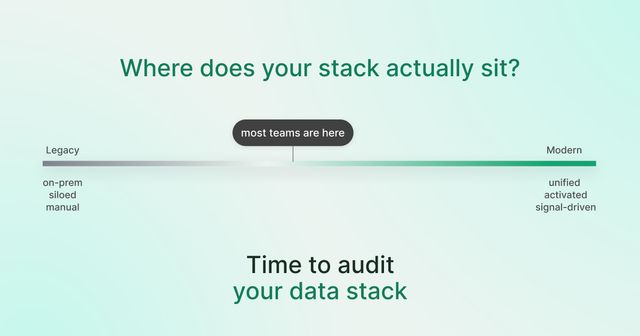
Modern data stack vs. legacy data stack
Understanding why the modern data stack matters starts with knowing what it replaced.
Legacy data stacks were built on on-premises hardware. Data had to be cleaned and structured before storage: the traditional extract, transform, load (ETL) workflow. Scaling required hardware investment. Flexibility was limited. Real-time processing was largely out of reach.
Modern data stacks flipped the model. With cloud data warehouses as the storage layer, teams can ingest raw data first and transform it later (ELT). Compute scales on demand. Tools are modular and replaceable. Real-time pipelines are achievable without custom engineering.
The key differences at a glance:
- Infrastructure: Legacy relies on physical servers; MDS is cloud-native
- Scalability: Legacy requires manual provisioning; MDS scales on demand
- Flexibility: Legacy is monolithic; MDS is modular and composable
- Analytics: Legacy supports batch reporting; MDS enables real-time insights
- Cost model: Legacy requires large upfront investment; MDS uses pay-as-you-go
Most GTM teams made this transition years ago. The problem is that in doing so, they accumulated tools at every layer of the modern stack without a consolidation plan. The architecture is modern, but the sprawl is sprawling.
The real cost of data stack sprawl
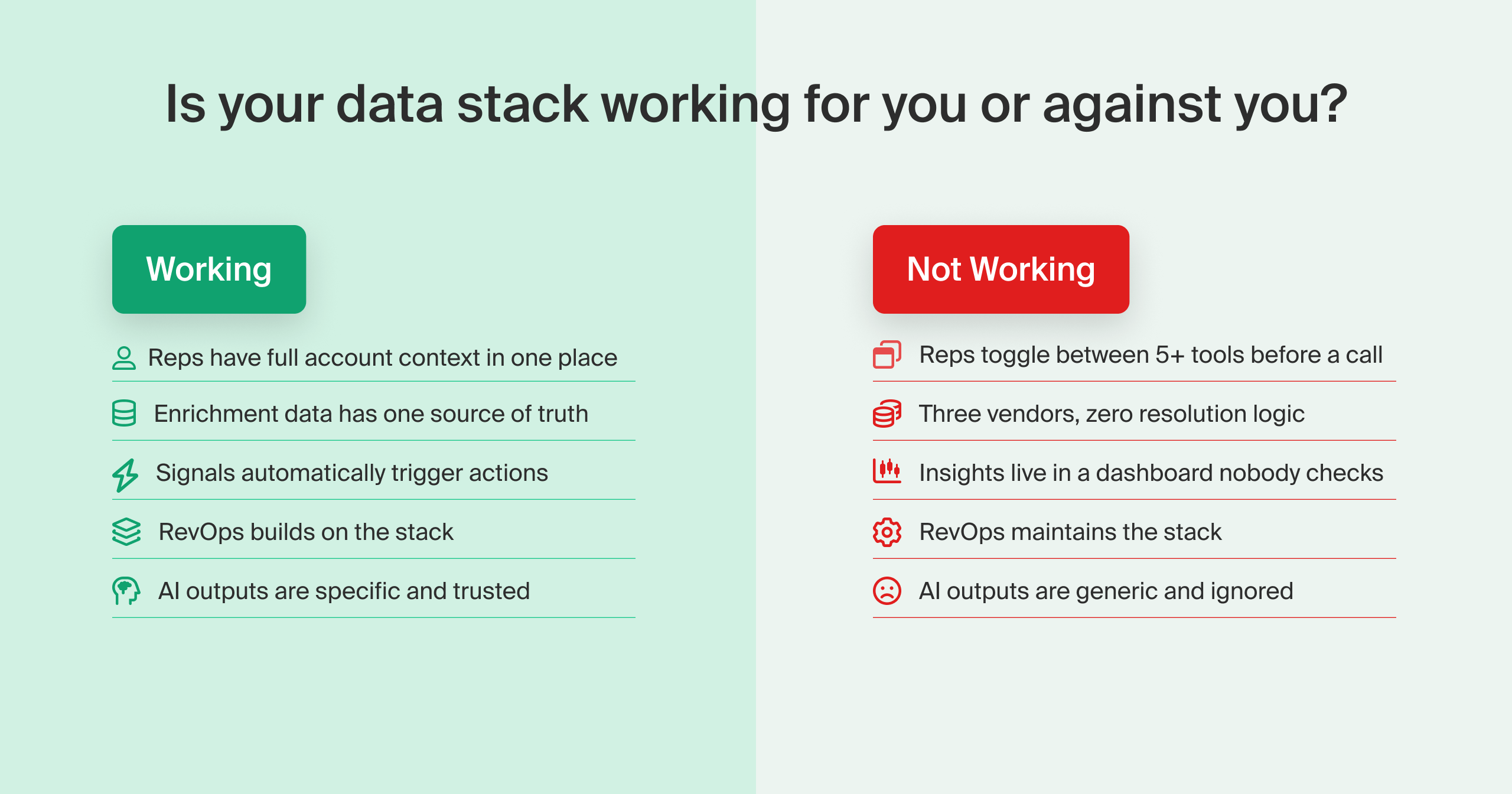
A sprawling data stack creates compounding problems across your entire GTM motion. Here's what that looks like in practice:
Reps working bad intel
CRM data goes stale fast. When enrichment is coming from three different vendors with no deduplication logic, reps inherit contradictory records and learn not to trust the data. Then they stop using it.
No single view of an account
Product signals live in one place, intent signals in another, engagement history in a third. Nobody has the full picture. Sales and marketing make decisions from different datasets and wonder why they’re misaligned.
RevOps becomes a stitching factory
Instead of enabling the team, RevOps spends cycles building and maintaining brittle integrations between systems that weren’t designed to talk to each other.
The AI problem nobody’s talking about:
How to audit your data stack: a practical framework
Before cutting anything, you need a clear picture of what you have and what it’s actually doing.
Step 1: Map every tool to a job
List every tool in your current stack and answer one question for each: what specific job does this tool do that nothing else in my stack does?
If you can’t answer that cleanly, that’s a flag. If two tools are doing the same job, that’s a consolidation opportunity. Pay particular attention to your data sources and enrichment layer, this is where sprawl is most common and most expensive.
Step 2: Trace your data flows
Where does data enter your stack? Where does it go? What transforms it, and what activates it? Draw this out. You’re looking for:
- Dead ends: data that gets collected and never used
- Duplication: the same data being pulled, stored, or processed in multiple places
- Manual handoffs: places where a human has to move data between systems because there’s no integration
Manual handoffs are particularly telling. Every manual step is a latency problem, a consistency problem, and an attrition risk.
Step 3: Ask what your data is actually driving
For each tool category, ask: is this data source producing pipeline? Are reps actually using the signals this tool generates? Can you prove ROI, or are you assuming it because the vendor told you to?
Intent data is a good example. Most teams have it. Few teams can point to a deal they won because of it. That doesn’t mean it has no value, but it does mean you should understand what you’re getting before renewing.
Step 4: Identify the consolidation candidates
After mapping and tracing, you’ll see a pattern. Some tools are core to how you operate, and some are peripheral tools that were bought to solve a specific problem and never fully integrated. Consolidation candidates typically share a few characteristics:
- Low rep adoption (they don’t use it even when trained)
- Overlap with a tool you already have
- Data that lives in the tool but doesn’t flow into your warehouse or CRM in a usable way
- Renewal driven by inertia, not ROI
Step 5: Evaluate your activation layer
This is the most overlooked part of the audit. You can have excellent data assets (clean, unified, real-time) and still not generate pipeline if there’s no activation layer connecting intelligence to action.
Ask: when an account shows strong buying signals, what happens automatically? If the answer is “a rep eventually notices in a dashboard,” you have an activation gap. Signals that require manual review are signals that get missed.
What to actually cut from your data stack
After the audit, the tools worth cutting tend to fall into a few buckets:
- Redundant enrichment vendors. Pick one primary source with a defined waterfall. Running three vendors in parallel usually means paying three times for data of similar quality with no clear resolution logic when records conflict.
- Point solutions with single-use outputs. If a tool produces a signal that doesn’t flow into your core systems or trigger any action, it’s producing noise, not intelligence.
- Tools your team has quietly stopped using. Check license usage. If adoption has dropped below 20 to 30 percent six months post-implementation, that’s a signal the tool didn’t solve the problem it was bought to solve.
- Anything requiring a full-time admin to maintain. Operational overhead is a hidden cost. If keeping the tool running requires dedicated RevOps cycles, factor that into the ROI calculation.
The case for consolidation
There’s a belief in GTM that more data sources equal better decisions. In practice, more data sources without a unified intelligence layer equal more confusion and slower execution.
The teams outperforming their peers right now aren’t running bigger stacks. They’re running tighter ones with cleaner data, better identity resolution, and a clear path from signal to action.
Legacy data stack thinking treated tools as independent capabilities. Modern data stack thinking treats the whole system as a foundation for execution where every data source feeds a shared, continuously updated view of your buyers, and that view drives what your team does next. See how RevOps teams are approaching this in practice.
Cutting tools becomes both a cost-saving exercise and a clarity exercise when done this way.
What a rationalized data stack enables
When you get this right, a few things change:
- Reps stop toggling. They work from one place that surfaces the context they need (product signals, engagement history, enrichment data) without hunting across systems.
- RevOps stops stitching. Integrations are managed at the platform level, not maintained manually. The team shifts from data plumbing to enablement.
- AI actually works. When buyer intelligence is complete, unified, and continuously updated, AI agents can prioritize accounts accurately, generate useful research, and surface the right actions at the right time. The outputs are specific, not generic.
- Pipeline becomes more predictable. Better data inputs, better prioritization, better timing. The variance that comes from bad data and missed signals starts to shrink.
If your team is managing tool sprawl across enrichment, intent, CRM, and orchestration layers (and struggling to connect those data assets into something your reps can actually use), Common Room consolidates buyer intelligence and AI-driven execution into a single platform.