
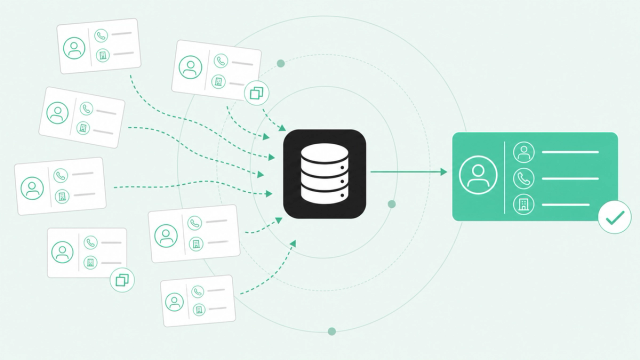
Open your CRM and count the damage. Duplicate contacts, titles from two jobs ago, missing phone numbers, accounts with no clear owner. Every rep works around it, and every AI tool you've bought quietly inherits it.
Not long ago, how to choose a data enrichment company was a procurement checkbox: you picked a database, paid per record, and moved on. In 2026, it's a decision that shapes whether your AI workflows produce pipeline or produce confident nonsense.
That shift is the reason this guide exists. Most comparison content ranks the same six databases and stops there.
You'll get something different: a framework for evaluating a data enrichment company on the things that actually change outcomes. You'll also get a plain look at how the market works and where it's heading.
If you own RevOps, sales ops, or GTM systems, you already feel the pressure. The stack keeps growing, signals live in silos, and teams layered AI on top of a messy process instead of cleaning it first. Enrichment sits underneath all of it.
That's the frame to hold onto as you read. Every criterion below ladders up to one question: will this vendor make your systems more trustworthy, or just add another feed you have to babysit? Keep that test in mind and the shortlist gets shorter fast.
Key Takeaways
- A data enrichment company fills, verifies, and updates the contact and account data in your CRM, but the best ones do more than append fields.
- Most vendor roundups rank the same databases, but the real decision comes down to architecture, match rate, deduplication, and AI-readiness.
- Single-source enrichment typically matches 50-70% of a list, while waterfall enrichment across several providers commonly reaches 80-95%.
- Duplicates and stale records quietly break AI workflows, so identity resolution matters as much as raw coverage.
- Evaluate every vendor on eight criteria that span coverage, accuracy, architecture, identity resolution, signal breadth, integrations, pricing model, and AI-readiness.
1. What a Data Enrichment Company Actually Does
Start with the plain definition. A data enrichment company combines outside data with the records you already own. It fills missing fields, verifies contacts, and refreshes information that's gone stale, so your team works from a current picture instead of a guess.
In practice, that data falls into a few buckets. Contact-level data covers names, titles, emails, and phone numbers. Account-level data covers company size, industry, and location.
Technographic and intent data show what a company runs and what it's researching right now.
The value isn't in any single field. It's in having enough of them, accurate and connected. That's what lets a rep or an AI agent act without second-guessing the record in front of them.
Why the constant upkeep? People change jobs, companies reorganize, and phone numbers get reassigned.
The US job-separations rate ran about 3.3% a month across 2024 and 2025, according to the Bureau of Labor Statistics. That churn is the structural driver of contact-data decay.
You'll often see a sharper number attached to this problem. One widely cited benchmark from MarketingSherpa, which HubSpot published, pegs contact-data decay near 22.5% a year. Treat that as a benchmark, not settled fact, but the direction is real: data ages the moment you save it.
Here's the reframe most roundups miss. The strongest providers don't stop at completing fields.
They resolve identities and unify buying signals into one profile of each person and account. Enrichment becomes a source of truth rather than another data dump.
It also helps to separate two terms people blur together. Data enrichment tools are the software you log into and configure. Data enrichment companies, or providers, are whose data you actually buy.
Many searchers conflate them, and vendors are happy to let the confusion ride.
2. Why Data Enrichment Matters More in the AI Era
Bad data has always cost money, but the bill is bigger than most teams admit. Gartner estimated in 2020 that poor data quality costs the average organization at least $12.9M a year. That's the price of decisions made on records nobody trusts.
The daily cost is quieter but just as real. Salesforce's 2024 State of Sales report found reps spend 70% of their time on nonselling tasks.
In the same research, only 35% of sales professionals completely trust their organization's data. When trust drops, reps rebuild lists by hand and forecasts turn into fiction.
Then AI arrived and raised the stakes. McKinsey's 2024 State of AI found 65% of organizations regularly use generative AI in at least one function, nearly double the prior year.
The biggest jump came in marketing and sales. ICONIQ's 2025 report found roughly 70% of companies reported at least moderate AI adoption in GTM workflows.
For the teams that own these systems, adoption is the easy part. The hard part is knowing whether the AI is actually working, and that answer depends on the data feeding it. You can't measure the impact of an agent when half its inputs are stale or duplicated.
Here's the catch that vendors skip. AI amplifies whatever you feed it, good or bad. Salesforce found 83% of sales teams using AI grew revenue in 2024, versus 66% of teams without it.
But scoring models, routing rules, and agents all inherit every duplicate and stale field beneath them.
This is where the AI conversation usually goes sideways. Teams debate models and prompts while the real constraint sits in the data layer. A world-class agent working a CRM full of duplicates will still email the wrong person at the wrong company.
So the phrase to keep in mind is simple: quality data in, effective AI out. An AI built on a partial view of the buyer isn't smart; it's confidently wrong.
The winning teams aren't the ones with the flashiest models. They're the ones with better buyer intelligence underneath.
3. How to Choose a Data Enrichment Company: 8 Criteria That Actually Matter
Most comparison posts rank the same handful of databases and call it analysis. The better questions are structural, because two vendors with similar coverage can produce wildly different results in your CRM.
Here's how to choose a data enrichment company without getting dazzled by a headline contact count. Score every vendor against these eight criteria before you sign anything.
Treat these as a scorecard, not a wish list. Weight them by your motion and your stack, then insist on proof for the ones that matter most to you. A vendor that welcomes a test on your own data is telling you something; so is one that dodges it.
Data Coverage and Breadth
Ask what a provider actually covers: contacts, accounts, technographics, and intent, across the regions you sell into. In our experience, coverage is uneven by region, so a vendor that's strong in North America can thin out fast across DACH or Japan. Map its coverage to your ICP — if you sell into APAC mid-market, test it there — not to its headline contact count.
Accuracy and Verification
In our experience, every vendor claims high accuracy. Ask one to verify job titles and direct dials for your DACH target accounts on the spot, though, and almost none can. Ask how records get verified, how often they're refreshed, and where the underlying data comes from.
Treat unverifiable "95%+ accurate" claims with skepticism. The only honest test is a bakeoff on a real sample of your own list.
Enrichment Architecture (Single-Source vs. Waterfall)
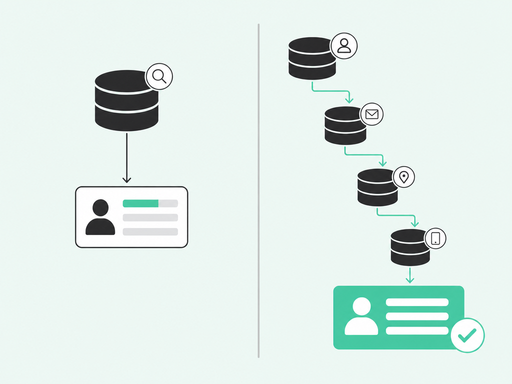
This is the difference that moves match rates most. Single-source enrichment pulls from one database, while waterfall enrichment queries several in sequence until it finds a match. Practitioner benchmarks from Ascentrik Research show single-source matching about 50-70% of a list, while waterfall across three or four providers commonly reaches 80-95%.
Identity Resolution and Deduplication
This is the criterion most roundups skip entirely, and it's the one that quietly decides everything. Enrichment that appends data without resolving identity just creates more duplicates, which makes your CRM worse. Strong providers merge personal and work emails, catch people who've changed jobs, and collapse duplicate records into one clean profile.
Signal Breadth (Beyond Static Fields)
Static firmographics tell you who someone is, not whether they're in-market. Look for enrichment that connects signals, for example, website visits, job changes, product usage, community activity, and G2 research, to the right person. Fields tell you who to call; signals tell you when, and that timing is where pipeline hides.
Integrations and Workflow Fit
Enrichment only helps if it lands cleanly in the systems your team lives in. Confirm native support for Salesforce, HubSpot, Slack, and your warehouse, then ask the harder question: does it write back without spawning duplicates? A provider that dumps unmatched records into your CRM is creating tomorrow's cleanup project.
Pricing Model
In our experience, pricing shapes behavior more than most buyers expect. Per-record and per-credit models punish scale: every refresh and every new contact adds cost. That quietly pushes teams to enrich less than they should.
Platform pricing removes that tax and lets you enrich everything, so coverage decisions stay strategic instead of budget-driven.
AI-Readiness
This is the newest criterion, and the one that separates 2026 vendors from 2020 ones. Ask whether the output is deduplicated, person-level, and structured so LLMs and agents can consume it directly.
If the answer is a pile of raw fields your team still has to clean and reconcile, it isn't AI-ready. That's true no matter what the sales deck says.
4. Types of Data Enrichment Companies
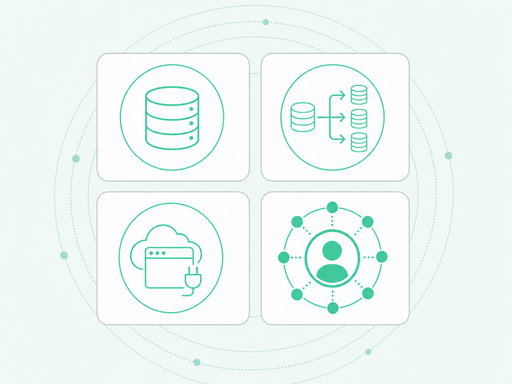
Once you've got a scorecard, it helps to know what you're actually scoring. Vendors describe themselves in a dozen ways, but the market sorts into four broad types. Matching the type to your motion matters more than chasing a brand name, because each type solves a different slice of the problem.
- Contact and database providers: large, mostly static databases you query for contacts and firmographics
- Waterfall and aggregator platforms: services that route each lookup across many sources to lift match rates
- CRM-native enrichment: enrichment that platforms like Salesforce and HubSpot build directly into their products
- Buyer-intelligence platforms: the emerging category that unifies enrichment, identity resolution, and signals into one profile
The first three types have existed for years, and each has a fair use case. Database providers give you reach, aggregators give you match rate, and CRM-native options give you convenience. The fourth type is newer, and it exists because static fields stopped being enough once AI entered the workflow.
One measure of momentum: Grand View Research estimated in June 2024 the data enrichment solutions market will reach $4.58B by 2030, a 10.1% CAGR. That growth reflects demand for cleaner inputs, not just more records.
Many teams end up combining types, and that's fine. The trap is buying three overlapping tools that each enrich in isolation and never reconcile with one another. When that happens, you don't get a fuller picture; you get three versions of the same contact and a new deduplication problem.
Your motion should guide the choice. Outbound teams lean on coverage and match rate, PLG teams need product and community signals unified with identity, and ABM teams need account-level depth. We think the category is moving toward buyer-intelligence platforms. Static fields alone no longer answer the only question that matters: who's ready to buy, and why?
5. How Common Room Approaches Data Enrichment
Everything above maps to how we built our enrichment layer at Common Room by Zoom. The goal isn't more data; it's turning the signals you already have into one deduplicated, AI-ready profile of each person and account.
person360 is Common Room's AI-powered waterfall enrichment and identity resolution engine. It unifies fragmented signals into one trustworthy, deduplicated profile of the right person and account, so your team acts on records it can rely on.
It runs waterfall enrichment across dozens of providers with no cost per enrichment. In head-to-head bakeoffs, that delivers 30-50% higher match rates than competitors, and its AI identity merging reduces duplicate records by up to 79%.
person360 also includes prospector, which uses AI-powered prioritization to surface the right in-market contacts. It helps you identify and prioritize the right buying committee members from the signals you already have.
Lead and account scoring combine hundreds of signals into a transparent, adjustable score. A Chrome extension lets reps enrich and act from Salesforce, HubSpot, or LinkedIn without tab-hopping.
Enrichment on day one only matters if the data stays true on day 90. That's the job of dataagent. It continuously monitors your CRM to surface what's true now, correcting outdated and duplicate records while preserving activity, relationships, and account context.
That keeps GTM systems accurate and AI-ready over time, not just on import day.
For the person who owns GTM systems, that combination matters. You get one enrichment and identity layer to govern instead of a patchwork of contracts, credits, and cleanup jobs. Scoring is transparent and adjustable, so you can explain why a lead ranks the way it does and tune it as the motion changes.
All of it runs on native, fully managed integrations across 50+ channels, including Salesforce, HubSpot, Slack, Snowflake, Segment, GitHub, G2, and Bombora. It's the same approach that Atlassian, Anthropic, Autodesk, Notion, Okta, and Snowflake trust to keep their buyer intelligence clean.
As part of Common Room by Zoom, that trusted, person-level buyer intelligence is the identity and enrichment layer of a revenue operating system. It pairs with Zoom's native action layer for calling, sequencing, coaching, and forecasting, so your team turns clean intelligence into coordinated action. Every call, sequence outcome, coached conversation, and closed deal writes back to the shared context layer, so targeting, coaching, and forecasting improve over time. You also carry less vendor overhead, because there's no patchwork of enrichment feeds to reconcile.
That's the whole thesis in practice. Enrichment isn't appending fields; it's unifying every buying signal into one profile your team and your AI can both rely on.
Want to see it on your own data? Request a demo.
6. Frequently Asked Questions
What are the top data enrichment companies?
The market splits into database providers, waterfall platforms, CRM-native tools, and buyer-intelligence platforms. Choose by architecture and fit for your motion, not by brand name.
How much does data enrichment cost?
Pricing usually follows a per-record or per-credit model, or a flat platform model. Per enrichment pricing gets expensive fast at scale, because every refresh and new contact adds cost.
What are data enrichment services?
Data enrichment services combine external data with your records to fill gaps, verify contacts, and refresh stale information. The best ones also resolve identity and unify buying signals.
What is waterfall data enrichment?
Waterfall data enrichment queries multiple providers in sequence to maximize match rate. Practitioner benchmarks from Ascentrik Research put it near 80-95%, versus 50-70% for single-source enrichment.
Is data enrichment worth it for AI and GTM workflows?
Yes, because AI amplifies whatever data quality it inherits. Deduplicated, AI-ready enrichment is a prerequisite for scoring, agents, and any trustworthy AI output.
If you remember one thing about how to choose a data enrichment company, make it this: match coverage to your ICP, not to the pitch.
The right data enrichment company won't just hand you more records. It will give your team and your AI a single, current view of every buyer. And it will keep that view honest as people change jobs and companies change shape.
Bad data doesn't announce itself. It shows up as a missed forecast, a duplicate outreach, or an AI agent that confidently works the wrong account.
The right data enrichment company turns that risk into a foundation you can build on. See how we do it on your own data: Request a demo.