

Updated: September 24, 2026
Most go-to-market teams are blind to the majority of their buying signals. Even when they spot one, they can't act on it fast enough. That's the gap our customer intelligence platform closes.
We started Common Room to change how organizations connect with people. Our customers transformed us.
Our work began in community and developer relations. We saw fast-growing companies like Figma, Asana, dbt Labs, and dozens of others rewriting the go-to-market playbook.
We saw them turning product users into product champions. And we saw them building a new type of growth engine in the process.
But we also saw them struggling.
Community and DevRel teams had no tools, they were constantly reacting while working out of spreadsheets. So we set out to build what they needed.
And then a funny thing happened. As they connected their work to the wider GTM org, teammates started exploring how they could drive business outcomes using Common Room.
We heard from hundreds of teams across the GTM spectrum. That included sales leaders at Temporal, growth marketers at Amplitude, customer success reps at Notion, and RevOps managers at Apollo GraphQL.
It was clear teams in every corner of GTM felt the problems we were solving for community and DevRel.
No matter the company, no matter the team, everyone was in search of the same solution:
One place that automatically captures every buyer and customer signal, no matter the source.
One place to connect those signals to a unified profile for every person and account.
And one place to automate last-mile actions on those signals and rapidly iterate.
We listened. We dug deep into our customers' pain points and goals. And we applied those learnings to our product.
The result is the first of its kind: a customer intelligence platform, built for GTM teams, by GTM teams. It has end-to-end signal capture, person-first visibility, and workflow automation at its core.
Our customers are inventing the future of GTM right now, and they're leading the way.
Innovation requires new ways of thinking
Here's what I've learned after countless customer calls. Most GTM teams are blind to the majority of buying signals, or can't connect them across the customer journey. And even when they do, they can't act on them.
It's no secret that the customer journey keeps getting cloudier and more fragmented. Gartner finds 67% of B2B buyers now prefer a rep-free experience. McKinsey reports buyers now use an average of 10 channels across the purchase journey. As Gartner describes it, buyers loop through that journey in no fixed order, and sales reps are just one of many channels they use.
In fact, it's something our original customers in community and DevRel are intimately familiar with.
Communities, no matter where they live, are inherently messy. And anonymity is often a feature, not a bug. So lack of visibility into people and their actions across channels was a challenge from the get-go.
But as the dark funnel gets darker, organizations are waking up to how broken GTM truly is.
Companies adopt endless point solutions in an attempt to fix the problem, but it only compounds it. GTM teams jump from interface to interface trying to piece together a patchy view of the customer. They spend hours stitching together disjointed data points, and more time struggling to take action on what they find.
If they're lucky, they get access to confusing dashboards built by overworked data teams. But they can't see the people behind the bar charts.
More often than not, they're either incapable of accessing the insights they need or inundated with a firehose of data that causes analysis paralysis.
The trouble stems from legacy technologies that have become entrenched in GTM. These tools were built for an earlier era, one where teams focused on linear sales funnels, account-level data, and generic, high-volume outreach. Person-level insights and modern buying behaviors weren't part of the equation.
Vendors build every new piece of GTM tech around them and their outdated data structures. So each point solution that enters the market aims to treat a symptom of the problem instead of the underlying cause.
We avoided this trap because our product wasn't built around that paradigm. We were working with organizations that needed a person-first, cross-channel view of customers far outside the bounds of what traditional tools could offer.
If the last 25 years of GTM have been about digitizing Rolodexes and chasing account-level "intent," the future is what our customers are doing today.
We designed our customer intelligence platform to help every GTM team do the same.
GTM can be fixed
Most organizations run their GTM operations using dozens of point solutions built on top of their CRMs, data warehouses, and marketing automation tools.
Many of these technologies go unused or offer a sliver of insights instead of the whole picture. They create bloated tech stacks that are essentially held together with duct tape. And, worst of all, they don't solve the issues plaguing GTM teams:
Siloed and unseen signals
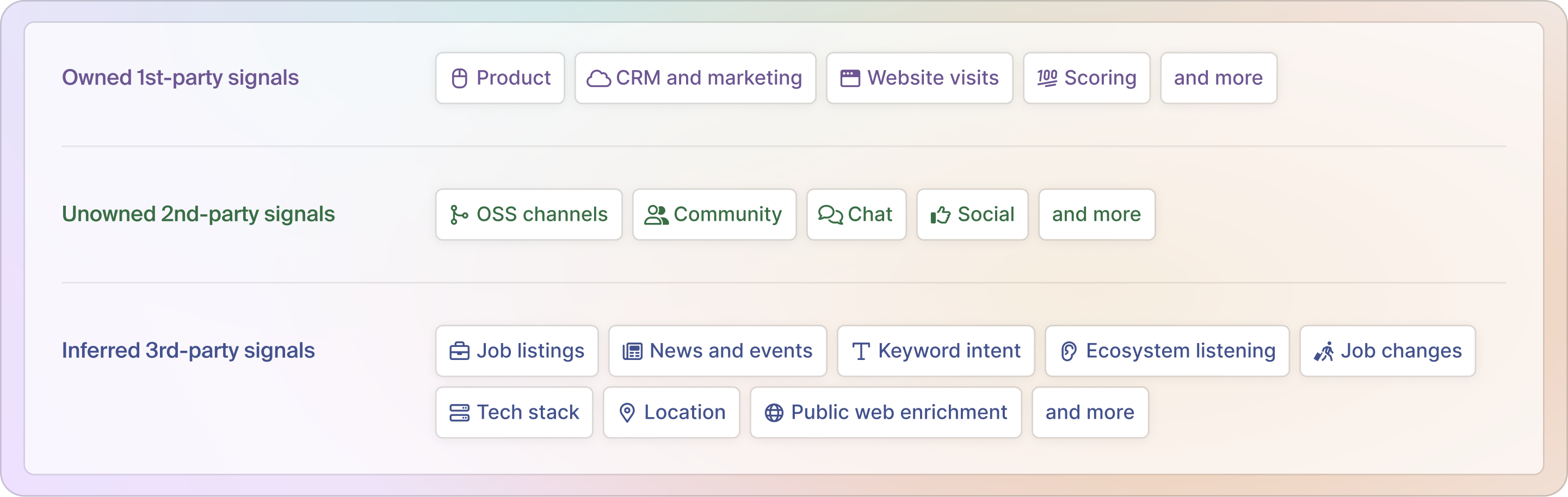
Customer and account signals come in many forms: owned first-party signals, unowned second-party signals, and inferred third-party signals. They sit siloed across multiple technologies or hidden in the dark funnel, leaving GTM teams reliant on stretched-thin operations teams for basic insights. Worse yet, in our experience most martech and salestech misses the majority of the modern funnel.
👂 What we heard
One of our customers, a leader in video editing software, shared a telling stat. Sales reps there spend 60% of their time cobbling together context for personalized outreach instead of actually selling. Missed pipeline opportunities, and, even worse, missed revenue targets, are the norm.
Identity blindness
Spotting signals is hard enough. Getting visibility into the people behind them and connecting the dots across channels is next to impossible. GTM teams lack key context and end up chasing account-level info that fails to generate quality opportunities, conversations, or relationships.
👂 What we heard
One of our customers, a leader in workflow automation software, saw the payoff of reaching the right personas. That work drove 62% of overall revenue and 44% higher annual contract values, yet teams mostly reached out to the wrong stakeholders. High-intent, high-fit opportunities fall through the cracks.
Manual workflows
The last mile from data to action requires GTM teams to stitch together data and push it from one tool to another. The best performers try their best with user-unfriendly tools. The rest settle for the status quo.
👂 What we heard
One of our customers, a leader in security software, described a fractured data problem. The data its teams need for sales, marketing, and success is split across multiple tools, unenriched, unmapped to accounts, and inaccessible to the GTM org. Planning and launching plays requires massive effort from ops and hours of context-switching from GTM teams.
Our Head of Marketing, Kevin White, shared a resource on LinkedIn highlighting the sheer breadth of modern signals available to GTM teams. It listed 100 of them, in fact, and the response was overwhelming.
Every organization is hungry to succeed in this new era of GTM.
But as our customers told us, in order to do that, you need:
- Signal prioritization: Unify existing signals and surface the next best action for each person and account.
- Unified identity: Connect those signals to real people and the places where they work.
- Workflow automation: Explore, act on, and automate responses to those signals at scale.
That's exactly what our customer intelligence platform delivers, all in a fully customizable package with a user interface designed specifically for GTM practitioners.
Go to market intelligently
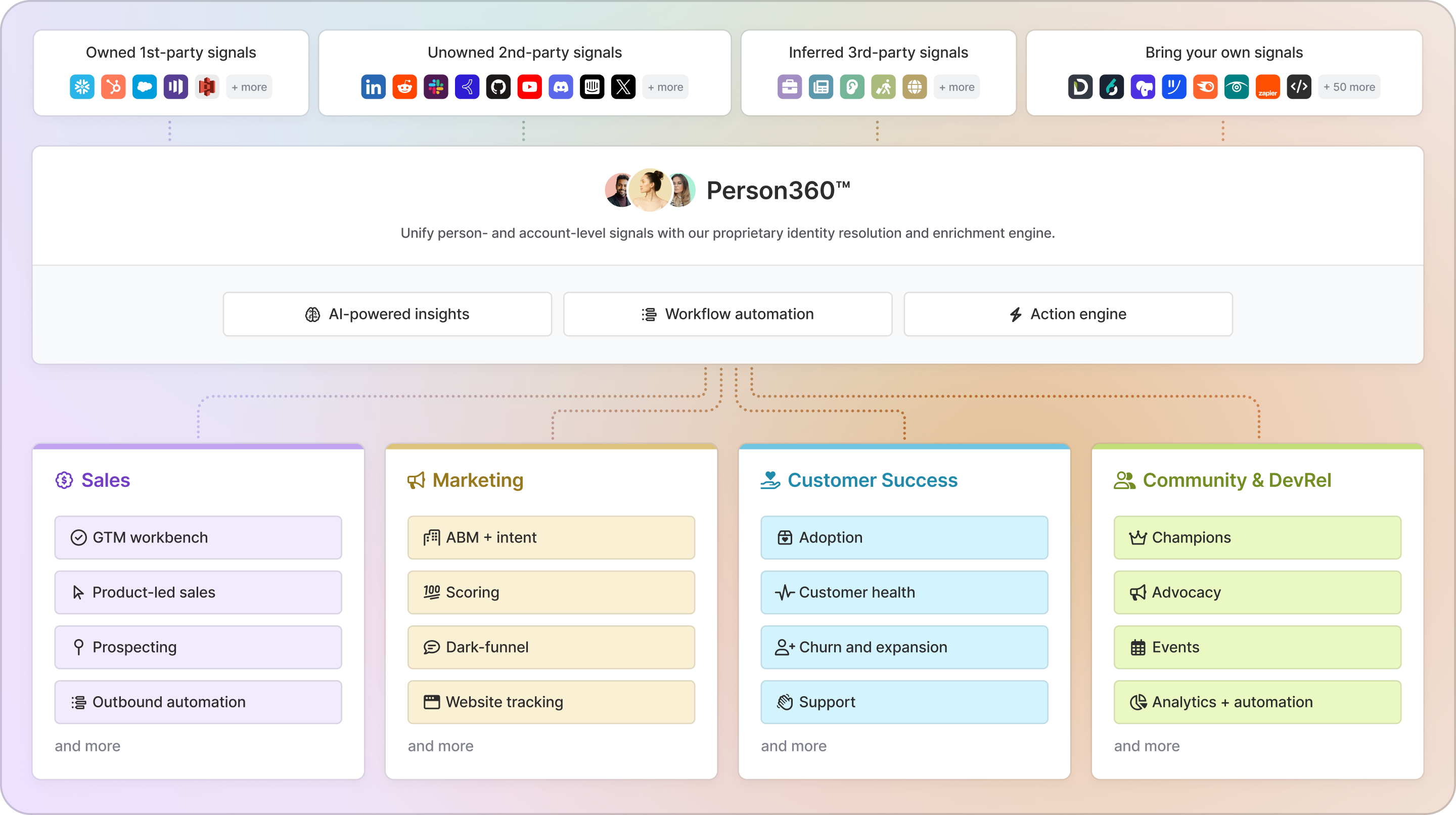
We democratize customer intelligence for every GTM team, giving them a unified, person-first view of the entire customer journey across every touchpoint. More than that, we give teams the tools they need to take action on it fast.
Here's how our customer intelligence platform makes every member of GTM, from sales to marketing to community to CS to ops, a top performer:
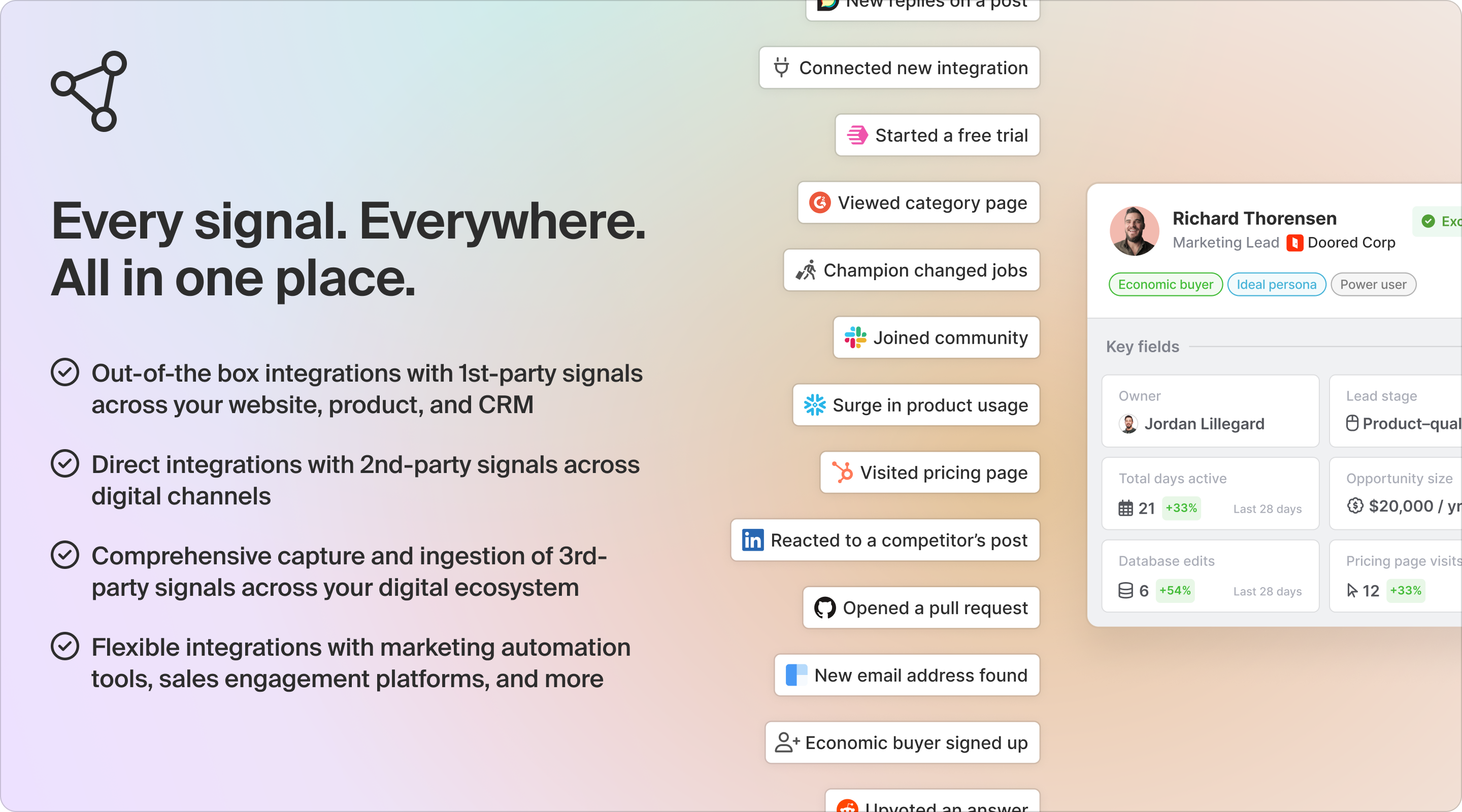
Digital signal capture
Buyer and customer signals are everywhere. They span owned, first-party sources like your product, website, and CRM. They include second-party sources like social and community channels. They also draw on third-party sources like job listings, news and events, and intent vendors.
Common Room unifies all of them and highlights which prospects and customers deserve action now, so you get a complete, prioritized picture of every buyer.
Instantly alert Salesforce account owners in Slack the moment a current champion or customer changes jobs.
Automatically add budget holders at accounts seeing a surge in product usage to personalized Outreach sequences.
Immediately plug anyone who engages with a competitor on social into a tailored HubSpot campaign.
Our customer Apollo GraphQL uses our flexible, out-of-the-box integrations to centralize previously siloed and hard-to-see signals in one place.
Common Room combines dark-funnel signals from open-source repositories, social channels, and online forums with website engagement data, product usage insights, and CRM records. GTM teams can spot the signals that matter most and act on them faster.
Visibility into this activity helps Apollo GraphQL drive 26% of qualified leads.
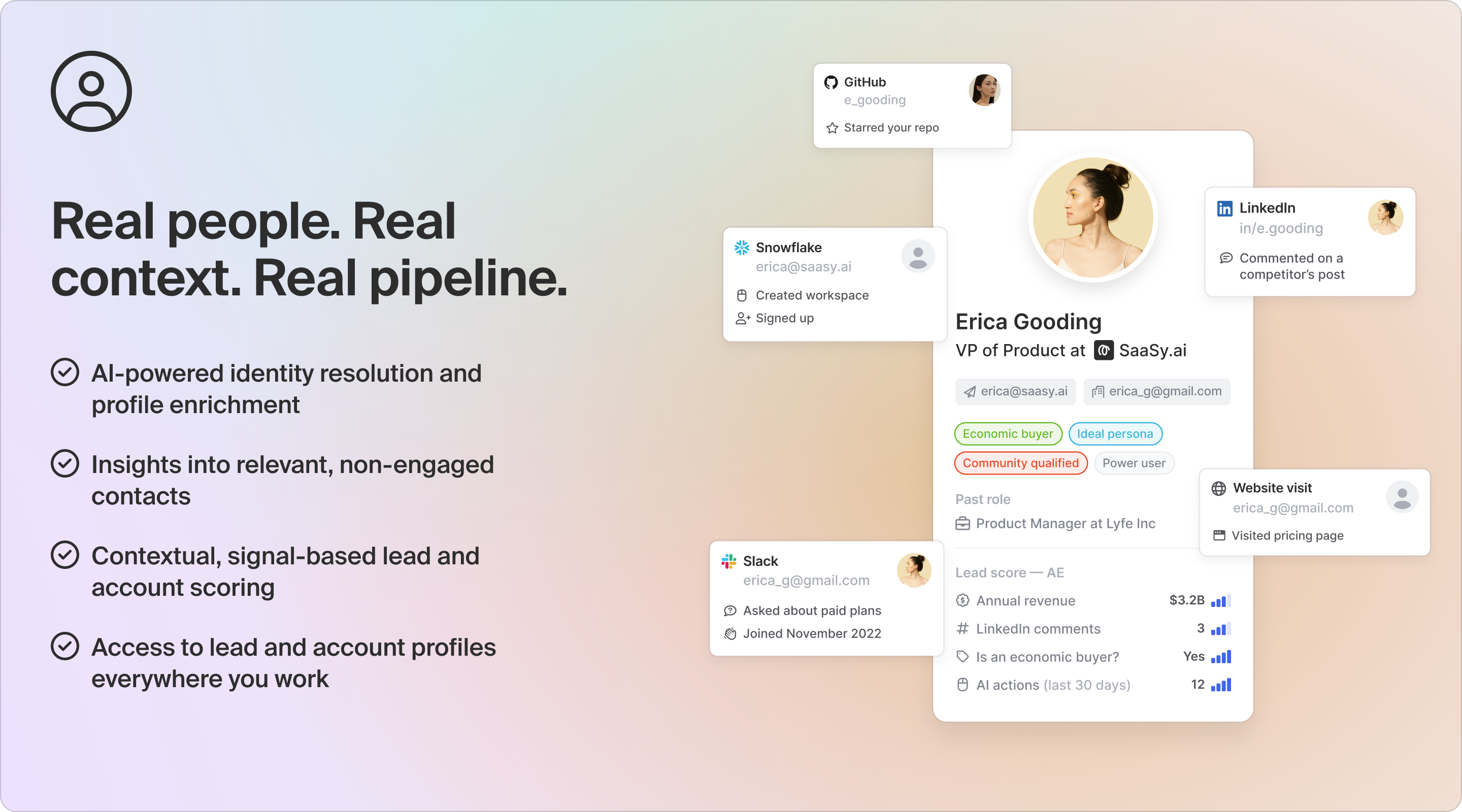
Unified identity and account intelligence
Signals aren't valuable unless you can see the person behind them. That means their title, seniority, and whether they belong to an account worth paying attention to.
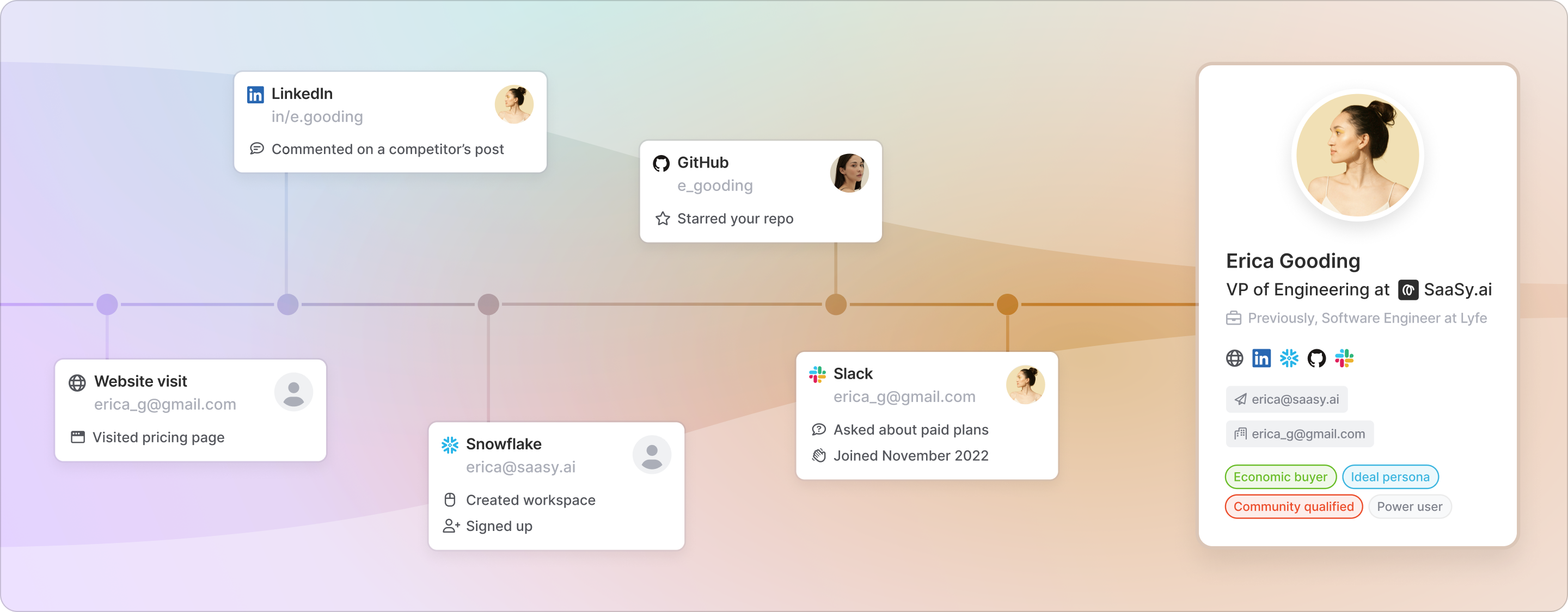
Common Room's person360 provides an intuitive, 360-degree view of every interaction across the modern customer journey. It connects each interaction to a real person and account.
It combines a 400M+ contact directory with your first-party customer data and real-world buyer signals across CRM, product, marketing, and engagement systems. Together, that resolves every identity at the person level.
Automatically tag and identify anyone with a director-level or above job title as an economic buyer.
Easily add demographic and firmographic behavioral data to lead and account scores.
Go beyond waterfall enrichment to achieve the highest match rate (50%) and accuracy (90%-plus) in the industry.
Our customer Pulumi uses our AI-powered identity resolution and enrichment engine. It matches, merges, and enriches signals from every channel where buyers and customers are active.
Common Room syncs each signal to a unified identity and account. That profile reveals job title, work history, contact information, firmographic fit, recent activity across digital channels, and more. GTM teams quickly zero in on high-intent, high-fit opportunities.
Access to person-first insights helps Pulumi drive 27% of meetings booked.

Actions and automation
Signals are only as good as what you do with them, and how quickly you act.
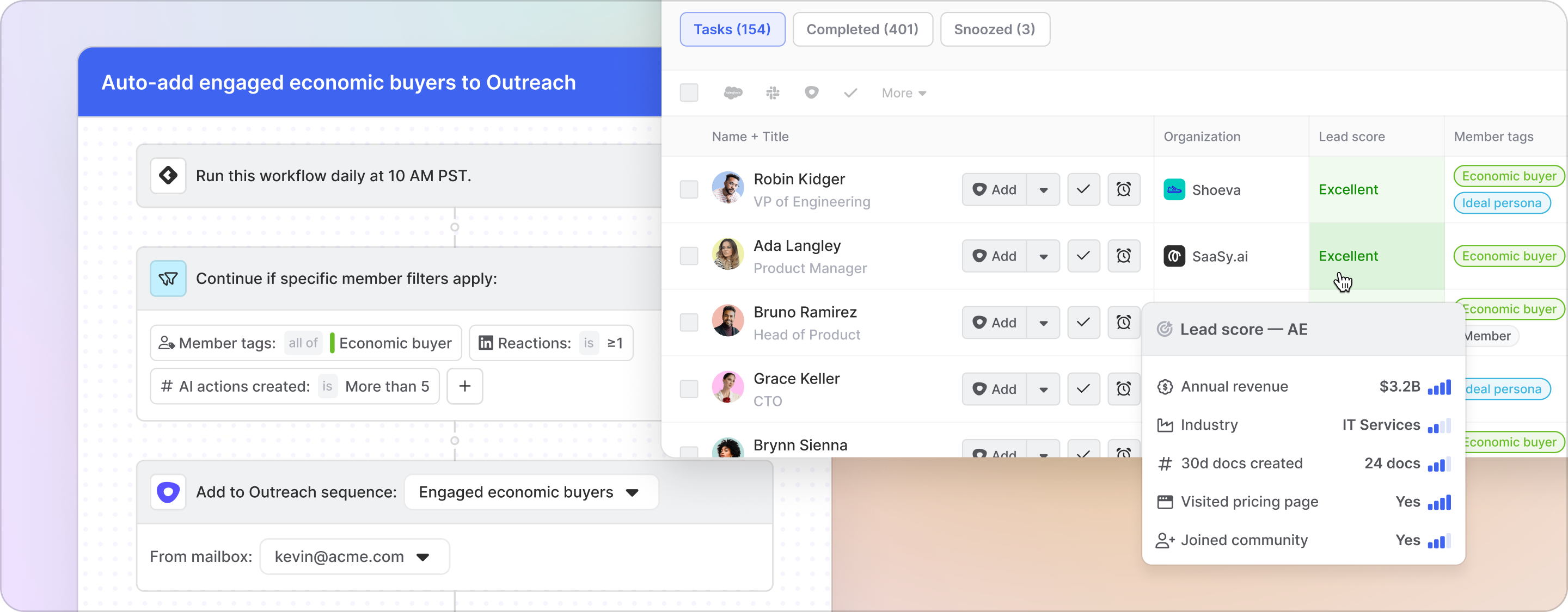
We enable you to customize, templatize, and automate plays based on any combination of signals to drive business outcomes at scale.
Automatically add prospects who interact with website content to customized burn-down lists.
Send real-time notifications to reps when economic buyers join priority accounts in the product.
Effortlessly send a personalized DM to ideal personas who join a community.
Our customer Notion uses our segments, real-time alerts, and customizable workflows to quickly take action on buyer and customer activity.
Common Room automatically adds high-fit product users and ideal personas to dedicated burn-down lists, segmented by region and account ownership in Salesforce. Real-time alerts keep teams updated on economic buyer activity and recent job changes.
Automated workflows let teams tag people and accounts for different plays, add them to personalized email sequences, and more. GTM teams act on customer intelligence instantly.
Prebuilt templates and powerful automations help Notion reach the right person every time. Teams always deliver the right message at the right moment.
We know that no two teams are exactly alike. Each needs the freedom to adapt its data models and workflows in an instant, without waiting for permission or resourcing from other teams.
Common Room's intuitive UI treats GTM users as first-class citizens. It's easy to gather timely insights, pinpoint high-value opportunities, and take action without depending on technical teams.
We've seen firsthand how transformative a customer intelligence platform is for our customers.
Sales teams can boost rep productivity, prioritize the best opportunities, and hit their revenue targets.
Marketing teams can grow the top of the funnel with signal capture across dark-funnel touchpoints. They can take a more informed approach to account-based programs and show the impact of investments in once hard-to-track channels.
Community and DevRel teams can automate manual tasks to focus on high-value activity and deliver better experiences to prospects and customers. They can show business impact without stitching everything together in spreadsheets.
Customer success teams can proactively spot churn risks, build stronger customer relationships, and fuel account growth.
And operations teams can consolidate unused point solutions and reduce operational burdens on themselves and GTM teams. They can deliver actionable insights that accelerate growth.
The new breed of data-driven GTM leader is rewriting the playbook for how modern organizations go to market.
They're only getting started, and we're thrilled to be the first platform to help them turn their vision into reality.
Every signal, everywhere. Tied to a unified identity. Made actionable and automated.
The future is here, and the Common Room customer intelligence platform powers it.
Thank you to Roomies Kevin White, Bowen Pan, and Eric Wendt for the collaboration.
Customer intelligence platform FAQs
What is a customer intelligence platform?
A customer intelligence platform captures buyer and customer signals from every channel, connects them to real people and accounts, and turns them into action. Instead of account-level records and disconnected dashboards, it delivers person-level buyer intelligence: a unified, continuously updated view of who's in-market and why. That's what lets sales, marketing, and revenue operations teams act on the right signal at the right moment.
How is a customer intelligence platform different from a CRM?
A CRM stores what your team already knows: contacts, deals, and notes your reps enter by hand. A customer intelligence platform sits on top of that record and fills in what the CRM can't see. That includes job changes, product usage, community activity, and social engagement across the dark funnel.
It resolves those signals to a person, not just an account. Teams stop chasing stale contact lists and start reaching buyers who are actually ready to talk.