

Most PLG + SLG motions don't stall because the strategy is wrong.
They stall because the org doesn't evolve alongside it.
The signals get defined. The plays get built. The automation goes live. And then the motion gets layered on top of existing roles, existing responsibilities, and existing incentives that were designed for a different job. The demand gen team is optimized for self-serve volume. The sales team is built for inbound qualification. Both are good at what they were hired to do.
Neither was hired for this.
Adding an SLG motion to a PLG company isn't about replacing what's working. It's about adding new capability alongside it: new roles, new muscle, new accountability structures that didn't need to exist before. The companies that get this right treat it as an expansion of the team, not a reorganization of it.
The ones that get it wrong try to run the new motion with existing bandwidth and wonder why nobody has time for it.
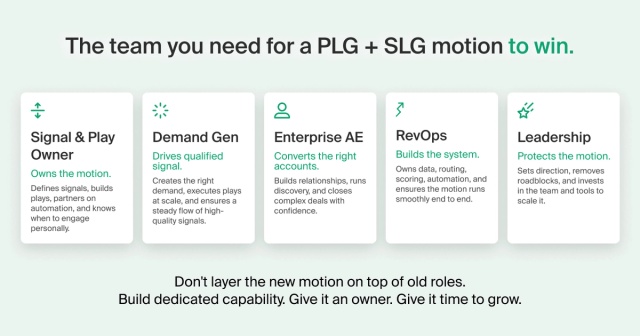
What the new motion actually requires
PLG and SLG require genuinely different skills, not better or worse, just different.
PLG motion is built by people who think in systems. Content, product, community, onboarding: the work scales without constant human intervention. The best PLG operators have spent years building things that run themselves, and they're rightly proud of it.
SLG motion is run by people who think in relationships and timing. Reading signals, finding the right person in an account, knowing when a conversation is worth having and when to let the automation do its job. The best enterprise operators have instincts built from thousands of conversations that no amount of tooling fully replicates.
The PLG + SLG motion needs both. Asking the people who are great at one to also own the other, on top of their existing responsibilities, is how you get a motion that's nobody's priority and everyone's problem.
The answer isn't to choose between them. It's to build both.
The hire that unlocks the motion
The most important hire in the PLG + SLG motion isn't a VP of Sales.
It's the person who owns the connective tissue between product and revenue: someone who can read product signals, define plays, work with demand gen on automation, and also pick up the phone when the signal is strong enough to warrant a human conversation.
This person is genuinely rare because the role sits at an intersection most career paths don't prepare people for. They need to be analytically rigorous enough to build a scoring model, technically literate enough to work with the automation layer, and commercially sharp enough to know what to do when the play surfaces a real opportunity.
They're usually coming out of somewhere in between pure sales and pure marketing: revenue operations, growth, or an early PLG company where they had to do all of it at once out of necessity.
Otter AI made this hire deliberately. They brought in a dedicated leader specifically for the PLG + SLG motion, giving the new motion its own owner rather than distributing responsibility across existing roles. That decision matters more than it sounds. When a new motion sits under existing leadership without its own dedicated owner, it gets prioritized like everything else that leadership already owns, which means it gets deprioritized the moment something more urgent shows up. Which is always.
Give the new motion its own leader. Give that leader clear accountability. Give them time to build before you judge the results.
The handoff that breaks most motions
Even when the right people are in place, the motion often breaks at the handoff.
A signal fires. The play runs. A response comes in. And then, nothing. Because the demand gen team thinks sales owns it from here, and the sales team thinks it's still in the marketing funnel, and by the time anyone figures it out the moment has passed.
This sounds like an operational problem. It's actually a structural one.
Traditional PLG handoffs are clean. Marketing owns top of funnel. Sales takes over at an agreed point: a demo request, a form fill, a trial that hits a threshold. Everyone knows the rules. The process works because it's been refined over years and the handoff point is unambiguous.
Signal-based plays don't work that way. The handoff point isn't a form fill. It's a judgment call: is this signal strong enough, is this account ready enough, does this warrant a human conversation or should it stay in automation? That judgment call needs to be made consistently, by people who agree on the criteria, without relitigating it every time something fires.
The teams that solve this write the criteria down. Explicitly. In advance. Not a general principle, a specific rule. Executive signup at a tier-one account gets a human within 24 hours. Signup surge at a tier-two account runs automated and gets human review only if there's a response. Feature gap play at an existing customer goes to the CSM, not the AE.
When the rules exist, the handoff works. When they don't, the motion depends on coordination between teams with different priorities. And coordination between teams with different priorities is just conflict that hasn't happened yet.
Demand gen and sales as one motion
In most companies, demand gen and sales have a relationship best described as politely adversarial.
Demand gen thinks sales doesn't follow up. Sales thinks demand gen sends them garbage. Both are usually at least partially right, and neither is entirely wrong. The tension is structural: demand gen is measured on volume, sales is measured on revenue, and the incentives don't naturally align.
The PLG + SLG motion changes this, or at least it should.
Signal-based plays aren't leads in the traditional sense. They're triggered moments that require a specific response within a specific window. Demand gen has to build them. Sales has to run them. Neither succeeds without the other, which means the politely adversarial model has to go.
The companies that make this work stop treating demand gen and sales as separate functions with a clean handoff between them. They treat them as a single motion with shared accountability for pipeline. The signal fires, the play runs, the rep acts, and both teams own what happens next.
This requires shared metrics, not marketing-qualified leads at the top and revenue at the bottom. Pipeline, all the way through, owned jointly. When both teams are measured on the same number, the incentive to blame each other quietly disappears. It doesn't happen overnight. But it happens.
What the evolved team actually looks like
There's no universal org design for this. Company size, product complexity, and go-to-market stage all shape the right structure.
But the teams doing it well tend to share a few things.
They added dedicated ownership for the new motion rather than distributing it across existing roles. One person, or one small team, with clear accountability for signals, plays, automation, and the first human touch.
They have explicit handoff rules that are written down and actually followed. Not "use your judgment," specific criteria, specific owners, specific timeframes that everyone has agreed to in advance.
They measure demand gen and sales on shared pipeline metrics. Not vanity metrics at the top of the funnel and quota at the bottom. The same number. All the way through.
And they give the motion time. The PLG + SLG motion isn't a quarter-long project. It's a multi-year build. The companies that get impatient and judge the results before the motion has had time to compound are the ones that abandon it right before it would have started working.
The existing team got you here. The evolved team takes you further.
Both are necessary. Neither is sufficient alone.
The series so far
Seven posts in, here's what we've covered.
The case for layering SLG on top of PLG, and why the window to move is now. How to define your real enterprise ICP from closed revenue data, not gut instinct. Why behavioral scoring outperforms firmographic scoring, and how to build the model. The five signal-based plays every PLG company should be running. How to build a signal hierarchy that tells you when to activate and what to ignore. Why most automation breaks, and how to build it so it doesn't. And now, the org evolution that has to happen alongside all of it.
The through-line is the same across all seven: the companies that win aren't the ones with the most users, the most signals, or the most automation. They're the ones that built the full stack: ICP clarity, behavioral scoring, plays, signal hierarchy, automation architecture, and the team to run it, and gave it time to compound.
That foundation doesn't build itself.
But once it's built, it's very hard to catch up to.
That's what this series has been about.