
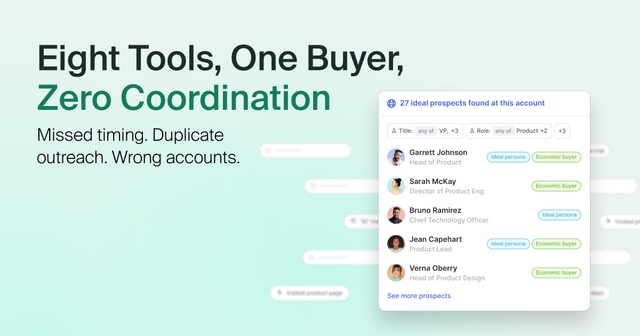
Two reps email the same contact on the same Tuesday morning, forty minutes apart.
Neither one knows the other exists. Neither tool they're using knows either. The contact, understandably, replies to neither. They just quietly file your company under "disorganized" and move on with their day.
Nobody made a bad decision here. Both reps followed their process. Both tools did exactly what they were built to do. The problem isn't a person or a platform. It's the eight or ten systems standing between them, each holding a fragment of the same buyer, none of them talking to each other.
This is the cost of fragmented data. It rarely shows up as one dramatic failure. It shows up as a hundred small ones, quietly compounding, until a quarter ends and nobody can explain exactly where the pipeline went.
Fragmentation doesn't look like chaos. It looks like a normal Tuesday.
If fragmented data caused visible fires, it would get fixed fast. Instead, it causes something quieter and more expensive: a system that looks like it's working while it's actually leaking value out of every seam.
Picture an account moving through a real deal cycle. Marketing automation has one view of that account, based on email opens. The CRM has another, based on the last logged call. The intent platform has a third, based on anonymous web activity. Product usage data lives somewhere else entirely, often in a warehouse nobody outside of data engineering has ever opened.
Each system is confident in its own version of the truth. None of them are lying. They're just each holding one instrument's sheet music, with no conductor in the room and no shared tempo. The result isn't silence. It's noise that sounds like music if you don't listen too closely.
What's missing is buyer intelligence: one continuously updated understanding of the buyer that travels with them across every system, instead of eight separate half-pictures.
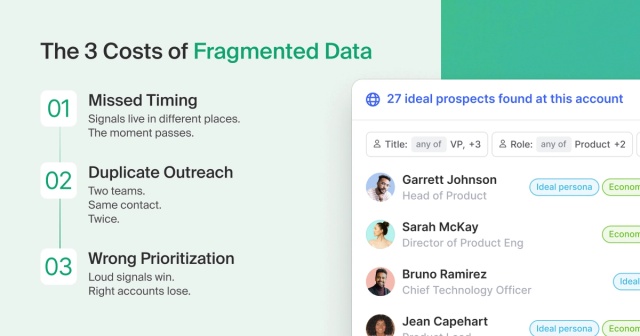
The three costs that actually show up in the pipeline
Fragmentation doesn't cost you in the abstract. It costs you in three specific, expensive ways, and all three show up in a normal week, not a crisis.
Missed timing
A contact gets promoted into a budget-holding role. A product trial hits a usage threshold that historically predicts a buying conversation. A prospect leaves a pointed comment on a community post asking about a feature your roadmap just shipped.
Any one of those moments is a legitimate reason to reach out today. In a fragmented stack, each signal lives in a different system, discovered by a different team, on a different timeline. By the time anyone connects the dots, often during a pipeline review two weeks later, the moment has already passed. The buyer has already moved on, or worse, a competitor already showed up while the window was open.
Timing is the one thing you can't get back. A fragmented stack doesn't lose data. It loses the window the data was supposed to open.
Duplicate outreach
This is the version everyone's felt personally, whether as the rep sending the redundant email or the buyer receiving it. Two systems, unaware of each other, both decide the same contact deserves a message this week. Neither is wrong on its own. Together, they make your company look like it doesn't know its own customers.
Duplicate outreach isn't just an efficiency problem. It's a trust problem. A prospect who gets contacted twice about the same thing doesn't conclude you're thorough. They conclude nobody's actually paying attention, which is the opposite of the impression a GTM motion is supposed to create.
Wrong prioritization
Maybe the most expensive cost, because it's invisible until you go looking. When buyer signal lives in eight disconnected places, prioritization gets built on whichever slice of data happened to be easiest to query, not the most complete picture of what's actually happening.
An account that looks quiet in the CRM might be lit up with product activity nobody on the sales side can see. An account with a rising intent score might already have churned interest three weeks ago, a fact sitting untouched in a support ticket system. Reps end up chasing the accounts the dashboard made loud, not the accounts that are actually ready. Fragmentation doesn't just slow teams down. It actively points them at the wrong doors.
This isn't make-believe. incident.io ran the numbers on their own CRM before fixing the underlying identity problem: about 3% of their accounts were duplicates. After, that number dropped to roughly 0.3%. A tenfold reduction, on the exact failure mode this piece is describing.
Why "unified" gets used so loosely
Almost every GTM tool on the market claims to be "unified" now. Most of them mean something much smaller: a shared login, a single pane of glass, a dashboard that pulls a few feeds into one screen without ever resolving whether "Sam Chen" in the CRM and "S. Chen" in the product database are the same human being.
Sitting on stale or duplicate CRM records is the norm, not the exception because most teams have far more decay in their data than they'd guess, and it compounds the moment nobody's actively fixing it.
That's consolidation, not unification. It's tidier. It's still fragmented underneath, just fragmented with better paint.
Real unification means every signal, regardless of which system captured it, resolves back to one real, continuously updated record of who this person is and what's actually happening with them. Not a login. A living identity.
What unified actually requires
Getting there takes more than picking a platform with the word "unified" in its pitch deck. It requires three things working together, continuously, not as a one-time cleanup project.
Identity resolution that never stops running. People change jobs, change titles, and show up across a dozen systems under slightly different names and email addresses. Unification means automatically resolving all of that back to one person and one account, in real time, not during an annual data hygiene sprint.
Data that stays honest over time. Duplicate records and stale fields creep back in constantly. A system that checks its own work, flagging drift before it corrupts a pipeline report, is what keeps "unified" from quietly decaying back into "fragmented" within two quarters.
A single view that travels into the workflow. Unified data that only lives in a new dashboard hasn't actually solved the original problem. It has to show up where the decision gets made: inside the CRM record, the Slack thread, the inbox, the call prep a rep opens five minutes before dialing.
Miss any one of those three, and you've built a nicer-looking version of the same fragmentation, just with fewer visible seams.
The question worth asking your own stack
Not "how many tools do we have." Most teams already know that number, and it's rarely flattering.
Ask instead: if a buyer signal appeared in any one of our systems right now, would every other system, and every person relying on them, know about it within the hour?
If the honest answer is no, that's the cost of fragmented data showing up in your pipeline right now, quietly, on an otherwise normal Tuesday. The orchestra's still playing. The question is whether anyone's finally holding the baton.