
Somewhere in your company right now, there's a gym membership nobody uses.
Not a real one, necessarily. A tool. A platform. Something that got a great demo, a confident champion, and a signed contract, and now sits quietly in the corner of your tech stack with a login page nobody's visited since onboarding.
It wasn't a bad tool. It just asked people to change how they move through their day, and people, reasonably, didn't. Adoption doesn't fail because a feature is weak. It fails because the feature lives somewhere reps have to remember to go.
Meeting reps where they work isn't a nice phrase for a slide. It's the single variable that decides whether an AI tool becomes muscle memory or becomes a line item nobody can explain in next year's budget review.
The graveyard is full of powerful tools nobody opened twice
Walk through the history of any GTM stack and you'll find a small graveyard of genuinely capable software. Tools that scored accounts correctly. Tools that surfaced real insight. Tools that, on paper, should have changed how a team worked.
Most of them share the same cause of death: they required a new habit. A new tab to remember. A new login to keep open. A new place to check, on top of everywhere else a rep already has to check.
Reps aren't lazy for skipping that step. They're rational. A day already has a CRM, an inbox, a calendar, a Slack workspace, and a dozen browser tabs open at once. Every additional surface a tool asks for isn't a small ask. It's a tax on attention that gets paid every single day the tool stays in the stack, whether anyone uses it or not.
Adoption doesn't break at the feature level. It breaks at the doorway: powerful intelligence sitting behind a door nobody opens might as well not exist. It's the exact problem Intelligence Doesn't Need a Home Screen digs into: most AI adoption fails at the same moment, when a rep hits a wall, gives up on the tool, and does the work by hand instead.
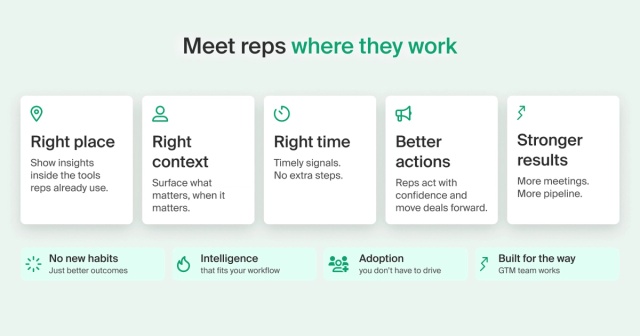
What meeting reps where they work actually looks like
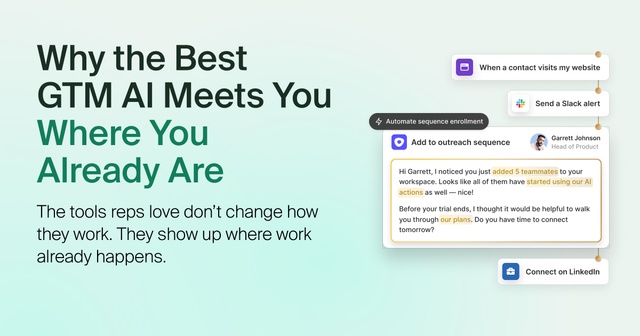
Inside the CRM, where deals already live, the buyer intelligence shows up on the record itself, not in a separate report a rep has to go pull.
Inside Slack, where teams actually coordinate deals in real time, the alert about a hot account or a newly active buyer arrives in the channel where the conversation is already happening, not in a weekly digest email nobody opens.
Inside the browser, while a rep is already looking at a LinkedIn profile or a prospect's website, the context appears alongside what they're already viewing, instead of requiring them to copy a name into a different tool entirely.
Inside email, where outreach actually happens, the personalization context shows up while the rep is drafting, not as a separate research step that happens hours earlier and gets forgotten by the time they sit down to write.
None of these are exotic integrations. They're the ordinary places where work already happens. The intelligence doesn't ask reps to come find it. It arrives.
Notion is a clean example of what this looks like at scale. Their team wasn't short on data about prospects, they were short on a way to get it in front of reps at the moment it mattered. Once buyer intelligence started showing up where reps already worked instead of in a separate report, meetings per rep went up 30% and pipeline grew 74% in a single quarter. That's not a story about a smarter tool. It's a story about removing the doorway entirely.
No behavior change is the ambitious goal, not the modest one
There's a temptation to treat "no behavior change" as a modest, almost apologetic goal, something you settle for when you can't ship anything more ambitious. That's backwards.
Getting a genuinely intelligent system to operate invisibly, inside habits that already exist, is a harder problem than building the intelligence itself. Anyone can bolt a new dashboard onto a stack. Building something that changes outcomes without changing how someone's day feels is the actual craft.
The teams that get this right aren't asking, "what powerful new thing can we build." They're asking, "where does a rep already look, and how do we make sure the right thing is already there when they do." That's a smaller, humbler question. It's also the only one that survives contact with an actual Tuesday.
The tell that separates a tool people use from a tool people tolerate
There's a simple test that predicts adoption better than any feature comparison: ask a rep to describe their morning routine, out loud, in order. CRM, email, Slack, maybe a browser tab for research. Whatever they list, in whatever order, is the map of where a tool needs to live.
If your AI tool isn't on that list, it's not a productivity gain. It's homework. And homework, no matter how well-designed, competes for a kind of attention reps have already allocated to something else.
The inverse is just as telling. When a tool shows up inside that existing list, unprompted, reps stop thinking of it as a tool at all. It becomes part of how the CRM behaves, part of what Slack does, part of what shows up when they open a prospect's page. That's the moment adoption stops being a metric you track and becomes a habit nobody has to be reminded to keep.
Meeting reps where they work is a retention strategy, not just a UX preference
It's worth saying plainly: every AI tool that requires a new surface is quietly betting against its own adoption curve. Some reps will use it in month one, out of curiosity or obligation. By month four, only the most disciplined few will still remember to check it, and by month eight, it's the gym membership nobody talks about anymore.
Meeting reps where they work isn't a feature to ship once and move on from. It's the operating principle that decides whether everything else you build actually gets used, or just gets bought. Intelligence where you need it shows exactly which surfaces this looks like in practice.
The best AI a GTM team will ever adopt won't announce itself. It'll just already be there, in the CRM record, the Slack thread, the browser tab, and the email draft, exactly where the rep was already headed. That's not a lesser version of intelligence. It's the only version that survives an actual workday.