
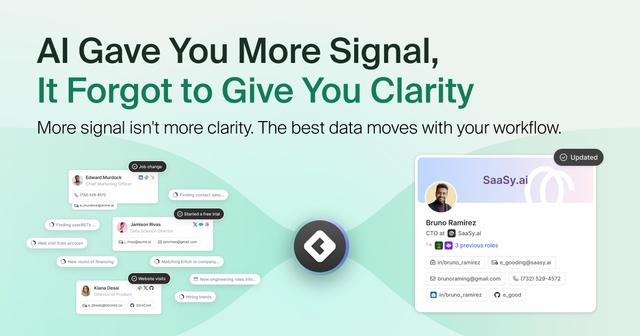
Open a flood gate wide enough, and you don't get water. You get a wall.
That's what most GTM stacks feel like in 2026. Every tool promised more visibility. Every integration promised more context. And somewhere along the way, "more" quietly stopped meaning "clearer" and started meaning "louder."
Reps didn't ask for a tenth dashboard. RevOps didn't dream of a fourth intent source. Everyone just wanted to know, before a call, who to talk to and why it matters right now. Instead, AI showed up and did the one thing nobody actually needed: it made more of everything.
More signal is not more clarity. It never was. And until GTM teams accept that, they'll keep mistaking a louder room for a smarter one.
The flood was never the plan, but it's what we built anyway
Nobody set out to drown their sales team in dashboards. It happened one well-intentioned tool at a time. An intent platform here. A chat enrichment tool there. A scoring model nobody remembers building, still quietly running in the background, tagging accounts with confidence nobody can explain anymore.
Each addition made sense on its own. Stacked together, they built a swamp. Reps now spend real chunks of their day translating between systems that were each sold as "the answer," none of which talk to each other, all of which claim to know something the others don't.
AI made this worse before it made it better. Generative tools are extraordinarily good at producing more: more content, more talking points, more "personalized" outreach that reads like it was written by nobody in particular. Activity went up. Clarity did not follow it.
Why volume was never the bottleneck
Here's the assumption worth interrogating: that the reason deals stall is a lack of data. It rarely is. Most enterprise GTM teams are sitting on more first-party and third-party data than they know what to do with. Product usage. CRM history. Community activity. Web visits. Support tickets. Job changes. None of it is in short supply.
Data sitting in a warehouse, or trapped inside a dashboard nobody opens between Tuesday standups, isn't intelligence. It's a filing cabinet with better branding.
Signal and noise get confused constantly because they look identical on a chart. A spike is a spike, whether it's a real buying signal or a bot crawling your pricing page for the fourth time this week. Volume tells you something happened. It doesn't tell you whether it mattered, to whom, or what to do next. That distinction, not the raw count of data points, is the actual job to be done.
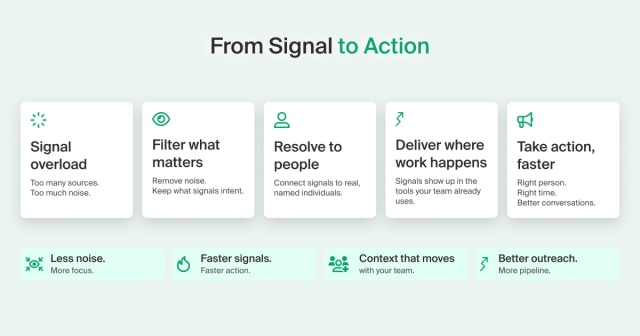
The real unlock isn't more data. It's data that moves.
Here's the reframe that actually changes outcomes: the goal was never to collect more. It was to make what you already have movable, so it shows up where a decision is being made instead of where it was originally captured.
Movable data means a signal generated in one system, a product login, a support conversation, a job change, doesn't just sit there waiting to be discovered during a quarterly review. It travels. It shows up in the CRM record a rep is already looking at. It surfaces in the Slack channel where the deal is actually being discussed. It appears in the browser tab open during a live call, at the exact second it's relevant.
Static data answers a question if you know to ask it and know where to look. Movable data answers the question before you've finished forming it, because it followed you into the workflow instead of waiting for you to go find it.
That's the actual difference between a stack that's "AI-powered" and one that's just AI-labeled. One produces more outputs. The other reduces the distance between a signal and an action.
What movable data actually looks like day to day
Picture the same account activity happening in two different stacks.
In the first, a contact at a target account logs into a product trial, leaves a comment on a community post, and gets promoted into a budget-holding role, all in the same week. That information lives in three different systems, seen by three different teams, none of whom compare notes until the deal is already stalling out.
In the second, that same activity resolves back to one person automatically, and shows up as a single, quiet nudge inside the rep's existing workflow: this person is active, just got promoted, and is worth a message today. No new dashboard to check. No separate login. The signal did the traveling, not the human.
This is the exact pattern behind Weaviate's approach to GTM: instead of reps toggling between product usage, community activity, and CRM data to find who's worth a call, signals resolve into a single command center that surfaces the right account automatically. That shift is what took their pipeline from one stream to three times the volume, without adding headcount or a new tool to check.
The difference isn't how much data either team has access to. It's identical data, in both scenarios. The difference is whether that data had to be found, or whether it arrived.
The question worth asking before you buy the next tool
How far does this data have to travel before someone can act on it, and how many extra steps stand in the way? If the honest answer involves a new login, a new dashboard, or a new habit your team has to build from scratch, you've found more noise with better packaging. If the signal shows up inside the workflow your team already uses, without anyone going looking for it, you've found the thing that was actually missing.
More signal is not more clarity. It never will be. Clarity comes from distance, the distance between a signal and the moment someone can actually do something about it, closing to nearly nothing. That's the real unlock. Everything else is just a louder version of the same flood.