
Every gold rush needs someone standing at the entrance to the mine, selling shovels and a map only they know how to read.
Enterprise AI has found its shovel salesperson: the specialist. The prompt architect. The platform operator. In go-to-market circles, we've even given this person a title: the "GTM engineer."
Here's the uncomfortable truth hiding behind that job title. If your AI tool needs a dedicated human just to translate its value to the rest of the team, the tool didn't deliver leverage. It just moved the bottleneck.
AI adoption without gatekeepers isn't a nice-to-have philosophy. It's the only model that actually scales.
We've watched this movie before
Enterprise software has a long memory, even when vendors would rather you forget it.
CRM admins became the only people who could pull a real answer out of Salesforce. Marketing ops became the toll booth between an idea and a live campaign. RevOps queues replaced Monday-morning momentum with a ticket number and a "we'll get to it."
Every one of those tools worked. Eventually. After translation. After mediation. After someone with the right badge got around to it.
The result was always the same: slower adoption, delayed time-to-value, and power concentrated in the hands of the few people fluent enough to operate the machine. Most of the org just waited its turn.
Notion's go-to-market team ran into the same wall. Signals about who was engaged, who had gone quiet, who was worth a call were scattered across tools, and getting a straight answer meant finding whoever knew how to pull it. Once that answer was just there, waiting in the workflow instead of behind a person, reps started booking more meetings without anyone teaching them a new system. The insight didn't get smarter. It got closer.
AI was supposed to break that pattern. Instead, a lot of it is quietly rebuilding it, just with a shinier name.
The question that separates leverage from theater
Here's the test that cuts through almost any AI pitch you'll hear this year:
Does this tool require a new role to unlock its value?
If yes, it has already failed the only job that matters. Real leverage means fewer handoffs, not more. Faster decisions, not a queue. Relief for the person doing the work, not a new dependency on someone else's expertise.
Tools that need a specialist might look impressive in a demo. Power without accessibility doesn't scale, it concentrates. And concentration always looks fine right up until the person holding all that expertise takes a new job.
Sorting real AI from shelfware: a simple map
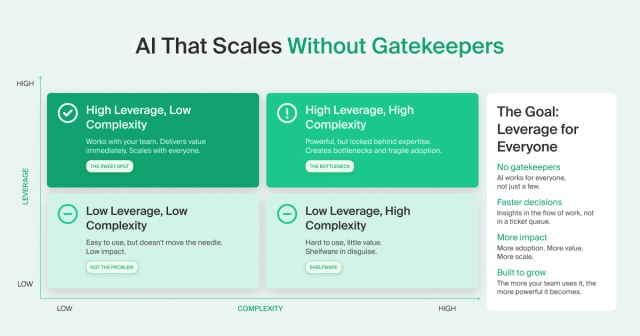
Plot any AI tool on two axes: how much leverage it creates, and how much complexity it demands. Four quadrants fall out, and each one tells you exactly what you're looking at.
Low leverage, low complexity. Easy to use, barely moves the needle. Harmless, forgettable, and not the problem here.
Low leverage, high complexity. Long setup, custom workflows, a specialist required just to get it running. This is shelfware: bought with enthusiasm in Q1, abandoned quietly by Q3.
Ask any RevOps leader who inherited a "powerful" AI tool from a predecessor. The dashboards were impressive. The one person who knew how to configure them left for a new job six months later, and the tool has been running on autopilot ever since, quietly drifting out of date. Nobody turned it off. Nobody uses it either.
High leverage, high complexity. The dangerous one. Genuinely powerful, but only in the hands of rare expertise. Value pools in one role and becomes a bottleneck the moment that person is out sick, overloaded, or gone. This is where most hyped AI platforms live today, and it looks inevitable right up until scale exposes how fragile it actually is.
High leverage, low complexity. Works with the roles you already have. Delivers value on day one. Spreads capability across the whole team instead of hoarding it in one seat.
That's the only quadrant where the tool gets more valuable the longer it's been in place, not less. Six months in, nobody remembers a rollout because there wasn't one. The new hire just watches the answer show up and assumes it always has.
What gatekeeper-free adoption actually looks like
Picture two versions of the same Tuesday.
In the first, a rep needs an account brief before a call. They ping the 'AI person' on the team, wait twenty minutes for a Slack reply, and open the call half-briefed anyway because the answer landed two minutes after they'd already dialed in. The AI is powerful. The rep is still stuck.
In the second, the rep opens their workflow and the brief is already there: who's active, what changed last week, who to loop in. No translation layer. No waiting on a badge. The AI didn't ask anyone's permission to be useful.
That's the difference between AI that requires a gatekeeper and AI that just works. The goal was never to make AI look impressive in a boardroom demo. The goal was leverage for the person actually doing the job, on day one, without a six-week rollout plan standing in the way.
The next phase of AI won't be won on intelligence alone
Buyers are getting sharper about this, and fast. As budgets tighten and headcount gets scrutinized, the questions get pointed: Who actually uses this day to day? What happens if that person leaves? Why does value stall the moment nobody's babysitting it?
At that point, complexity stops looking like sophistication. It starts looking like risk.
The next phase of enterprise AI won't be judged by how advanced it looks in a slide. It'll be judged by how fast teams get value, how broadly that value spreads across a team, and how little organizational change it takes to get there.
AI adoption without gatekeepers is what that looks like in practice: intelligence that meets people in the tools they already use, agents that do the research nobody wants to do manually, and a system that gets more useful the more people touch it, not less.
The tools that win won't raise the bar to entry. They'll lower it, one workflow at a time, until nobody even notices the AI is there. They just notice the work got easier.
The next time a vendor demo impresses you, ask the question that actually matters: who on your team will need to become fluent in this to get value out of it, and what happens the day they're not around to ask? If there's a real answer to that question, you've found the shovel salesperson. If there isn't, you've found the thing worth paying for.