
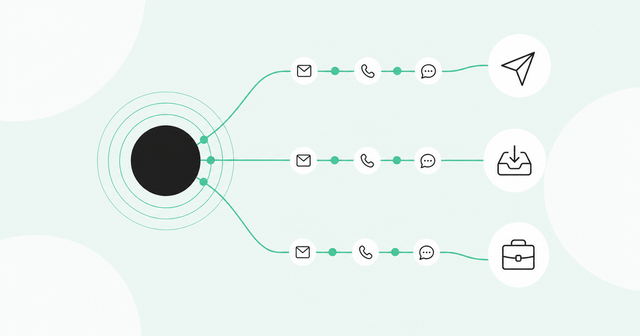

Most SDR leaders I've talked to had the same problem. They'd run outbound sequences all day, hit their activity numbers, and still miss pipeline targets. Not because they weren't working hard. Because they were treating every engagement motion like outbound, running single-channel sequences to single contacts, across every situation.
Industry benchmarks typically put cold email reply rates between 2% and 5%. Research suggests that when execution is left to individual discretion rather than structured selling motions, win rates can drop significantly — in some analyses, from as high as 59% to 42%. That gap is the cost of improvising.
Outbound has its own rhythm. Inbound follow-up is a completely different animal. And book-of-business engagement barely gets sequenced at all. On top of that, most teams are single-threading accounts (one contact, one email cadence) when every deal that actually closes involves multiple stakeholders.
If your sequencing motion doesn't distinguish between these three motions, and doesn't account for multi-channel execution and multithreading, you're running one play for three different games.
Start with the engagement decision loop
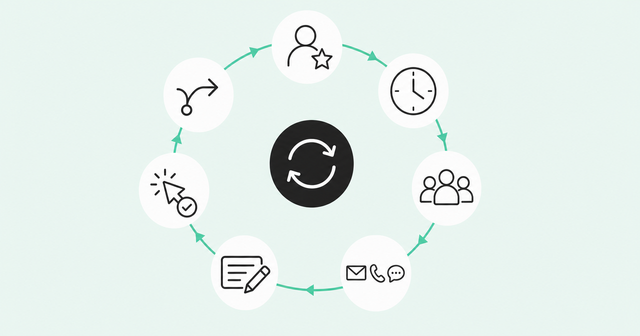
Before I get into the three motions (outbound, inbound, and book of business), here's the basic sequencing framework I use.
Every sequence should be built on these seven questions:
- Who deserves attention? Not "who's on my list," but who's showing signals that they're worth my time right now.
- Why now? What's the observable reason to reach out today? A job change, an intent signal, a usage shift, a renewal date.
- Which stakeholders? Who at the account needs to hear from me, and what does each role care about?
- Which channels? Email for context. Phone for urgency. LinkedIn for relationship. Run them together, not separately.
- What to say? Personalize from the signal. The buyer should know why I'm reaching out today, not why my product is great in general.
- What did they do? An opened email, a returned call, a LinkedIn accept. Every response shapes the next step.
- What happens next? The sequence adapts based on engagement, or advances and exits on its own.
If you can't answer all seven for a given sequence, you've got gaps.
Outbound: Multi-thread from the start
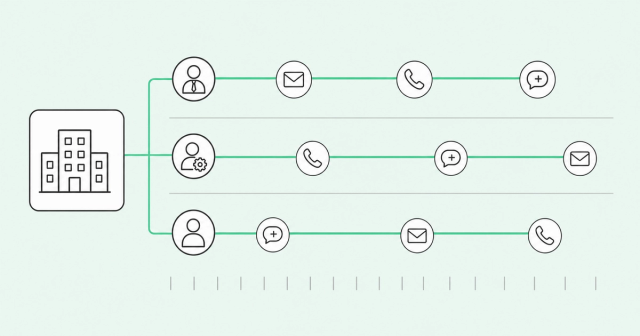
The old outbound playbook was: pull a list, write an email sequence, send to one contact per account, hope they reply. That worked when buyers made decisions alone. They don't anymore.
The shift is multi-threading from day one. When you identify an account worth pursuing, map the buying committee: economic buyer, technical evaluator, end user, and anyone else who influences the decision. Then enroll the right stakeholders in coordinated sequences, with messaging tailored to what each role cares about and timing staggered so the account doesn't get overwhelmed by a ton of the same emails on a random day.
Channel mix for outbound: According to industry research, multichannel sequences can increase contact rates by 161% and see response rates of 16.3% versus 3.1% for email alone. The lift is real, but only if you coordinate the channels instead of running them separately.
Your first touch to a cold prospect should be the channel with the highest likelihood of getting noticed. That varies by persona, and the sequencing platform you use should let you run all of them in one coordinated flow. Engage, built into Zoom Revenue Accelerator, handles email steps, call steps, LinkedIn Connect, and LinkedIn Message as part of a single sequence so you're not juggling three separate tools. (LinkedIn steps may require separate eligibility or add-on access; see feature availability for details.)
For executives, phone and concise email. These buyers don't scroll LinkedIn for vendor pitches, but they do answer calls and read short emails that get to the point.
For directors and senior managers, email and LinkedIn together. They're active on both. A LinkedIn Connect that follows an email doubles your surface area without doubling your effort.
For frontline managers and ICs, LinkedIn first. They live there. Meet them where they are, then layer in email and phone as the relationship builds.
Day 1
Email (signal-based, referencing the specific reason for outreach)
Day 2
LinkedIn Connect with a relevant note
Email tailored to their role ("Your team's BDR ramp" for the sales ops lead vs. "Your outbound pipeline" for the VP)
Day 3
Phone call (reference the email, 30 seconds if voicemail)
Day 4
LinkedIn Connect
Day 5
Email (new angle, not "just checking in")
Day 6
Phone or email depending on persona
Day 8
LinkedIn Message (direct, value-forward)
Day 9
LinkedIn Message or final email
Day 11
Phone call
Day 12
"Final" email (before re-engaging later)
The stagger is important. If the economic buyer gets your email Monday and the technical evaluator gets a nearly identical email Tuesday, you look uncoordinated. If they each get a role-specific message a few days apart, you look like a team that understands their org.
Inbound: Speed, relevance, and immediate multi-threading
Most teams treat inbound as a single-contact motion. Someone fills out a form, a rep follows up with that person. But the buyer who filled out the form is rarely the only person who matters at that account.
The best inbound response I've seen does three things simultaneously:
1. Respond to the lead within minutes. The first touch should reference exactly what they did. "You just downloaded our sequencing playbook" is better than "Thanks for your interest." Automated sequences that fire on the inbound action and reference the specific content or page are what make the 5-minute window possible.
2. Check the account for other signals. Did anyone else at this company visit the pricing page last week? Is there a champion from a previous deal who recently changed roles into this account? Common Room by Zoom helps surface account-level buying signals from a range of sources, giving your team the context to understand whether you're looking at a single curious contact or a buying committee warming up.
3. Multi-thread if the account signals warrant it. If multiple stakeholders are active, don't just follow up with the form-filler. Enroll the relevant buying committee members in a coordinated sequence, with the inbound lead as your anchor. The person who raised their hand becomes your entry point, not your entire strategy.
Channel mix for inbound:
Phone-heavy. These buyers are warm. A phone call within hours of their action is your fastest path to a conversation. Follow with email and LinkedIn to stay present if they don't pick up.
Within 5 minutes
Automated email referencing the specific action
Within 2 hours
Phone call from the assigned rep
Day 1
LinkedIn Connect
Day 2
Email with a complementary resource
Day 4
Phone follow-up
Match sequence intensity to signal strength. A demo request gets a phone call in 5 minutes, period. An ebook push gets a lighter nurture that warms toward conversation over a few days. Don't run the same sequence for both.
Book-of-business: Multi-thread the accounts you already have
This is the most under-sequenced motion in sales, and it's where multithreading matters most.
AEs managing 50 to 200 accounts don't have a way to stay in front of all of them. They focus on active deals, imminent renewals, and accounts that are escalating. Staying present with key accounts (even between active deals) helps maintain relationships before buying moments arise.
The fix is signal-triggered, multi-threaded engagement across the accounts you already own. This is where a platform like Engage becomes essential. Every rep gets a prioritized daily Action Items list covering who to reach, how, and when. Not a static task list, but a dynamic queue built to support rep decision-making, not replace it.
What triggers a book-of-business sequence:
These aren't calendar reminders. They're observable signals that something changed:
- A champion left the company or changed roles
- Product usage dropped
- A new stakeholder joined (especially in a decision-making role)
- A competitor was mentioned in a conversation
- A renewal is approaching within 90 days
How to multi-thread existing accounts:
When a signal fires, don't just reach out to your primary contact. Map who else matters. If a new VP of RevOps joined, that's a stakeholder worth engaging directly. If usage dropped, the end users and the technical admin both need attention, with different messages.
Day 1
Personalized email referencing the signal for primary contact
Email with a role-specific angle for secondary stakeholder
Day 3
Phone call for primary contact
Day 5
LinkedIn touchpoint (engagement or direct message) for primary contact
Day 7
Email for third contact (if first two haven't responded)
The goal is different here. Outbound is about starting a conversation. Inbound is about converting interest. Book-of-business is about staying present so that when the buying moment comes, you're already in the room with multiple relationships, not scrambling to rebuild from one contact.
What connects all three
The teams building pipeline consistently aren't running the most sequences. They're running the right sequences for the right motion, across the right channels, to the right stakeholders.
That means having three distinct playbooks, not three variations of the same email cadence. It means multithreading from the start instead of hoping one contact carries the deal. It means running email, phone, and LinkedIn in one coordinated flow instead of managing channels separately. And it means building every sequence on intelligence about why this account, why these people, why now, not just who's on the list.
The engagement decision loop holds across all three motions: who deserves attention, why now, which stakeholders, which channels, what to say, what did they do, what happens next. If your sequencing motion can answer all seven, you've got something that works. If it can only answer two or three, you've got a tool, not a motion.
Build for all three. Multi-thread from the start. Run every channel in one flow. That's what turns sequencing into an engagement system. The best reps already do this instinctively. Engage, powered by Common Room by Zoom, gives the whole team that same motion: intelligence-driven prioritization, multichannel execution, and multi-threaded outreach in one platform. Your top performer's engagement shouldn't be an exception.
How Engage makes all three motions possible at scale
Executing three distinct sequencing motions, each with the right channels, the right stakeholders, and the right timing, is straightforward in theory and operationally complex in practice. That's the problem Engage, built into Zoom Revenue Accelerator and powered by Common Room, is designed to solve. Rather than asking reps to manage outbound cadences, inbound follow-up, and book-of-business engagement across separate tools and disconnected workflows, Engage brings all three into a single platform.
For outbound, Engage surfaces account-level signals from Common Room (job changes, intent data, product usage shifts) and uses them to prioritize which accounts deserve attention today. Reps can enroll multiple stakeholders in coordinated, multi-channel sequences directly from that signal context, with email, call, and LinkedIn steps running in one flow rather than three. For inbound, automated sequences fire the moment a lead takes action, referencing the specific content or page they engaged with, while Common Room simultaneously surfaces whether other stakeholders at that account are showing buying signals, giving reps the full picture before they pick up the phone. For book-of-business, Engage replaces the static task list with a dynamic, signal-triggered Action Items queue that tells each AE exactly who to reach, on which channel, and why, so high-value accounts don't go dark between active deals.
The result is that the engagement motion your best rep runs instinctively (signal-driven, multi-threaded, coordinated across channels) becomes the default motion for your entire team. Engage doesn't replace rep judgment. It gives every rep the intelligence and structure to exercise that judgment consistently, across every account, every day.
Ready to see it in action? Book a demo and watch how Engage turns your best rep's instincts into your entire team's default motion — across outbound, inbound, and your book of business.