
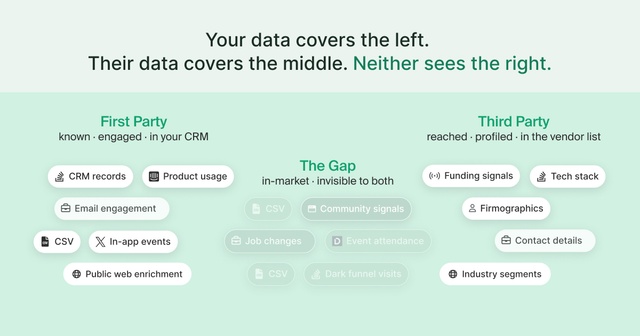

Most GTM teams aren't short on data. They're short on the right combination of it.
You have a CRM full of records, a marketing automation platform running campaigns, and probably a data vendor refreshing contact lists on some quarterly cadence. And yet, reps are still cold-calling accounts that haven't shown real buying interest, while genuinely warm buyers go unnoticed.
The conversation around first-party versus third-party data usually gets framed as a privacy story: third-party cookies going away, regulations tightening, first-party is the future. That framing isn't wrong, but it's not the most useful lens if you're trying to figure out why your pipeline is inconsistent.
The more useful question is what each type actually captures and where the gaps between them are costing you pipeline. Because the teams that win aren't the ones with more data. They're the ones who've figured out how to make each type work where it's strongest.
The four data types, quickly defined
Before going deep on first and third-party data, it helps to have the full map. There are four types most B2B go-to-market (GTM) teams encounter, sitting on a spectrum from most direct to most removed from your actual buyers.
What is zero-party data?
Zero-party data is information a person intentionally shares with you: survey responses, stated preferences, onboarding questions, intent signals a buyer declares. It's the most consent-forward type, which is why it's considered highest-trust. The limitation is volume. You can't build a complete data strategy on voluntary disclosures alone.
What is first-party data?
First-party data is information your company collects directly from your own audience through your own channels. CRM records, product usage events, website behavior, email engagement: data collected directly from people who've interacted with your brand. You own it, you control it, and because it came straight from the source, it's the most accurate picture of your known buyers available.
A company's first-party data is also exclusive by definition. Nobody else has access to your product telemetry or your sales interaction history. That exclusivity is a meaningful competitive advantage, and it's part of why first-party data collection has become a strategic priority rather than just a compliance response to the deprecation of third-party cookies.
What is second-party data?
Second-party data is someone else's first-party data, shared through a direct relationship and a formal agreement.
Two companies with complementary audiences exchange anonymized behavioral signals, each accessing the other's own collected data. It's more targeted than buying from a data broker, and because there's a direct relationship between the parties, data quality tends to be higher than broad third-party sources. In practice, second-party arrangements are less common in B2B and require deliberate partnership infrastructure to execute.
What is third-party data?
Third-party data is information collected by an entity with no direct relationship to your audience, aggregated from across the web and sold at scale.
Data brokers and third-party data providers compile this from public records, behavioral tracking, content consumption networks, review sites, and more. For B2B GTM, that typically means firmographic profiles, contact details, technographic intelligence, and intent scores.
Third-party data is broadly available and useful for prospecting. It's also broadly available to your competitors, which is worth keeping in mind.
First-party data in depth: the foundation of a modern GTM motion
What first-party data collection looks like in B2B SaaS
First-party data collection happens across every touchpoint where a buyer or user directly engages with your brand. For most B2B SaaS companies, the primary data sources include:
- CRM records: company name, contact details, deal history, stage progression
- Product usage data: feature adoption, login frequency, active user counts, usage trends
- Website behavior: pages visited, time on site, content downloads, pricing page activity
- Marketing engagement: email opens and clicks, webinar registrations, ad interaction
- Support and CS interactions: ticket history, health scores, NPS responses
- In-app events: trial activations, onboarding completion, upgrade triggers
When unified, these data sources give you a real-time picture of your known accounts: who's engaged, who's dormant, and which accounts are showing expansion signals. Many teams centralize this in a customer data platform (CDP), which aggregates first-party inputs across systems and makes them accessible for segmentation, scoring, and activation.
Why first-party data matters for GTM teams
First-party data is the most accurate customer data you have, because you collected it yourself. No aggregation, no inference. When a contact visits your pricing page three times in a week and downloads a comparison guide, that's a specific, confirmed behavior, not a probabilistic signal derived from what anonymous users did on someone else's website.
It's also exclusively yours. Every rep at every competitor using the same data provider is working from the same database. Nobody else has your product usage data or your customer interaction history.
For retention and expansion motions, first-party data is irreplaceable. Detecting a customer going quiet, or an account accelerating toward an expansion decision, requires signals that live inside your own systems.
The limitations of first-party data alone
First-party data has a fundamental coverage problem: it only tells you about people and accounts who have already interacted with you.
A company evaluating your category right now, visiting competitor sites, running an internal scoring process, is invisible to your first-party data until they raise their hand. Your CRM has no record of them. They exist in the dark funnel, and your own data can't reach them.
Data quality is the other issue. CRM records go stale as contacts change jobs or leave companies. Without a mechanism for continuous enrichment and data quality monitoring, your own data degrades quietly, and decisions made on stale records are expensive.
First-party data tells you what your buyers have done with you. It says nothing about what they're doing everywhere else.
Third-party data in depth: reach, coverage, and the real tradeoffs
How third-party data is collected and what it covers
Third-party data providers and data brokers compile this data from a wide range of external sources: public records, web crawls, behavioral tracking networks, review platforms, purchasing data, and survey panels. This data is collected at scale by design, because the whole value proposition is breadth.
Providers aggregate, normalize, and sell the resulting profiles to businesses seeking coverage beyond their own audience.
For B2B GTM, third-party data typically includes:
- Firmographic data: company size, industry, revenue range, headcount, location, funding status
- Contact data: names, job titles, email addresses, phone numbers
- Technographic data: the tools and platforms an account currently runs
- Intent signals: topic-level engagement scores from content consumption across third-party networks
- Growth signals: investment rounds, headcount changes, geographic expansion
Where third-party data earns its place
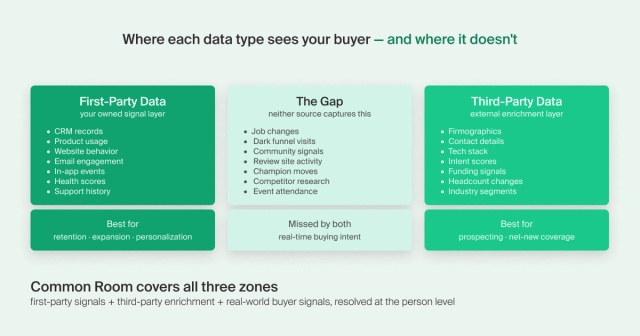
For prospecting and net-new pipeline, third-party data is genuinely useful. It surfaces accounts you've never heard of and gives you context before the first interaction: firmographic fit, tech stack, funding stage. You can build ICP-matched lists without waiting for buyers to find you.
Technographic data has particular strategic value. Knowing an account runs Salesforce and recently adopted a competing solution tells you something meaningful about their evaluation criteria before you ever reach out.
Third-party intent signals, aggregated across content networks and review sites, can also surface accounts actively researching your category, which is a better prioritization trigger than firmographic fit alone.
Limitations and risks
Third-party data comes with well-documented problems. Most teams underweight them until they've run into them firsthand.
- It's not exclusive. When you buy from a data provider, so does your competitor. If your ICP is a 300-person SaaS company using Salesforce and Marketo, everyone targeting that profile has the same list. The data itself can't give you an edge.
- It goes stale fast. Party data is collected on a lag. People change jobs, companies pivot, contact information expires. By the time that data reaches your CRM, it may already be weeks or months behind. Data quality issues from stale third-party records are one of the most common and most quietly expensive problems in B2B sales.
- Intent signals are blunt. Account-level topic scores tell you that someone at a company consumed content about "revenue operations" this month. They don't tell you who, what they're specifically evaluating, or whether it's a buying decision or background research.
- Integration has a real cost. Third-party data doesn't land in your CRM ready to use. You have to buy it, ingest it, map it to records, resolve duplicates, and refresh it on some cadence. That's operational overhead most teams underestimate when evaluating a data provider.
There's also a longer-term structural risk. Chrome's third-party cookie restrictions are rolling out. Safari and Firefox blocked them years ago. Cookie-based tracking is how most third-party providers collect behavioral signals at scale. As that infrastructure erodes, first-party data isn't just a strategic priority. It's the only durable foundation.
First-party vs. third-party vs. second-party data: side by side
| First-party data | Third-party data | Second-party data | |
|---|---|---|---|
Source | Your own systems: CRM, product, web, email | Data brokers and external providers | A trusted partner's own collected data |
Accuracy | High — collected directly from your audience | Variable — aggregated, often lagged | Moderate — depends on partner quality |
Exclusivity | Yours alone | Available to every competitor who buys it | Shared only with that partner |
Coverage | Known contacts and accounts only | Broad — new accounts you've never heard of | Limited to partner's audience |
Freshness | Real-time if synced properly | Often weeks to months behind | Depends on partner's update cadence |
Best for | Retention, expansion, personalization | Prospecting and net-new reach | Audience extension and co-marketing |
Most teams need both, and the ones that win have figured out how to make each type work where it's strongest rather than defaulting to whichever vendor they last renewed.
There's also what's missing from both. First-party data only captures your known universe. Third-party data gives you a snapshot of the broader market. Neither captures the real-time behavioral signals that indicate a specific account is actively in-market right now.
How to use first-party data in sales and marketing
A first-party data strategy isn't just about collecting more. It's about activating what you already have more precisely. The highest-leverage uses in B2B GTM:
- Account prioritization. Product usage events, web activity, and email engagement create a real-time signal layer that tells you which accounts are warming up and which are going quiet. This is materially better than static ICP scoring.
- Personalized outreach. When reps have visibility into what a contact actually did, outreach relevance improves significantly. Audience insights from your own data make generic sequences obsolete.
- Retention and expansion detection. Product usage trends, support interactions, and health scores give CS teams early signals that an account is drifting toward churn or ready for an expansion conversation.
- Data quality management. First-party records are the foundation, but they need to stay current. Layering enrichment on top of your own data keeps your CRM accurate rather than a time capsule of six months ago.
On the collection side, the most effective approach is to instrument your key touchpoints progressively rather than trying to capture everything at once. Ask for role and team size after an initial sign-up, then layer in tech stack and goals over time. Be transparent about how you’ll use the data.
The value exchange has to be genuine, especially as buyers become more deliberate about what they share.
The limiting factor for most teams isn't a shortage of first-party data. It's that the data sits in disconnected systems: CRM, MAP, product analytics, customer success tools, with no unified view of what's actually happening across them.
The signal gap no single data type fills
First-party and third-party data combined still leaves a meaningful blind spot in the buyer's journey.
First-party data shows what's happening inside your four walls. Third-party data gives you coverage on the broader market.
But neither captures the in-between: when a champion leaves their company and joins a new account, when a target company engages with your community before filling out a form, when an account visits your pricing page six times without converting, when a competitor's customer starts appearing at your events.
These are real buying signals. They don't come from a data broker's quarterly refresh. They happen across review sites, community platforms, job postings, and your own web properties.
Catching them requires buyer intelligence: a unified view of what your buyers are doing across every surface, not just the ones you already control. The teams that get there first show up at the right moment with the right context. The ones that don't send the same sequence to an account that made a decision three weeks ago.
The gap between first-party and third-party data is where your best pipeline signals live.
How Common Room unifies signal across data types
Common Room unifies first-party signals with real-world buyer activity into a single, continuously updated view of your buyers so the gaps between data types stop costing you pipeline. In practice, that means:
- First-party signals from your CRM, product, marketing automation, and web properties
- Third-party enrichment across firmographic, contact, and technographic sources via an AI-powered waterfall that runs across multiple providers, not a single vendor dependency
- Real-world buyer signals neither data type captures on its own: dark funnel web activity, job changes, G2 and review site engagement, community participation
Person360 and Context360 resolve every signal to a real person and account, so instead of disconnected data points across systems, you get a person-level view of your buyers that reflects what they're actually doing, not just what they've told you.
Rather than depending on a single third-party data provider, Common Room runs waterfall enrichment across multiple sources and resolves to the highest-quality answer available for each field. DataAgent monitors records continuously for gaps, duplicates, and outdated information, keeping the intelligence underlying your GTM decisions accurate over time.