
Your top account is suddenly hot. Someone there has viewed your pricing page four times this week, and the intent score just jumped. Then your rep asks the only question that matters: "Great, who do I call?"
Most account-based marketing (ABM) playbook templates can't answer that. They're static decks that list accounts but stop before anyone takes action.
That's a big gap for a strategy this common. Demand Gen Report's 2025 ABM Benchmark Survey found "71% of practitioners currently utilize an ABM strategy [...] with an additional 23% planning to add one."
This guide gives you an ABM playbook template you can actually run. You'll tier accounts, map the buying committee, pick the signals that start each play, assign owners, set handoff rules, and measure results. You'll also get a copyable table and a filled example.
What a Good ABM Playbook Includes
The best ABM playbook template is one your sales and marketing teams can run together. It defines your ideal customer profile (ICP) and account tiers, maps the buying committee, and names the signals that trigger each play. It also assigns owners and channels, sets handoff rules, and tracks account-level outcomes.
Account-based marketing is a strategy where sales and marketing focus on a defined set of high-fit companies instead of chasing every lead. The SiriusDecisions ABM definition calls ABM "a strategic approach that aligns demand creation programs and messaging against a set of defined accounts and goals." It adds that the work should be "relevant and valuable to those accounts and to sales."
An ABM playbook is the written plan for doing that work. A traditional marketing plan starts with channels and lead volume. An ABM playbook starts with a short list of accounts and their people, then spells out who does what when they show interest.
Here's the part most templates skip: Accounts don't buy, people do. That's why we break down traditional versus person-level ABM as two different operating models.
Every solid ABM playbook template covers these six steps:
- Define your ICP and tier your accounts: Decide which companies fit and how much effort each one gets.
- Map the buying committee: List the roles that influence the deal and find real people for each.
- Choose your trigger signals: Pick the behaviors that tell you an account is ready for outreach.
- Build plays per tier: Give every play a channel, an owner, and an exit rule.
- Set handoff rules: Agree on when marketing passes an account to sales and how fast sales responds.
- Measure what matters: Track engagement, pipeline, and win rate at the account level.
Step 1: Define Your ICP and Tier Your Accounts
Your ICP describes the type of company most likely to buy, succeed, and stay. Build it from three inputs, and lean hardest on the last one.
- Firmographics: These are company traits, such as industry, employee count, revenue, and region.
- Technographics: These are the tools a company already uses, such as its CRM or data warehouse.
- Past wins: Your best current customers show you which patterns actually close and renew.
Next, turn your ICP into a target account list. Start smaller than feels comfortable, because a list your team can work beats a list of 5,000 logos nobody touches.
Then keep the list alive. A list built once a year goes stale fast. Refresh it monthly with recent activity, so accounts showing new interest move up and quiet ones move down.
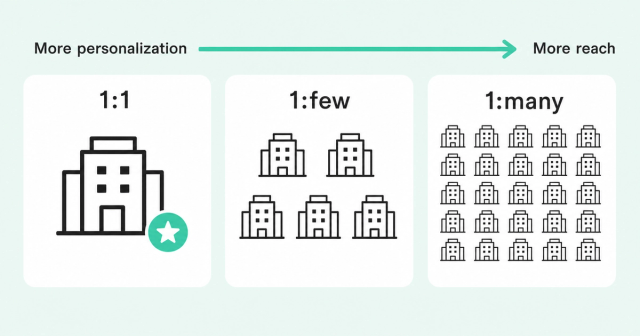
1:1, 1:Few, and 1:Many at a Glance
Once you have a list, split it into tiers. Each tier gets a different level of effort and a clear owner. That owner is usually an account executive (AE), a sales development rep (SDR), or a marketer.
| Tier | Account count | Personalization | Main channels | Owner | Typical metric |
|---|---|---|---|---|---|
1:1 (Tier 1) | Up to 10 | Custom for each account and person | Executive outreach, custom content, events, direct mail | AE with ABM manager | Buying committee coverage |
1:few (Tier 2) | 10-100 | Tailored by industry or use case | Industry content, account-based ads, small events, sequences | ABM manager with SDR | Meetings booked |
1:many (Tier 3) | Hundreds or more | Light, by segment | Programmatic ads, email nurture, webinars | Demand gen | Engaged accounts |
Use 1:1 for your largest, most complex deals, where a single win changes your quarter. Use 1:few when several accounts share the same pain, and 1:many when deal sizes are smaller and you need reach with some relevance.
Step 2: Map the Buying Committee
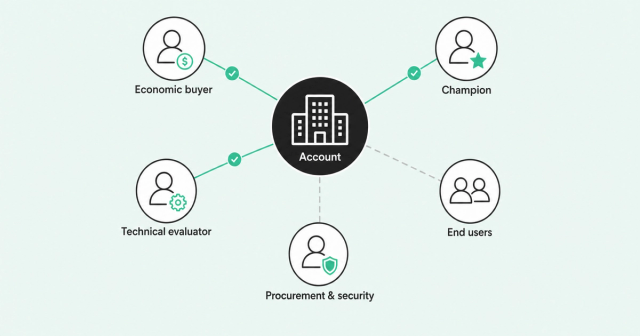
A buying committee is the group of people who influence a purchase. It's bigger than most teams plan for. The Forrester State of Business Buying report for 2026 found that "On average, 13 internal stakeholders and nine external participants influence buying decisions."
Start by naming the core roles you need to reach in every deal:
- Economic buyer: This person owns the budget and signs off on the purchase.
- Champion: This person wants you to win and sells your solution internally.
- Technical evaluator: This person tests whether your product fits their systems.
- End users: These people use the product daily and shape the team's opinion.
- Procurement and security: These teams review pricing, contracts, and risk before anyone signs.
Set coverage thresholds by tier. For example, a Tier 1 account needs a champion plus at least three other roles identified. A Tier 2 account needs a champion plus one more role, and a Tier 3 account needs at least one engaged contact.
This is where multithreading matters. Multithreading means building relationships with several committee members at once, so one person going quiet doesn't stall the deal.
An account score can tell you a company is interested. It can't tell you who. For practical tactics on finding the real buying committee, start with the people already engaging, then fill the gaps by role.
Step 3: Choose the Signals That Trigger Each Play
A buying signal is an action that shows someone may be ready to talk. Signals answer the question every rep asks: why this person, and why now?
These are the signals worth tracking for ABM plays:
- Website visits: Repeat visits to pricing, security, or integration pages suggest active evaluation.
- Product usage: A jump in free users or a new team joining a trial shows real adoption.
- Hiring: Job posts for roles your product supports can point to a new project.
- Job changes: A former champion who lands at a new company already knows your value.
- Funding and news: A new funding round or leadership change often resets budgets and priorities.
- Intent topics: Research on third-party sites about your category shows the account is learning.
- Social and community engagement: Questions, comments, and forum posts from ICP-fit people reveal interest early.
One signal is a hint. Stack two or three from the right people, such as a pricing visit plus a related job post, and you have a reason to act.
Timing beats volume. Across hundreds of go-to-market calls we've analyzed, teams tell us email response rates sit near 1% and call connect rates near 2.5%. They also tell us reps lose more than 70% of their time to research and admin.
Sending more messages won't fix those numbers. A 2025 Gartner rep-free buyer survey of 632 buyers found that 73% of B2B buyers actively avoid suppliers who send irrelevant outreach.
Signals usually live in disconnected tools, so reps ignore most of them. Common Room's unified buying signal capture brings 50+ native signal types into one place.
Separately, Common Room identifies up to 50% of US web traffic at the person level. Each alert can then point to a real person with a reason to reach out.
The goal is fewer, better alerts. Joe Broome, Global ABM Manager at Workvivo by Zoom, saw that shift firsthand. "Common Room is a living, breathing dashboard with real-time insights about real individuals [...] rather than static visuals of an account," he said.
Step 4: Build Plays per Tier With a Channel and an Owner
A play is a repeatable set of steps your team runs when a specific signal appears. Most templates list channels and stop there. A complete play card answers seven questions:
- Trigger: This is the signal or signal stack that starts the play.
- People: These are the buying committee roles you'll reach, by name when possible.
- Message: This is the core point of view, tailored to the account's situation.
- Channels: These are the touchpoints you'll use, such as email, ads, calls, or direct mail.
- Owner: This is the one person accountable for each step.
- Timing: This sets the order and spacing of steps, such as a call within one business day.
- Exit rule: This tells you when to stop, pause, or move the account to another play.
Here are three ABM plays you can adapt, one for each tier:
- Champion job change (1:1): A past champion joins an ICP account. The AE reaches out within two days, and marketing starts custom ads.
- Pricing-page visits (1:few): Two ICP-fit people from one account view pricing in a week. The SDR calls the most senior visitor first.
- Product usage spike (1:many): Free users at one account pass a set number. Demand gen starts a nurture, and an SDR follows up.
Job changes make a strong first play because the person already trusts you. Our job-change tracking plays show setups you can copy.
Write every play for the whole buying group, beyond your single favorite contact. Gartner buying group research from 2025 found that "when buyers experience buying group relevance, they are three times more likely to report a high-quality deal."
Don't skip the exit rule. Without one, accounts sit in sequences forever, and reps learn to tune out your alerts.
Step 5: Set Sales and Marketing Handoff Rules
In our experience, handoffs are where ABM programs stall most often. Marketing spots a hot account, and the signal lands in a dashboard or a CSV nobody opens. By the time a rep notices, the buyer has moved on.
It's a widely shared problem. In the same 2025 Demand Gen Report survey, surveyed practitioners ranked sales and marketing alignment (43%) second among their challenges. Only proving return on investment, or ROI, ranked higher (47%).
A good handoff carries a name, a reason, and a next step. Use this checklist to build yours:
- Threshold: Define the exact signal stack and fit level that make an account sales-ready.
- Named owner: Assign one rep per account, so no alert lands in a shared inbox.
- Person and reason: Include who to contact and the signal that earned the outreach.
- Response SLA: Set a service-level agreement (SLA), such as one business day for Tier 1.
- Alert location: Send alerts where reps already work, such as Slack, the CRM, or a sequence.
- Feedback loop: Let reps mark each handoff as useful or not, so marketing can tune thresholds.
- Weekly standup: Review new, stuck, and closed accounts together in a 15-minute meeting.
In our experience, manual handoffs break as volume grows. Common Room's automated pipeline plays automate account research, personalization, and sequence enrollment. They also send real-time Slack or email alerts for speed-to-lead, so the owning rep can act within your SLA.
Step 6: Measure Account Engagement, Pipeline, and Win Rate
ABM needs account-level metrics, since lead counts hide what's happening inside a buying committee. Split your metrics into two groups.
Leading indicators show whether the program is working right now:
- Buying committee coverage: The share of required roles identified and engaged per account
- Engaged contacts per account: The number of ICP-fit people active in the last 30 days
- Meetings booked: First meetings with committee members, tracked by tier
- Signal-to-action rate: The share of handoffs a rep acted on within the SLA
Lagging indicators show business results over a quarter or longer:
- Pipeline created: The dollar value of new opportunities from tiered accounts
- Velocity: The average days from first meeting to closed deal
- Win rate: The share of opportunities that close, compared by tier
- Deal size: The average contract value for ABM accounts
Signal-to-action rate deserves special attention. If reps aren't acting on handoffs, the problem is the signal, the threshold, or the context, and better creative won't fix it.
Review leading indicators weekly in your standup. Refresh your ICP and tiers quarterly. Skip vanity metrics like impressions and raw click counts, which tell you nothing about who's ready to buy.
Copyable ABM Playbook Template
Copy this ABM playbook template into a doc or spreadsheet and fill in one row at a time. The examples come from the illustrative campaign in the next section.
| Section | What to fill in | Example | Owner |
|---|---|---|---|
Goal | The business outcome and number you're working toward | $1.5M in new pipeline from Tier 2 accounts this quarter | Marketing and sales leaders |
ICP | Firmographics, technographics, and traits of past wins | US fintech, 200-1,000 employees, uses Salesforce | RevOps |
Tier | 1:1, 1:few, or 1:many, and why | 1:few, grouped by payments and lending | ABM manager |
Target accounts | The account list and how often you refresh it | 25 accounts, refreshed monthly with recent activity | RevOps and ABM manager |
Buying committee coverage | Required roles and minimum coverage per account | Champion plus one other role identified | SDR |
Trigger signals | The signal stack that starts the play | Pricing visit by an ICP-fit person plus a related job post | Marketing ops |
Play | The message and offer for this trigger | Peer benchmark on compliance reporting time | ABM manager |
Channels and sequence | Touchpoints in order, with spacing | Call, email, LinkedIn ad, then a custom one-pager | SDR and demand gen |
Owner | One accountable person per account | Named SDR, with the AE joining at first meeting | Sales leader |
Handoff rule and SLA | What makes an account sales-ready and how fast reps respond | Threshold met, rep contacts the visitor within one business day | Marketing and sales leaders |
Exit rule | When to stop or switch plays | No engagement after 21 days, move to 1:many nurture | ABM manager |
Metrics | Leading and lagging measures you'll report | Coverage, meetings booked, pipeline created, win rate | Marketing ops |
Review cadence | How often you check results and refresh the list | Weekly standup, quarterly ICP and tier review | Marketing and sales leaders |
Pick tools after you fill in this ABM playbook template. Once you know your signals, owners, and handoff rules, you can judge any platform on whether it supports them. Here's how to choose an ABM platform without paying for capabilities you won't use.
Example ABM Campaign Walkthrough
Illustrative example: The company, accounts, and steps below are hypothetical. They show how the template works when you fill it in.
A compliance software company runs a 1:few campaign for 25 mid-market fintech accounts. The trigger is a pricing-page visit by an ICP-fit person plus an open job post for a risk or compliance role. Here's how the play runs at one account:
- Day one: A compliance director views pricing twice, and the account posts a risk analyst role. The alert reaches the named SDR in Slack.
- Day one, a few hours later: The SDR calls the director and references the new hire. The SDR then sends a short benchmark on reporting time.
- Day three: Demand gen adds the account's buying committee to a LinkedIn ad audience with the same benchmark.
- Day five: The ABM manager sends the economic buyer a custom one-pager. It shows how similar fintech teams cut audit prep.
- Day eight: The director books a meeting, and the SDR hands off to the AE with notes on every touch.
- Day 21: Accounts with no engagement exit to the 1:many nurture, freeing the SDR for new signals.
At the 30-day review, the team checks committee coverage, meetings booked, and signal-to-action rate by account. They drop quiet accounts from the list and promote two new ones that started showing activity.
For a real result, look at Workvivo. The team saw a 40% increase in meetings booked in one month after moving to person-level insights. Read how Workvivo increased meetings booked for the full story.
Frequently Asked Questions
New to ABM? These quick answers cover what teams ask most when they fill in their first ABM playbook template.
What Is an ABM Playbook?
An ABM playbook is a written plan that tells sales and marketing which accounts to focus on and which signals start outreach. It turns ABM strategy into repeatable plays with owners, channels, and exit rules.
What Are the Three Types of ABM?
The three types are 1:1 for a handful of high-value accounts, 1:few for small clusters with shared needs, and 1:many for larger segments. Each tier trades personalization for reach.
What Are the Steps to Build an ABM Playbook?
Define your ICP and tiers, map the buying committee, choose trigger signals, build plays with owners, set handoff rules, and measure results. The copyable ABM playbook template above walks through each one.
What Metrics Should You Use to Measure an ABM Campaign?
Track leading indicators like buying committee coverage, engaged contacts, and meetings booked, plus lagging indicators like pipeline created, velocity, and win rate. Add signal-to-action rate to see whether reps act on handoffs.
Why Is Sales and Marketing Alignment Important for ABM?
ABM depends on both teams working the same accounts at the same time. Without shared handoff rules, marketing's signals never turn into sales conversations.
Can Small Businesses Use ABM?
Yes, because ABM is about focus, and small teams can't afford wasted outreach. Start with a 1:few tier of 10-25 accounts and one or two signal-based plays.
Turn Your ABM Playbook Into Action
An ABM playbook works when the right signal reaches the right rep with a name, a reason, and a next step. Everything else in your ABM playbook template supports that moment.
Common Room helps teams run person-level ABM programs that connect buyer signals to coordinated action across sales and marketing. Want to see how it works with your accounts? Request a demo.