
Many sales teams pick a methodology the way people pick a gym: they go with whatever their friends use. Six months later, the framework lives in a CRM field nobody updates, and deals still stall in the same places.
This guide explains the top sales methodologies in plain language. It compares them side by side and shows you how to choose one that fits your deals.
What Is a Sales Methodology?
A sales methodology is the set of principles and techniques reps use to discover, qualify, and advance deals. There's no single best sales methodology. The right one depends on your deal size, sales cycle length, buying group, and team experience.
Think of it as a shared playbook for how your reps think and talk with buyers. Popular sales methodologies include MEDDPICC, SPIN Selling, the Challenger Sale, Sandler, BANT, and Solution Selling.
Here's where many teams go wrong. They pick the most popular framework, run a training, and add a few required fields. Within a quarter, reps fill those fields just to move deals forward, and the framework turns into paperwork.
The framework usually isn't the problem. Every methodology runs on information about the buyer: who's involved, what they care about, and what changed recently. When reps don't have that information, they guess.
Buyers also don't give you much time to fill the gaps. A 2020 Gartner release found that buyers spend only 17% of their time meeting with potential suppliers during a purchase, per Gartner buyer time research. So the best sales framework is the one your reps can feed with good buyer information.
Sales Process vs. Sales Methodology
A sales process is the set of stages a deal moves through. A sales methodology is how reps act inside each stage.
Your process might move from prospecting to discovery, qualification, proposal, and close. Your methodology decides which questions reps ask in discovery and what proof they need before a deal moves forward. Teams often call that proof exit criteria, meaning the facts a deal needs before it reaches the next stage.
| Sales process | Sales methodology | |
|---|---|---|
What it answers | Where is this deal right now? | What should the rep do next? |
Focus | Stages and steps | Skills, questions, and behaviors |
Example | Discovery, then qualification, then proposal | Asking SPIN questions during discovery |
Usually owned by | Revenue operations (RevOps) | Sales leaders and frontline managers |
Shows up in the CRM as | Deal stages | Required fields and exit criteria |
What goes wrong | Nobody agrees what each stage means | Reps go through the motions without real proof |
You need both. A process without a methodology tells reps where they are but not what to do. A methodology without a process gives reps good habits but no shared way to track deals.
Many B2B sales methodologies assume you already have a basic process in place. If your stages are fuzzy, fix those first.
The Top Sales Methodologies Compared
Each sales methodology solves a different problem, so some help reps ask better questions and others help them qualify deals. Here's how the six in this guide compare.
Buying groups make the choice harder. A Forrester business buying study found that, on average, 13 internal stakeholders and nine external participants influence buying decisions. That number increases for more expensive or complex purchases.
| Methodology | Core idea | Best for | Main strength | Main watch-out | Signals that help |
|---|---|---|---|---|---|
MEDDIC and MEDDPICC | Qualify deals with evidence across six or eight elements | Complex enterprise deals with long cycles | Forecast rigor | Turns into a checklist filled with guesses | Buying group engagement, champion activity, and job changes |
SPIN Selling | Ask questions that help buyers see the cost of a problem | Consultative mid-market deals | Strong discovery | Too many situation questions | Website visits, content views, and product usage |
Challenger Sale | Teach, tailor, and take control | Crowded markets and "do nothing" competition | Moves buyers who are stuck | Insight that isn't tailored feels condescending | Hiring trends, new leaders, and competitor research |
Sandler | Sell as equals and disqualify early | Consultative, relationship-heavy sales | Saves time on bad-fit deals | Can feel scripted | Repeat visits and engagement from several contacts |
BANT | Check budget, authority, need, and timeline | Fast, high-volume qualification | Speed and simplicity | Authority breaks down in group decisions | Fit scores, intent scores, and pricing page visits |
Solution Selling | Uncover buyer challenges and align solutions to business needs | Configurable products and services | Tailored proposals | Long discovery stretches cycles | Product usage, technical questions, and community activity |
MEDDIC and MEDDPICC
MEDDIC is a qualification framework, which is a list of facts a rep confirms before trusting a deal. MEDDPICC is the expanded version, and it adds Paper Process and Competition to the original six letters.
Here's how the MEDDICC MEDDPICC guide lists each letter.
- Metrics: This is the measurable result the buyer wants, like hours saved or revenue gained.
- Economic Buyer: This is the person who controls the budget and can approve the purchase.
- Decision Criteria: These are the standards the buyer will use to compare options.
- Decision Process: These are the steps and people involved in making the choice.
- Paper Process: These are the legal, security, and purchasing steps needed to sign.
- Implicate the Pain: This is the business problem that makes the purchase urgent. MEDDIC versions call this letter Identify Pain.
- Champion: This is a person with power, influence, and credibility inside the customer's organization.
- Competition: These are the other options, including doing nothing.
MEDDPICC works best for complex enterprise deals with long cycles and many stakeholders. Its main strength is forecast rigor, because managers can see what's proven and what's missing.
The watch-out is simple. MEDDPICC becomes a checklist when reps fill fields from guesses, like naming the friendliest contact as the champion.
Economic Buyer and Champion are the hardest fields to fill honestly. Common Room's buying committee view tags each person at an account by role and engagement level. It helps reps map the full buying committee and fill those fields with evidence.
SPIN Selling
SPIN Selling is a discovery method built on four types of questions. Discovery is the early stage where reps learn about the buyer's situation and problems.
The method comes from Huthwaite SPIN research. That research involved "observing 35,000 business-to-business sales interactions to reveal exactly what successful sellers do."
Here's what each letter stands for.
- Situation: These questions gather facts about the buyer's current setup.
- Problem: These questions uncover what isn't working.
- Implication: These questions explore what the problem costs if it continues.
- Need-Payoff: These questions help the buyer describe the value of fixing it.
SPIN works best in consultative mid-market deals where buyers don't yet see how big their problem is. The watch-out is too many situation questions. Nobody enjoys a call that feels like filling out a form out loud.
Signals can answer many situation questions before the call. If a rep already knows the buyer read your pricing page and compared you with a competitor, they can move straight to implication questions.
The Challenger Sale
The Challenger Sale teaches reps to share a new point of view that changes how buyers see their business. Its three moves are teach, tailor, and take control.
The method draws on Challenger research on top performers. Challenger Inc. says teach means delivering commercial insight, tailor means adapting to stakeholder priorities, and take control means guiding the buying process. Challenger Inc. also describes the original CEB research, which found that nearly 40% of the high performers studied were Challengers.
The Challenger Sale works best in crowded markets where your real competitor is "do nothing," meaning the buyer keeps things as they are.
The watch-out is insight that isn't tailored. Telling a sales leader how to run their team without knowing their team rarely lands well.
Tailoring depends on knowing what the account is doing right now, like hiring, changing leaders, or researching competitors. Timing matters too.
Common Room's sales development team has seen 20%-plus reply rates across sequences when it reaches prospects within 24 hours of a social signal. For more timing ideas, check out these signals every rep should use.
Sandler Selling System
Sandler treats selling as a conversation between equals. Sandler Atlantic calls this Sandler equal business stature, meaning the buyer and seller are both professionals who can ask questions and say no.
Two habits sit at the center of Sandler. The first is the Sandler upfront contract, which Sandler by MP Solutions defines as an agreed expectation for the meeting and next step. The second is qualifying around pain, budget, and decision, which the same post also covers.
Sandler also pushes early disqualification. If a deal isn't a fit, reps say so early and move on, which saves everyone time.
Sandler works best for consultative and relationship-heavy sales. The watch-out is that it can feel scripted to experienced buyers who've heard the same questions before.
BANT
BANT is one of the simplest qualification frameworks. HubSpot's BANT guide defines it as a method for qualifying prospects at the start of the sales cycle. The letters stand for Budget, Authority, Need, and Timeline.
BANT works best for fast, high-volume qualification. It works well when you need quick yes-or-no qualification calls, like high-volume inbound.
The watch-out is Authority. When a group makes the decision, asking "Are you the decision maker?" rarely gets a useful answer.
At high volume, the harder question is which leads to work first. Common Room's AI scoring rolls hundreds of signals into one person-level score, then up to the account. With transparent AI lead scoring, reps can hover over any score and see why it rose or fell.
Solution Selling
Solution Selling focuses on understanding the buyer before recommending anything. The Richardson Solution Selling overview says it teaches sellers to uncover buyer challenges and align solutions to business needs.
Solution Selling works best for configurable products and services. The watch-out is long discovery, which can stretch sales cycles. If discovery never ends, neither does the deal.
How to Choose the Right Sales Methodology
The best sales methodology is the one that fits how your buyers buy and how your reps sell. Start with your own deals and ignore what's trending on LinkedIn.
Run your motion through five filters, then add one more: your biggest problem.
- Deal size: Bigger deals need more rigor, so lean toward MEDDPICC as contract values grow.
- Cycle length: Long cycles need a framework that tracks progress across months and many meetings.
- Buying group size: The more people involved, the more you need to track champions and economic buyers.
- Buyer awareness: Buyers who don't see their problem yet respond to Challenger insight or SPIN implication questions.
- Team experience: Newer reps do better with simple structures like BANT, while senior reps can handle MEDDPICC.
- Biggest problem: Ghost pipeline points to MEDDPICC, and weak discovery points to SPIN.
Ghost pipeline means deals that look alive in your CRM but have no real buyer activity behind them. Use this table to match your situation to a starting point.
| If your situation is... | Start with... | Why it fits |
|---|---|---|
Large enterprise deals stall mid-cycle | MEDDPICC | Forces proof of the economic buyer, champion, and paper process |
Pipeline looks full, but deals keep going dark | MEDDPICC | Exposes deals that lack real evidence |
Discovery calls feel shallow | SPIN Selling | Moves reps from facts to business impact |
You keep losing to "do nothing" | Challenger Sale | Gives buyers a clear reason to change |
Reps spend time on too many bad-fit leads | BANT plus scoring | Speeds up qualification and sets clear priorities |
Buyers push back on pushy sellers | Sandler | Builds trust and disqualifies early |
You sell configurable products | Solution Selling | Aligns the solution to the buyer's business needs |
Watch out for these common selection mistakes:
- Picking the framework your last company used
- Rolling out three methodologies at the same time
- Judging results after a single quarter
- Training reps but skipping their managers
By Deal Motion: Enterprise vs. SMB vs. PLG
Your deal motion is how your company finds and wins customers. Each motion has a different bottleneck, so each needs a different mix.
For enterprise outbound teams, start with MEDDPICC plus Challenger. Deals stall when one champion looks healthy while the rest of the buying group stays invisible. Reps need multi-threading across stakeholders, meaning relationships with several people at the account.
For SMB and commercial teams, start with BANT-style qualification plus a lighter version of SPIN. More activity doesn't equal more pipeline, so reaching the right lead quickly matters more than long discovery calls.
For product-led growth (PLG) teams moving to sales-led deals, start with SPIN discovery informed by product usage. PLG means users try the product before talking to sales. When many users sign up inside one account, usage data helps reps find the actual buyers and skip basic situation questions.
Can You Combine Sales Methodologies?
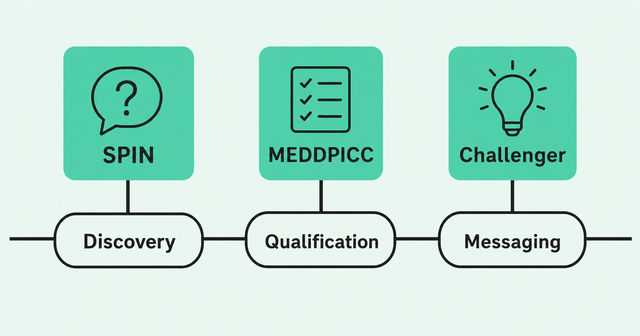
Yes. You don't have to pick only one sales methodology; you can layer them so each one does a specific job.
One way to combine them is SPIN for discovery, MEDDPICC for qualification, and Challenger for messaging. SPIN shapes the questions, MEDDPICC checks whether the deal is real, and Challenger gives the buyer a reason to act.
The key is giving each framework a clear job. If reps feel like they're running three playbooks at once, they'll run none of them well.
Write down which framework owns which stage, then build it into your deal reviews. For example, managers might ask SPIN questions about discovery calls and MEDDPICC questions about deals in the forecast.
How Buyer Signals Make Any Methodology Work Better
A buyer signal is an action that shows someone might be interested in buying, like visiting your pricing page or starting a new job. Methodologies tell reps what to ask, and signals tell them what's already true.
If the idea is new to you, start with signal-based selling explained. The short version is that reps act on what buyers do, so they don't have to rely only on what buyers say on calls.
If your team already has signals, the challenge is turning them into a clear next step for a specific person or account. Your website visits, product usage, job changes, and social activity may live in different tools.
Here's how signals support each part of a methodology:
- Discovery: Signals answer situation questions before the call, so reps spend more time on problems and implications.
- Qualification: Engagement across the buying group shows whether MEDDPICC fields reflect reality or wishful thinking.
- Insight: Account changes like new leaders, hiring, or competitor research give Challenger reps something specific to teach.
- Timing: Fresh signals tell reps when to reach out, while the buyer is still researching.
Want ideas for what to watch? Browse these real buying signal examples to see which actions point to real interest.
Here's what prioritization can look like in practice. In a Common Room customer story, Semgrep saw 74% more qualified pipeline in one quarter. Per the Semgrep customer story, the gain followed plays its reps ran from product usage, web visits, and GitHub activity.
Grammarly used AI-driven signals to book 2.5x more meetings. Learn more about signal-based outbound prospecting.
The common thread is focus: knowing which people and accounts to work first, and why. Results depend on your team, motion, and market, so treat these as examples of what's possible.
Common Room by Zoom pulls the signals you already have into one view and ranks them. That way, reps start each day knowing who to contact and what to say.
How to Operationalize a Sales Methodology
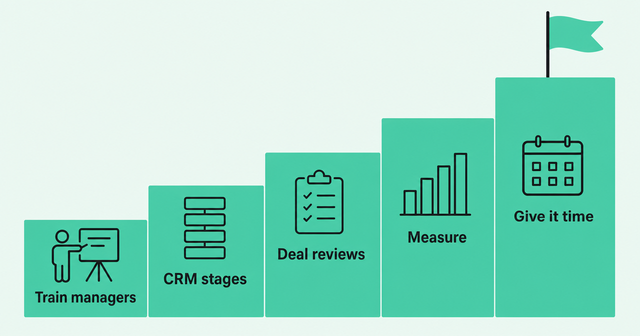
Operationalizing a sales methodology means making it part of daily work instead of a one-time training. These five steps help it stick.
- Train managers first: Managers coach the framework in every deal review, so they need to know it best.
- Build it into CRM stages: Add the methodology's fields as exit criteria, so deals can't move forward without proof.
- Inspect it in deal reviews: Ask framework questions about real deals every week.
- Measure adoption: Track completed fields and discovery call quality instead of training attendance.
- Give it time: Run the framework for two or more full sales cycles before you judge it.
Reps have little selling time, so the framework can't add busywork. According to Salesforce State of Sales 2026, "While the average seller spends 40% of their time selling, Gen Z reps are trapped at just 35%." Every extra field eats into that small slice.
Keep your CRM data current, too. A methodology can't work if your economic buyer left the company months ago and nobody updated the record.
Learn why CRM data decays and how to keep it fresh. When the data is stale, even a great framework runs on old facts.
Other Sales Frameworks Worth Knowing
The six frameworks above aren't the only ones. Here are a few others you'll hear about.
- Command of the Message: This Force Management framework helps reps structure sales conversations so they focus on value.
- GAP Selling: This problem-centric method, GAP Selling by Keenan, helps reps diagnose the gap between a buyer's current state and desired future state.
- SNAP Selling: This method from Jill Konrath's SNAP Selling rests on four rules: keep it simple, be invaluable, always align, and raise priorities.
- NEAT Selling: This qualification and discovery method from The Harris Consulting Group looks at need, economic impact, access to authority, and timeline.
Teams use different versions of the 5 C's of sales, and no single source defines the list. Some versions include the customer, the company, and the competition, so treat it as an informal checklist and pick what fits your team.
The 3-3-3 rule is also an informal convention with no single source. Teams use it as a rep productivity cadence built from small blocks of three. Definitions vary, so agree on your version before you track it.
FAQ
What are the top five sales methodologies?
Commonly discussed methodologies include MEDDPICC, SPIN Selling, the Challenger Sale, Sandler, and Solution Selling. BANT also comes up often for fast, high-volume qualification.
Which sales methodology is best for enterprise deals?
For enterprise deals, MEDDPICC is a strong starting point because it forces proof of the economic buyer, champion, and paper process. Some pair it with Challenger messaging.
Can you combine sales methodologies?
Yes, as long as each framework has a clear job, like SPIN for discovery, MEDDPICC for qualification, and Challenger for messaging.
How long does it take to implement a sales methodology?
Plan on at least two full sales cycles before you judge results. Reps need time to build habits, and managers need time to coach.
What's the difference between MEDDIC and SPIN?
MEDDIC is a qualification framework that checks whether a deal is real. SPIN is a discovery method that helps reps ask better questions.
Is the Challenger Sale still effective?
Yes, especially in crowded markets, as long as reps tailor their insight to each account. Generic insight feels like a lecture.
Should junior reps use the same methodology?
Yes, keep one framework across the team, but start junior reps with the simplest parts. BANT-style qualification and basic SPIN questions are good places to begin.
Do I need a methodology if I have a sales process?
Yes. Your process shows where a deal is, and your methodology tells reps what to do to move it forward.
Put Your Sales Methodology to Work
No sales methodology fixes a pipeline on its own. Pick the framework that fits your motion, run it long enough to build habits, and feed it real buyer context.
Common Room by Zoom turns the signals you already have into prioritized next steps for every rep. See how it can support the methodology your team runs today.
Request a demo
onroom.io/demo/)