

Updated: October 16, 2026
Account-based marketing tools: marketers love them, sales reps hate them.
Why? Because ABM tools show (often vague) buying signals from accounts, not the people behind them.
This level of detail works for marketing teams. They can use account-level intent data to power scoring models and blanket target accounts with ads.
But sales teams can't action on data they can't fully see. Account scores lack context. Account research eats up valuable time. And reps are left to dig through each account to find the right prospects.
Still, the promise of account-based experience (ABX) is possible for sales.
Here's how organizations like Notion, Apollo GraphQL, and Zapier turn account-level intent into actionable insights with Common Room.
Solve Account Scoring Mysteries
Problem
Account-level intent is often used as an input for scoring models, telling reps which accounts to focus on first.
But these scoring models are black boxes. Reps have zero context for why an account should be prioritized or how past activity should influence outreach.
Solution
Our customers use signal-based lead and account scoring to make account rankings useful in the field.
Accounts are scored based on every available buying signal, not just obvious behaviors like form fills and email opens. More importantly, reps can hover over any score to see exactly why an account was ranked that way and drill down into the account to get a holistic view of the actions powering the score.

Beyond fit criteria showing that an account matches an ideal customer profile, reps get full visibility into web visits, product usage, social engagements, and any other activity associated with an account.
Using calculated fields, our customers can also power account scores based on the volume of a particular signal, like companies posting a high number of relevant job listings.
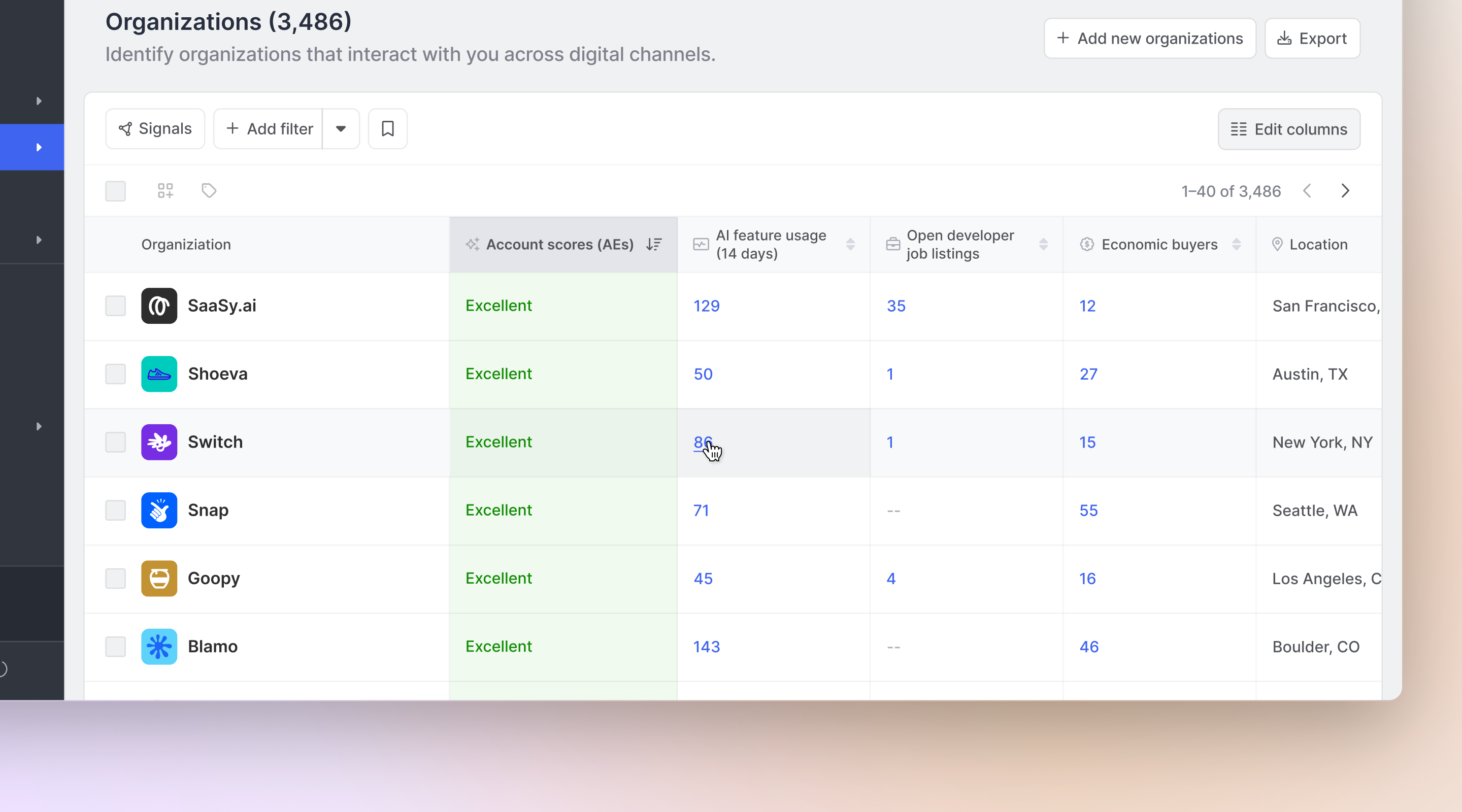
This makes it easy for our customers to prioritize which accounts to go after and tailor outreach based on granular actions and attributes.
Strategy
Notion uses signal-based lead and account scoring to give reps a 360-degree view of accounts within their book of business.
Instead of tabbing back and forth between tools to piece together a view of accounts, team members get all the info they need, including precise product usage data, in one place.
Reps quickly prioritize accounts based on ICP fit, dig into account-level behaviors across channels, and drill down to find economic buyers.
"Common Room shows all interactions that prospects had with Notion content across different channels," said Felipe Fernandez, Enterprise BDR. "I managed to book two meetings in an hour with this strategy by simply calling the prospects and personalizing the pitch a little bit."
Results
Improving account prioritization and visibility helped Notion generate 30% more meetings per rep per month.
"What once took hours and multiple tools to gather, product usage, job changes, social interactions, is now immediately available," said Pratyusha Ram, GTM Systems. "Most importantly, it's helping us generate more pipeline!"
Speed Up Account Research
Problem
Account research is essential to crafting messaging that lands. It's also a massive time sink. According to Salesforce's State of Sales research, reps spend just 28% of their week actually selling, while research, data entry, and similar tasks eat the rest. Every hour reps pour into building a POV, identifying decision makers, and personalizing outreach is an hour they're not in conversations.
Solution
Our customers use Common Room to auto-capture and centralize account context from across all first-, second-, and third-party data sources.
Job changes, job listings, news events— everything reps need to build a business case is served up on a silver platter.

Reps also use our GenAI research agent, RoomieAI™, to conduct account research at speed.
They simply ask RoomieAI any org-level question they have and get the results immediately, no screen switching necessary. RoomieAI will search the internet, including earnings calls and 10-K releases, to break down product lines, competitive analysis, user sentiment, and more.

This makes it easy for our customers to quickly get up to speed on target accounts and inform their outreach strategy.
Strategy
Apollo GraphQL uses Common Room's always-on signal capture to gather account context and spotlight lookalike accounts.
Reps get a personalized view of every account, from firmographic details to cross-channel behaviors, right where they work.
And real-time alerts make sure reps are notified about any account activity they care about instantly.
"Every customer's journey is different," said Aisha Nins, GTM Program Manager. "No sale is exactly the same, but with all these signals embedded in Common Room, we can identify trends across the board to understand what an ideal customer looks like and where there are opportunities to engage."
Results
Streamlining account research helped Apollo GraphQL drive 26% of qualified leads.
"Common Room gave us visibility into multiple signals to identify new, relevant stakeholders, as well as their activity across several platforms, to target new leads and gain insights into accounts sales reps couldn't see before," Aisha said. "We made Common Room the hub for all the signals that would point to an ideal customer profile."
Auto-Surface Contact-Based Intent
Problem
Account-level intent names the company that's in-market, not the specific people you need to reach. And there are a lot of people to reach: according to Gartner research reported by Advertising Week, the typical buying group for a complex B2B solution involves six to 10 decision makers. With a group that large, reps still have to figure out who's actually behind the signal, and whether they're the right fit.
Solution
Our customers use Common Room's identity resolution and waterfall enrichment engine, Person360™, to automatically reveal the people behind different intent signals.
In addition to account-level context, Person360™ provides names, job titles, work histories, contact information, cross-channel activities, and more in one unified profile. Economic buyers, ideal personas, and other key contacts are automatically spotlighted.

In cases where account-level activity is all reps have to go on, our customers use Prospector to surface the right stakeholders.
Reps simply input their criteria for prospects at an account, like job title and location, and Prospector returns a list of all individuals who match. Better yet, this process can be automated from end to end using intelligent workflows.

This makes it easy for reps to quickly find and follow up with the right people within each account.
Strategy
Zapier uses Person360™ and Prospector to zero in on above-the-line buyers within accounts.
This allows reps to focus on prospects with economic buying power, as well as find solid candidates for multithreading.
Reps simply filter their views of accounts for director-level stakeholders and above.
"Common Room gives me a view of all the important contacts at one company," said Strategic Account Manager Cathy Du. "All the info I need is all in one place and easy to sort through. It helps me find important contacts to outreach, understand who they are, and prioritize who's most relevant."
Results
Simplifying person-level prospecting helped Zapier increase meetings booked by 31% in 3 months.
"Reaching the right stakeholders is critical to building a repeatable sales motion and increasing ACVs," said Vice President of Sales and Customer Success Nalin Vahil. "Our teams had to jump back and forth between multiple tools to do that, and we were still missing key insights. With Common Room, we can identify the right stakeholders faster."
Make account scores practical, accelerate account research, and reveal the people behind the buying signals.
That's how Common Room customers turn account-level intent into actionable insights.
Account-Level Intent Data: Frequently Asked Questions
What Is Account-Level Intent Data?
Account-level intent data is the set of behavioral signals, for example web visits, content views, product usage, community and social activity, and third-party research, that show an account is researching your category. It tells you which organization is in-market, not which individual is doing the research.
Account-Level vs. Contact-Level Intent Data: What's the Difference?
Account-level intent points to the company showing interest. Contact-level intent, also called person-level intent, ties that activity to the specific individuals behind it, so reps know exactly who to reach. Common Room's Person360 resolves account signals to the people driving them.
Trade Old ABM for Real ROI With Common Room
Request a demo or get in touch to see how Common Room's AI-powered customer intelligence platform helps you capture, enrich, and take action on every buying signal.