
Your agent is working on half the buyer.
What to build, what to buy, and a test to find out which half you’re missing.
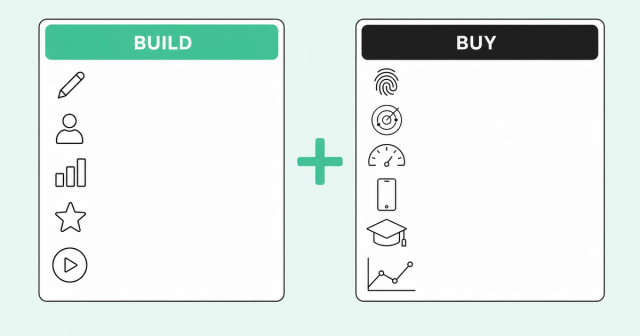
- Build what only you know. Messaging, personas, and signal ranking are yours to own, while identity, enrichment, and call capture are worth buying.
- Don't run on half the buyer. An agent that sees only what buyers did or only what they said will guess at the other half.
- Close the loop. A real system knows the buyer, acts on it, and learns from every call and deal outcome.
Overview
Anyone can spin up an AI agent in an afternoon. The harder question comes down to judgment: which parts of your GTM stack are worth owning, and which can you outsource?
This guide gives you a way to decide:
- Build: Anything that only your team knows, like messaging, personas, and which signals predict your deals.
- Buy: Tools that give you advanced capabilities, like a loop that knows the buyer, acts on it, and learns from every call and deal outcome.
- Keep: What the buyer did and what the buyer said in one context layer, because an agent that sees one half guesses at the other
The Build Gap
The prototype takes a weekend. The loop takes much longer.
Salesforce's "State of Sales" report (2026) found that the average team juggles 8 to 10 tools across outreach, follow-up, and account engagement. In the same report, 46% of sales professionals with agents say data quality issues hurt their sales. Gartner predicts that through 2026, organizations will abandon 60% of AI projects unsupported by AI-ready data.
The problematic pattern behind those numbers is familiar. An agent recommends an account the rep ends up skipping because it's already in an active sequence. Another sends a "personalized" email that references a job title the contact left months ago. A third gets routed a "high intent" account marketing has already spent weeks nurturing.
The call side fails the same way. The CRM says stage four, and the rep would have sworn the deal was a sure thing. Two calls back the rep brought up pricing, and the conversation slowed. That signal lived in a transcript nobody connected to the deal record until it was too late.In each case, the AI did what it was told. But because the tool lacked shared context, it had to work from a partial picture of the buyer: either what the buyer did, or what the buyer said, but not both, and not resolved to the same person.
Many internal builds clear the first hurdle easily. The agent runs, the outputs look reasonable, reps start getting recommendations. Then adoption slips, RevOps starts fielding questions, and the project gets shelved.
That leaves the person making the call holding two risks. Greenlight a build that stalls, and you own it. Veto one, and you may be the person who slowed the team down while everyone else shipped an agent.
Building the agent is the straightforward part. Building a system that knows the buyer, acts on it, and gets sharper after every deal is the part that often gets skipped.
What's Possible
The teams that get this right don't build less. They build different things.
Start with the revenue problem, not the model
Most builds begin with a model and go looking for a use case. Teams that see results start with a problem they can put a number on: reps calling the wrong people, pipeline stalling at the same stage, a forecast that misses every quarter.Northflank saw inbound traffic grow 20x in 18 months. The question changed from "how do we get attention?" to "who are these people, and which ones matter?" With one person running proactive outreach, every wrong contact carried a real cost.
Build what only you know
Your messaging, persona definitions, and view of which signals predict a deal are yours. Identity resolution, enrichment, signal collection, and call capture are capabilities any competitor can buy.
Jake Biskar, who runs Pipeline Operations at Atlan, drew the line this way: "We would never build a UI for our contact database. We'd never try to summarize everything a contact has done. [...] But the messaging layer? We know the tone, we know the most up-to-date assets, we know the personas. That part is worth building, because we know it better than any vendor could."
Buy the part that has to stay accurate
Northflank switched to a tool with a more modern interface and built-in outreach. Sequences aimed at senior engineering leaders pulled in unrelated titles, intent scores came with no explanation, and the dashboard eventually stopped matching the activity log. Head of Marketing & Operations Cristina Bunea put the lesson plainly: "It's really hard to fix something you don't know is broken."
A foundation only helps if it holds. That's the argument for buying it from a team whose job is keeping it accurate, and for choosing one that can explain its own scores.
Signals become action when reps know why
Reps often skip a signal because a signal isn't a reason to call. Jasper's team stacks firmographic fit, multi-person engagement across the account, and behavior across channels, so reps start the day with a ranked list and a reason. Jasper grew from 2 seats in December 2024 to 15+ by late 2025, driven by rep requests rather than mandate.
Fewer tools means more selling
Notion's reps once switched between as many as six tools to research and prioritize outreach. After consolidating on Common Room, the team booked 30% more meetings per rep per month in under five months, and Common Room contributed to 16% of total pipeline and 18% of total revenue between December 2023 and April 2024.
Maintenance is the hidden cost
A build isn't a one-time project. Every line below has to be solved again each quarter, not once.
| Component | What it takes | What it costs after launch |
|---|---|---|
GTM engineering headcount | Engineers to build and own the pipelines | A permanent owner, not a one-time project |
Enrichment vendor contracts | Multiple sources stitched into a waterfall | Costs that grow with every list refresh |
Identity resolution logic | Matching people across emails, accounts, and channels | Merge rules that break as data changes |
Data connectors | One API per source, each with its own rate limits and format changes | A change can quietly stop data flowing |
Call and meeting capture | Recording, transcription, and matching each conversation to the right person and deal | A second system to build, secure, and keep in sync with the first |
Closing the loop | Feeding call and deal outcomes back into scoring, coaching, and forecasting | Without it, every cycle starts from zero |
Prompt and model maintenance | Instructions that drift as vendors update models | An owner on top of a full-time job |
CRM write-back rules | Which fields an agent can change, and what happens with duplicates | Without rules, an agent can degrade data at machine speed |
Compliance enforcement | Suppression and consent honored in every tool | One missed sync is one bad email to someone who said no |
The opportunity: build the layer only your team knows, on a loop you don't have to maintain.
The Shift
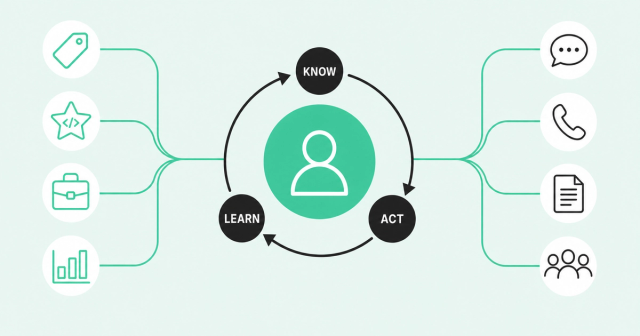
The loop only works when the buyer comes in one piece.
Many teams frame the decision as build versus buy. The more useful frame is which layer to own, and whether the system you run can know, act, and learn.
The Know, Act, Learn loop
This is the framework that separates a prototype from a system your revenue team runs on:
- Know: Identify who your buyers are, what they're doing, what they're saying, and who sits on the buying committee.
- Act: Put that context to work in engagement, dialing, and coaching, where an agent can take the action instead of only recommending it.
- Learn: Feed conversation and deal outcomes back in, so scoring, coaching, and forecasting sharpen with every cycle.
Each turn of the loop makes the next one smarter. A point build tends to start from zero every time. And the loop only works if the first step is complete.
Why "Know" is where builds break
Every buyer leaves two kinds of evidence. The first is what they did: a visit to the pricing page, a GitHub star, a new job, a spike in product usage, a post in a community. The second is what they said: the objection on the last call, the competitor they named, the colleague they pulled into the deal.Most stacks keep those halves in different systems.
| What the buyer did | What the buyer said |
|---|---|
Visited pricing, starred a repo, changed jobs, hit a usage threshold | Raised concerns about pricing, named a competitor, brought in a new stakeholder |
Spread across dozens of sources | Locked in call transcripts and meeting notes |
Needs identity to join it to a person | Needs identity to join it to a deal |
An agent that sees only one half fails in a recognizable way. With only behavior, it recommends a hot account the buyer already told the rep is a no. With only words, it coaches a call without knowing the champion changed jobs last week. With neither joined to the right person, it writes confident outreach about the wrong one.
Identity is what joins the halves. One buyer can show up as a CRM contact, an anonymous site visitor, a product user, and an event attendee. Until those merge, an agent pattern-matches across fragments, which is the root cause of stale personalization and misrouted accounts.
The two-halves test
Pick one closed-lost deal from last quarter.
Can your agent tell you, in one view:
- Who the buyer was, resolved across every system they touched
- What they did in the 30 days before the first call
- What they said on the call where the deal lost momentum
If it can't, your agent is running on half the buyer, and the loop has nothing complete to learn from.
The hybrid motion
Atlan bought Common Room as its buyer intelligence foundation, starting with 50 licenses and growing to 100 users. Contact prioritization changed the team's day-to-day: in an account with 244 contacts, the AI leaders rose to the top on refresh.
Signals weren't enough on their own, though. AEs saw them and often didn't act, because a signal isn't a reason to call. Jake built a Chrome extension that pulls Common Room signal data and Spark summaries, combines them with a GitHub repository of markdown files covering Atlan's personas, value props, tone, and signal ranking, and drafts personalized outreach straight into Gmail.The result: reps who once tabbed between LinkedIn, the CRM, and their own research now open one view that says who matters, what they've been looking at, and what to say. They started asking for access instead of being told to use it.
That's the split in practice: Atlan built what only it knows, and bought what keeps the picture of the buyer complete.Teams that want to build their own version can connect AI assistants and custom agents to identity-resolved buyer intelligence through the Common Room MCP Server and CLI, instead of working from raw API feeds.
A Buyer's Framework
Score your build in six questions
Give yourself one point for each "yes."
- Do you have dedicated GTM engineers with no higher-priority roadmap work? A build is a permanent job, not a one-time project. If the engineer who builds it moves on, so does the knowledge of how it works.
- Is account-level data enough, with no need for person-level identity resolution? If your agent needs to know who is in the buying committee, who changed jobs, or who visited the pricing page, you need person-level data.
- Can you fund enrichment costs that rise with every list refresh? Multi-source waterfalls grow more expensive as lists grow, and the costs are hard to predict.
- Can you guarantee suppression and consent rules hold across every tool? In a stitched-together stack, one tool may honor a do-not-contact flag while another ignores it.
- Will your build learn from every call and deal outcome, and join it to what buyers did before it? An agent that can't see last week's call, or last week's job change, can't act on either, and a loop that doesn't feed back never improves.
- Is buyer intelligence a true differentiator for your business, not table stakes? If a competitor could buy the same capability on Monday, building it is parity, not an edge.
5-6 points: A build may make sense. Pressure-test your cost assumptions before you commit.
3-4 points: A hybrid approach fits. Buy the loop, then build the context layer on top.
0-2 points: Buying will likely get you to value faster. Prove it on your own data first.
Test it on your own accounts
Run the same test on both paths over a few weeks:
- Define the decision the agent supports, such as which accounts a rep should work this week.
- Check how well records match across the systems you have today.
- Pilot both options on the same 20 accounts, including several private companies or early-stage startups with little public data, where weak data shows fastest.
- Run the two-halves test on the closed-lost deals in the pilot set.
- Measure rep usage and factual accuracy over the same period.
- Decide what to build and what to buy based on what you measured, then bring the results to your leadership team.
If you want to see what your stack is actually doing before you decide, the data stack audit guide walks through mapping every tool to a job, tracing data flows, and testing whether your signals trigger action.
Introducing Common Room and Zoom Revenue Accelerator
The loop that knows, acts, and learns, built to fit together
Common Room and Zoom Revenue Accelerator each arrived with their half finished. Common Room owns the identity layer: who the buyer is, what they're doing, and who else is involved. Zoom owns the conversation layer, along with the engagement, coaching, and forecasting built where sales conversations already happen. Together they run one loop on one context layer, so what buyers do and what they say inform the same next action.
Know: identity, signals, and the buying committee
Person360 stitches anonymous and known activity into one person-level profile, using handles, images, and social profiles rather than email matching alone. It merges automatically when confidence is high and sends uncertain matches to human review.
Common Room brings in more than 50 signal sources, including website visits, product usage from your warehouse, GitHub, Slack, Reddit, G2, job changes, and hiring. Many of them sit outside the CRM and outside call data.AI Scoring shows the exact signals behind every score, and Buying Committee shows who's involved in a deal, not just which account is interested.
Act: engagement, dialing, and coaching on the same context
Engage runs multichannel, multi-threaded sequences on buyer intelligence. Auto Dialer puts calls inside the same flow. AI Coaching turns live conversations into guidance and scorecards. Reps work from one prioritized list instead of switching tools.
Learn: conversations and outcomes that sharpen the next cycle
Zoom Revenue Accelerator captures meetings, calls, email, and messages. Forecast applies deal and conversation intelligence to pipeline. Conversation and deal outcomes are designed to flow back into the same context layer, so targeting, coaching, and forecasting get sharper over time.
Build on top
The MCP Server and CLI connect your own assistants and agents to identity-resolved buyer intelligence, so you keep control of the logic unique to your business.
Connected to the tools reps already use
Native integrations with Salesforce, HubSpot, Slack, Snowflake, Outreach, Salesloft, and 50+ other sources mean intelligence shows up where reps already work. Plus, we integrate with OpenAI so that you can do all of the GTM work your team needs in the ChatGPT window they're already using.
What changes day to day
Your team builds what only it knows, once, and refines it with real data. Reps start each day with a prioritized list and a reason for every account on it. They walk into calls knowing what the buyer did before them, and the call itself sharpens what comes next. RevOps stops maintaining connectors and merge rules and spends the time on the plays that set your business apart.
See what building on top of a loop that knows, acts, and learns looks like on your own accounts. Request a demo
FAQs: Build vs. Buy for GTM AI Agents
Should we build or buy an AI agent for sales and marketing?
Build the layer only your team knows, and buy the foundation that has to stay accurate. Your messaging, persona definitions, and view of which signals predict a deal are unique to you, so they're worth building. Identity resolution, enrichment, signal collection, and call capture are capabilities any competitor can buy, and they take permanent upkeep. A hybrid approach fits most teams: buy the loop, then build the context layer on top. Atlan's story shows what that split looks like in practice.
Is it possible to build a custom AI research agent instead of using an out-of-the-box one?
Yes, and most teams can have a working prototype in an afternoon. The harder part is everything after it: keeping data accurate, resolving identity across systems, feeding call and deal outcomes back in, and maintaining prompts as models change. Teams that build successfully build the logic only they know, such as messaging, personas, and signal ranking, on top of a bought foundation. The Common Room MCP & CLI connect custom agents to identity-resolved buyer intelligence, so you don't work from raw API feeds.
Why do internal AI agent builds stall after launch?
Most stall because the agent works from a partial picture of the buyer. It can see what the buyer did (site visits, product usage) or what the buyer said (call transcripts), but not both, and not resolved to the same person. The output looks reasonable but is wrong in ways reps notice, like recommending an account already in an active sequence or referencing a job title the contact left months ago. Reps stop trusting it, adoption slips, and the project gets shelved. For a closer look at how to find the gaps, see our guide on how to audit your data stack.
What is the "Know, Act, Learn" loop?
Know, Act, Learn is a framework for a revenue system that identifies buyers, takes action on that context, and improves from every outcome. Know means identifying who your buyers are, what they're doing, what they're saying, and who sits on the buying committee. Act means putting that context to work in engagement, dialing, and coaching, where an agent can take the action instead of only recommending it. Learn means feeding conversation and deal outcomes back in so scoring, coaching, and forecasting sharpen each cycle. Read the full framework in This Is Revenue OS.
Why does an AI agent need both what the buyer did and what the buyer said?
An agent that sees only one half guesses at the other. With only behavior, it recommends a hot account the buyer already told the rep is a no. With only conversation, it coaches a call without knowing the champion changed jobs last week. With neither joined to the right person, it writes confident outreach about the wrong one. Keeping both in one context layer is what lets an agent act on a complete picture. That's the idea behind pairing Common Room with Zoom Revenue Accelerator.
How do AI prospecting agents avoid relying on stale CRM data?
They pull from live signals and resolve identity across systems instead of trusting a static CRM record. Common Room brings in signals from 50+ channels, including website visits, product usage from your warehouse, GitHub, Slack, G2, and job changes, many of which sit outside the CRM. Person360 then merges those fragments into one deduplicated person-level profile and keeps titles and firmographics fresher over time. Browse the full list of integrations.
What is identity resolution, and why does it matter for AI agents?
Identity resolution is matching every touchpoint to the same real person. One buyer can show up as a CRM contact, an anonymous site visitor, a product user, and an event attendee. Until those merge, an agent pattern-matches across fragments, which is the root cause of stale personalization and misrouted accounts. Person360 connects anonymous and known activity, including personal email signups, to a business person and account when it finds a confident match. It reports 30-50% higher match rates in bakeoffs and up to 79% fewer duplicate records.
What is the two-halves test?
It's a quick check of whether your agent has a complete picture of the buyer. Pick one closed-lost deal from last quarter and ask whether your agent can show, in one view: who the buyer was, resolved across every system they touched; what they did in the 30 days before the first call; and what they said on the call where the deal lost momentum. If it can't, it's running on half the buyer. Zoom Revenue Accelerator captures the conversation half, and Common Room's buyer intelligence covers the behavior half.
How do I score whether to build or buy?
Give yourself one point for each "yes" to six questions, then match your score to an approach.
- Do you have dedicated GTM engineers with no higher-priority roadmap work?
- Is account-level data enough, with no need for person-level identity resolution?
- Can you fund enrichment costs that rise with every list refresh?
- Can you guarantee suppression and consent rules hold across every tool?
- Will your build learn from every call and deal outcome and join it to what buyers did before?
- Is buyer intelligence a true differentiator for your business, not table stakes?
A score of 5-6 means a build may make sense, so pressure-test your cost assumptions. A score of 3-4 fits a hybrid approach: buy the loop, then build the context layer on top. A score of 0-2 means buying will likely get you to value faster. Question two comes down to person-level data, which is what Buying Committee and Person360 are built on.
What are the hidden costs of building your own GTM AI agent?
A build is a permanent job, not a one-time project. Recurring costs include GTM engineering headcount, enrichment vendor contracts that grow with every list refresh, identity resolution logic that breaks as data changes, data connectors that can quietly stop flowing, call and meeting capture, closing the loop with outcomes, prompt and model maintenance, CRM write-back rules, and compliance enforcement across every tool. Cost also shows up at runtime: our CMO Tasha Reasor explains why agents burn expensive tokens on retrieval a query could handle.
What GTM tasks can AI agents fully automate versus just assist with?
Agents can fully automate mechanical, reversible work and should assist, not replace, on judgment calls. Researching a contact, matching records, refreshing CRM fields, ranking accounts, and logging call outcomes are good candidates for automation. Which accounts a rep works, what a first-touch message says, and whether a deal is truly a commit work best when an agent proposes and a human decides. That's why scoring transparency matters: Common Room's AI-Native Scoring is rules-based and editable, and nothing goes live until someone reviews and activates it.
How can GTM teams use AI agents to prioritize which accounts to work first?
Combine fit, multi-person engagement, and behavior across channels into a ranked list with a reason for each account. A signal alone isn't a reason to call, which is why reps often skip them. Jasper's team grew from 2 to 15+ seats in under a year using signals with full context. With Common Room, scoring shows the signals behind each rating and Buying Committee shows who's involved, not just which account is interested. For a deeper look at what separates trustworthy scores from noisy ones, see Best Lead Scoring Software for B2B Sales Teams.
How does Common Room work with Zoom Revenue Accelerator?
Common Room owns the identity layer, Zoom Revenue Accelerator owns the conversation layer, and together they run one loop on one context layer. Common Room covers who the buyer is, what they're doing, and who else is involved. Zoom Revenue Accelerator captures meetings, calls, email, and messages, and powers engagement, coaching, and forecasting. Each ZRA product also works standalone, so you don't need the full suite to start. Read how they fit together.
What does Common Room do in the Know, Act, and Learn stages?
Common Room and Zoom Revenue Accelerator cover each stage of the loop.
- Know: Person360 for person-level identity, 50+ signal sources, AI Scoring, and Buying Committee.
- Act: Engage for multichannel, multi-threaded sequences; Auto Dialer for calls inside the same flow; AI Coaching for live guidance and scorecards.
- Learn: Zoom Revenue Accelerator for call, meeting, email, and message capture, and Forecast for deal and conversation intelligence applied to pipeline.
Can I connect my own AI assistants and agents to Common Room?
Yes, through the Common Room MCP Server and CLI. The MCP Server connects AI assistants like Claude, ChatGPT, Cursor, and GitHub Copilot for conversational workflows, and supports both reading and writing records. The CLI handles deterministic, scripted execution in pipelines and custom agent backends. Both use the same per-user permissions as the Common Room UI, and you don't need Zoom Revenue Accelerator to use them. See the MCP Server docs and CLI docs, or learn more about MCP & CLI.
What results have teams seen from consolidating GTM tools?
Notion's team booked 30% more meetings per rep per month after consolidating on Common Room. Its reps previously switched between as many as six tools to research and prioritize outreach. From December 2023 to April 2024, Common Room contributed to 16% of Notion's total pipeline and 18% of total revenue. Read the Notion story. Other results include Superhuman (2.5x meetings booked) and Northflank, which grew inbound 20x and rebuilt its data foundation.
What should we test before deciding between building and buying?
Pilot both paths on the same 20 accounts for a few weeks and measure rep usage and factual accuracy. Define the decision the agent supports, such as which accounts a rep should work this week. Check how well records match across your current systems. Include private companies or early-stage startups with little public data, where weak data shows fastest. Then run the two-halves test on the closed-lost deals in the pilot set. Before you start, our data stack audit guide walks through mapping every tool to a job and tracing data flows.
How does an AI account-research agent handle accounts with very little public data?
It leans on first-party signals and identity resolution instead of public profiles. For private companies and early-stage startups, public data is thin, so website visits, product usage, community activity, and engagement from known contacts do most of the work. Person360 connects anonymous website activity and personal email signups to a business person and account when it finds a confident match. That's also why the playbook recommends including these accounts in any pilot.
We think you'd like these
Blog post
Best AI Prospecting Tools for B2B Sales Teams in 2026
Nov 12th, 2026·13min readThis guide compares the top AI prospecting tools for B2B sales teams in 2026, focusing on the two questions that actually drive pipeline: who to contact and why now. Learn how...Blog post
How to Measure Rep Performance and Deal Health in One Sales Dashboard
Nov 12th, 2026·12min readLearn how to combine rep performance metrics and buyer-driven deal health signals in one sales dashboard, so managers can drill from forecast numbers...Blog post
How to Run Email, Phone, and LinkedIn in One Multichannel Outbound Sequence
Nov 12th, 2026·10min readLearn how to turn scattered email, phone, and LinkedIn touches into one coordinated outbound sequence that feels like a conversation, not a...